


Description
Every day, someone is trying to influence you. Your customers. Your colleagues. Your suppliers. Your negotiating partners. The advertiser. The fundraiser. The salesperson. The politician. All of them are deploying — consciously or unconsciously — the specific psychological principles that Dr. Robert Cialdini spent his career identifying, researching, and documenting as the most reliable triggers of human compliance available.
And every day, you are trying to influence others. Your clients. Your team. Your investors. Your family. Your community. The specific success of every persuasion attempt you make — every pitch you deliver, every request you submit, every negotiation you enter — depends fundamentally on how well you understand the specific psychological principles that determine whether people say yes or no.
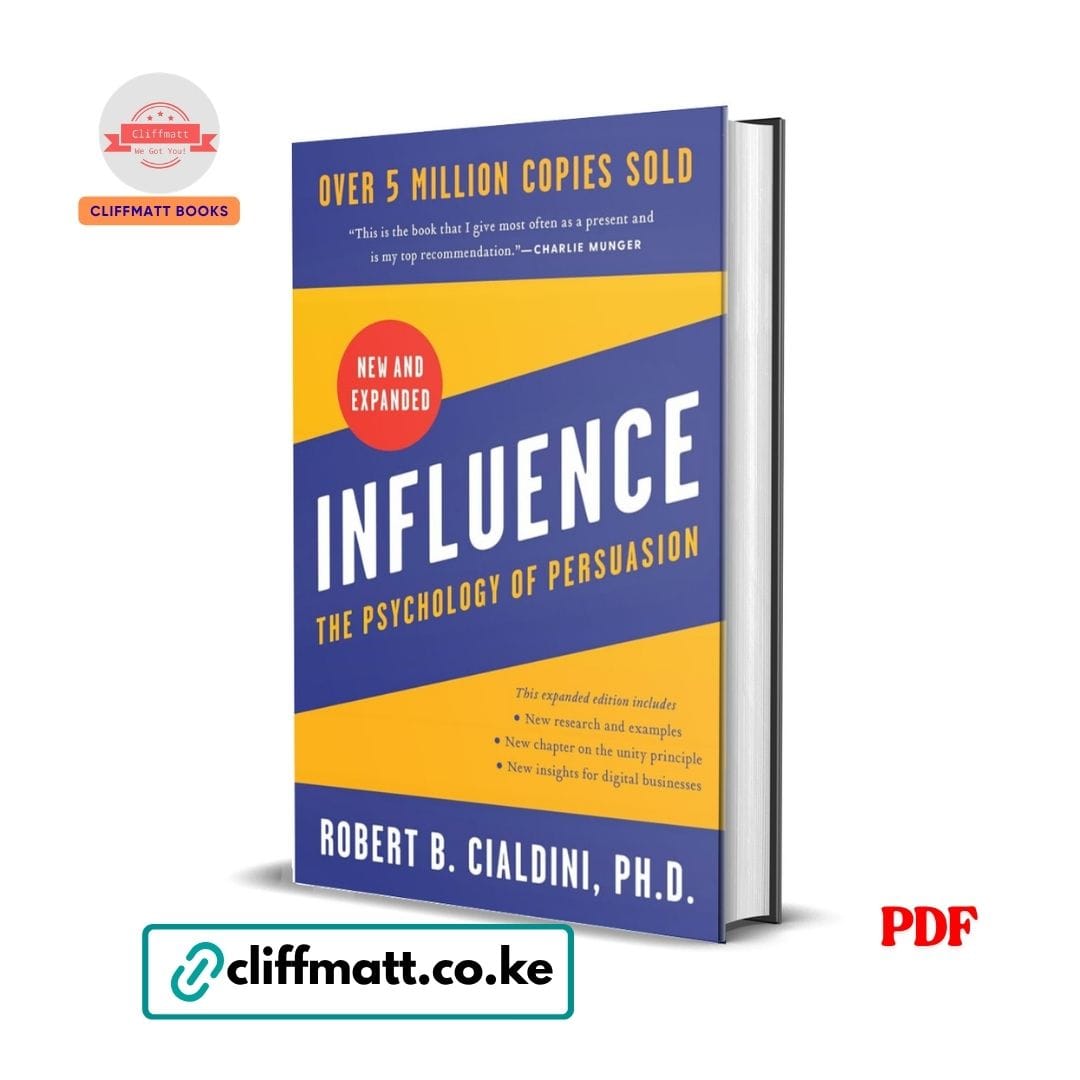
Influence: The Psychology of Persuasion (Revised Edition) by Robert B. Cialdini PhD — National Bestseller, praised by the Journal of Marketing Research as “among the most important books written in the last 10 years” — is the most thoroughly researched, most clearly written, and most immediately applicable guide to the specific psychology of persuasion ever produced. It is the book that Warren Buffett has recommended. The book that every top sales professional, every world-class marketer, and every serious negotiator has read. And the book that is now available to every Kenyan professional for Ksh 100.
What This Book Covers:
The Six Principles of Influence — The Complete Framework:
Principle 1 — Reciprocity:
- The specific psychological mechanism of reciprocity — the deeply ingrained human tendency to feel obligated to return favours, gifts, and concessions; why the specific feeling of indebtedness is one of the most powerful motivators of compliance available; how reciprocity operates below conscious awareness in the specific majority of influence situations
- The specific reciprocity research — Cialdini’s field studies demonstrating the specific power of small gifts, unexpected favours, and the specific first-mover generosity that consistently produces disproportionate compliance in return; why the value of what is given does not need to match the value of what is requested for reciprocity to produce compliance
- The specific applications for Kenyan sales professionals, marketers, and negotiators — the particular practices of leading with genuine value, of uninstructed concession, and of the specific generosity that creates the specific obligation that compliance follows; why the salesperson who gives genuinely before asking receives more than the one who asks immediately
- The specific ethical dimension of reciprocity — the distinction between using reciprocity to serve genuine mutual interests (ethical) and using it to create false obligations for personal gain (manipulative); why understanding the psychology of reciprocity is as important for protecting yourself from its misuse as for using it effectively
Principle 2 — Commitment and Consistency:
- The specific psychological mechanism of commitment and consistency — the powerful human drive to be and appear consistent with prior statements, positions, and behaviours; why the specific person who has made a public commitment is dramatically more likely to follow through than the person who has made a private one; how this principle operates in every sales, negotiation, and influence context
- The specific foot-in-the-door technique — the research demonstration that securing a small initial commitment dramatically increases the probability of securing a larger subsequent one; the specific psychological mechanism (the person’s self-image adjusts to accommodate the small commitment, making the larger request consistent with that adjusted self-image) that makes this technique so reliably effective
- The specific written commitment research — why asking someone to write down their commitment produces a dramatically different compliance rate than asking them to merely state it; what this reveals about the specific power of public and tangible commitment
- The specific applications for Kenyan entrepreneurs, sales professionals, and leaders — how to structure persuasion sequences that build commitment progressively; how to use consistency to maintain the specific agreements that business relationships require; how to protect yourself from the specific manipulation of commitment and consistency that unethical persuaders employ
Principle 3 — Social Proof:
- The specific psychological mechanism of social proof — the tendency to look to the behaviour of others to determine correct behaviour, especially in situations of uncertainty; why the specific question “What are other people doing?” is among the most powerful drivers of human compliance available
- The specific pluralistic ignorance research — how entire groups can simultaneously hold incorrect beliefs because each member is silently following the others, each of whom appears more certain than they actually are; how social proof amplifies both wisdom and foolishness depending on the specific social context
- The specific testimonials and social validation applications — why reviews, testimonials, case studies, and the specific visible behaviour of similar others are among the most powerful persuasion tools available in any Kenyan sales or marketing context; the specific design of social proof that produces the specific compliance maximisation
- The specific similarity dimension of social proof — why social proof from people who are similar to the target is more persuasive than social proof from those who are dissimilar; the specific implications for the specific testimonials and the specific case studies that Kenyan businesses use most effectively in their specific markets
Principle 4 — Authority:
- The specific psychological mechanism of authority — the human tendency to comply with requests from people who appear to be legitimate authorities in the relevant domain; why the specific signals of authority (titles, credentials, uniforms, expertise cues) produce compliance regardless of whether the underlying authority is genuine
- The specific Milgram obedience research — the foundational study demonstrating the specific extent to which ordinary people will comply with instructions from apparent authority figures; what this research reveals about both the power and the potential danger of authority as an influence principle
- The specific authority signals in the Kenyan business context — how titles, educational credentials, professional affiliations, published content, and the specific visual signals of expertise cue the specific authority perception that facilitates compliance; how to establish genuine authority in your specific market
- The specific authority protection — how to identify the specific authority appeals that are being used to influence you; how to distinguish genuine expertise from the specific performance of authority without underlying substance; why the most valuable response to any authority claim is the specific verification question
Principle 5 — Liking:
- The specific psychological mechanism of liking — the straightforward but profoundly powerful tendency to be more easily influenced by people we like; the specific factors that determine liking (physical attractiveness, similarity, familiarity, association with positive things, and the specific acts of genuine praise and genuine interest in others) and their specific implications for persuasion
- The specific similarity effect — why people who are similar to us — in background, in values, in interests, in communication style — are consistently more persuasive than those who are different; the specific applications for Kenyan salespeople who want to build the fastest possible rapport with the specific prospects they are seeking to influence
- The specific genuine compliment research — the consistent finding that sincere, specific, deserved praise is among the most effective liking-builders available; why the specific investment in genuine interest in the other person — their business, their challenges, their aspirations — produces the specific liking that facilitates influence
- The specific association principle — how the specific things we associate with a person affect how much we like them; why the specific environments, the specific associations, and the specific contextual framing of any persuasion attempt affects the specific liking response that facilitates compliance
Principle 6 — Scarcity:
- The specific psychological mechanism of scarcity — the tendency to value things more when they are rare or becoming unavailable; why the specific experience of potential loss is a more powerful motivator than the specific experience of equivalent gain; how scarcity consistently accelerates compliance in sales, negotiation, and every other influence context
- The specific deadline and limited availability research — the consistent finding that genuine deadlines and genuine limited availability dramatically accelerate purchase decisions and compliance; why the specific prospect who was undecided at unlimited availability becomes a buyer when genuine scarcity is introduced
- The specific Kenyan applications — how to use genuine scarcity (not manufactured urgency that damages trust) in the specific sales and marketing contexts of Kenyan business; how limited edition, limited time, and limited availability offers produce the specific acceleration in Kenyan buyer behaviour that the psychology of scarcity predicts
- The specific scarcity protection — how to identify when scarcity is being genuinely presented versus manufactured to produce compliance; why the specific question “Would I want this if it were freely available?” is the most useful protection against the specific scarcity manipulation that unethical persuaders employ
The Revised Edition — Updated Research and Applications:
- The specific updates that Cialdini made in the revised edition — new research, new examples, and the specific new applications that have emerged from the three decades of subsequent persuasion research that the original edition helped to inspire
- The specific new case studies — updated examples from contemporary business, marketing, and influence contexts that make the specific principles more immediately relevant to twenty-first century persuasion challenges
- The specific digital and social media applications — how the six principles operate in the specific online influence contexts (social media, email marketing, digital advertising, and e-commerce) that did not exist when the original edition was published
Protecting Yourself — The Defence Dimension:
- The specific automatic compliance triggers — why the six principles work so reliably: they exploit the specific cognitive shortcuts that allow humans to navigate complex social environments without evaluating every decision fully; why these shortcuts are generally adaptive and occasionally manipulable
- The specific manipulation identification practices — how to recognise when the six principles are being used to exploit rather than genuinely serve your interests; the specific questions that interrupt the specific automatic compliance that each principle can produce when used unethically
- The specific informed consumer advantage — why the Kenyan professional who understands the psychology of persuasion is simultaneously more effective at ethical influence and more resistant to the specific unethical influence that understanding makes visible
Why Kenyan Professionals Are Buying This Book: Every Kenyan who sells, negotiates, leads, markets, or manages — which is every Kenyan professional in every sector — is either using these principles or being used by them every day. Influence gives every Kenyan the specific scientific understanding of the psychology that governs compliance: why people say yes, why they say no, and how the specific application of each principle in the specific contexts of Kenyan professional life produces the specific outcomes that both ethical persuasion and informed self-protection require.
At Ksh 100, the most important persuasion book ever written — now available to every Kenyan.
Who This Book Is For:
- Kenyan sales professionals who want the most scientifically grounded understanding of why customers buy — and the specific applications of each principle to the specific sales contexts they navigate daily
- Kenyan marketers and advertisers who want the most thoroughly researched framework for designing campaigns that produce the specific compliance responses they are seeking
- Kenyan entrepreneurs and business owners who want to understand the specific psychology of their customers, their suppliers, and their negotiating partners at the deepest available level
- Kenyan leaders and managers who want to understand the specific influence dynamics of every team meeting, every performance conversation, and every stakeholder engagement they lead
- Every reader of How to Win Friends and Influence People (Carnegie), Talk Like TED (Gallo), It’s Who You Know (Garner), Just Listen (Goulston), and How to Win Every Argument (Pirie) who wants the most scientifically authoritative persuasion psychology framework to complete their influence and communication library
📖 Author: Robert B. Cialdini PhD 📄 Format: PDF eBook (instant download via WhatsApp or email) 💰 Price: Ksh 100 only 🚀 Delivery: Instant after M-Pesa payment confirmation
👉 Order now on cliffmatt.co.ke — Pay via M-Pesa, receive your PDF instantly.














Reviews
There are no reviews yet.