

Description
You know you should be handling your money better. The question is how.
Not how in theory. Not how in some distant future when your income is higher, your expenses are lower, and your financial situation is different from what it is today. How now. With the specific income you currently earn, the specific debts you currently carry, and the specific financial habits you have currently built — how do you produce a genuinely different financial outcome from the one you are currently heading toward?
Dave Ramsey — #1 New York Times bestselling author, host of The Dave Ramsey Show, the most widely listened-to personal finance radio programme in America, and the man who went broke at twenty-six and rebuilt from zero to genuine financial freedom — spent decades answering that question for millions of ordinary people with ordinary incomes and extraordinary financial messes. What he developed was not a theory. It was a specific, sequential, proven seven-step system — the Baby Steps — that has helped more than five million families do what most personal finance books only describe: actually get out of debt, actually build savings, and actually achieve the specific financial freedom that most people spend their entire working lives hoping for and never reaching.
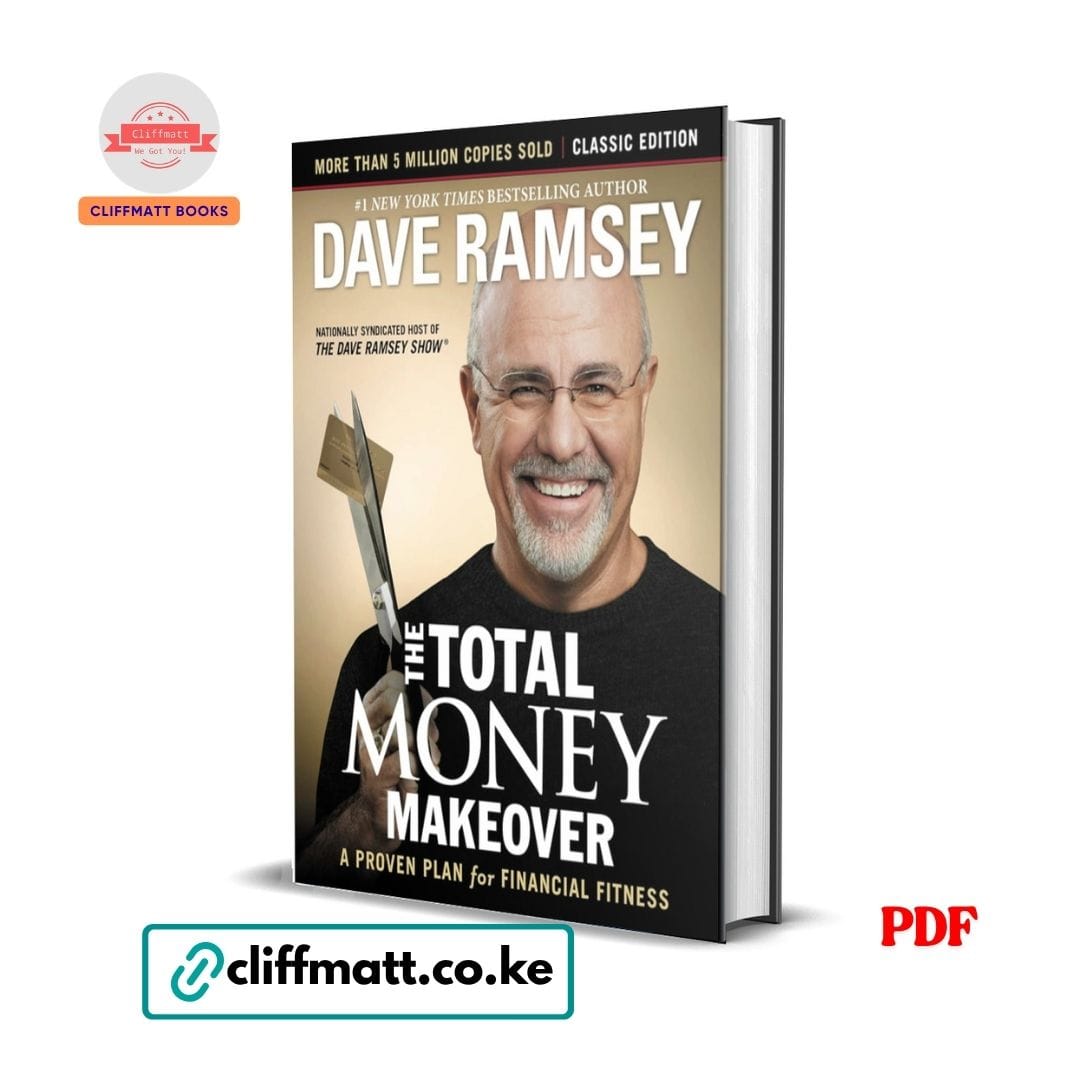
The Total Money Makeover: A Proven Plan for Financial Fitness — Classic Edition, more than 5 million copies sold — is that system. Complete. Specific. Proven. Available to every Kenyan for Ksh 100.
What This Book Covers:
The Foundation — Why Most People Never Win with Money:
- The specific money myths — Ramsey’s comprehensive demolition of the specific financial beliefs that keep most people permanently broke regardless of their income; the particular myths (debt is a tool, car payments are normal, I need a credit card for emergencies, I’ll start saving when I earn more) that are so widely accepted as financial common sense that most people never question them and never recognise them as the specific financial traps they consistently prove to be
- The specific “keeping up with the Joneses” problem — the particular social pressure to spend at the level of peers and neighbours regardless of what your actual financial position supports; why the specific Kenyan social context — with its specific cultural emphasis on visible generosity, on celebrations that meet community expectations, and on the specific social cost of being seen to have less — creates a particularly acute version of the specific spending pressure that Ramsey identifies as one of the most reliably wealth-destroying forces in any culture
- The specific denial patterns — the particular ways that most people avoid facing the specific reality of their financial position; the specific budgeting avoidance, the specific debt minimisation, and the specific future-income optimism that allow most people to remain in the specific financial position they are in for decades while telling themselves they are about to change it
- Why the specific Total Money Makeover works when other approaches fail — the particular combination of sequenced steps, behavioural psychology, and the specific social accountability that Ramsey’s system builds in that produces the specific results that information alone, motivation alone, and good intentions alone consistently fail to produce
The Seven Baby Steps — The Complete System:
Baby Step 1 — Save Ksh 100,000 (or your equivalent $1,000) as a Starter Emergency Fund:
- The specific purpose of the starter emergency fund — not to make you feel financially secure (it won’t) but to give you the specific financial buffer that prevents the specific unexpected expense from derailing your debt payoff momentum; the particular psychological function of having something in reserve that means a car repair or a medical bill does not require you to reach for debt
- The specific urgency of this step — Ramsey’s consistent instruction to complete Baby Step 1 as fast as humanly possible, selling things and cutting expenses with the specific intensity of someone who genuinely understands that the specific financial emergency they are trying to prevent from happening can happen at any moment
- The specific Kenyan application — the particular equivalent of the starter emergency fund in the Kenyan context; the specific M-Pesa savings practices, the specific chama contributions, and the specific informal savings structures that Kenyan households can redirect toward this specific first step
Baby Step 2 — Pay Off All Debt (Except the Mortgage) Using the Debt Snowball:
- The specific Debt Snowball method — the particular approach of listing every debt from smallest balance to largest (regardless of interest rate), making minimum payments on all but the smallest, and throwing every available shilling at the smallest debt until it is gone; then rolling that payment to the next smallest, and the next, until every debt is eliminated
- Why the Debt Snowball works psychologically where mathematically superior approaches fail behaviourally — Ramsey’s consistent, research-backed argument that the specific wins of paying off small debts first produce the specific motivation, the specific momentum, and the specific behavioural reinforcement that keep people on the plan through the specific months and years that complete debt elimination requires; why the specific mathematically optimal (highest-interest-first) approach consistently fails in practice because it takes too long to produce the specific first win that human psychology most needs
- The specific intensity Ramsey prescribes — “gazelle intense,” borrowing from the specific image of a gazelle fleeing a cheetah; the particular temporary sacrifice of lifestyle, convenience, and social spending that the specific debt elimination phase requires; why the specific person who treats debt elimination as a three-year leisurely improvement project consistently takes seven years, and the specific person who treats it as a twelve-month emergency consistently finishes in eighteen months
- The specific Kenyan debt landscape — mobile loans (Fuliza, M-Shwari, KCB M-Pesa), bank loans, SACCO loans, chama debts, family loans, and the specific informal debt structures that are unique to the Kenyan financial environment; how the Debt Snowball applies to each
Baby Step 3 — Build a Fully Funded Emergency Fund of 3–6 Months of Expenses:
- The specific fully funded emergency fund — the particular difference between the starter emergency fund of Baby Step 1 (a thin buffer against small emergencies) and the fully funded emergency fund of Baby Step 3 (the specific financial fortress that protects against job loss, major health crisis, and the specific large unexpected expenses that devastate the finances of families who don’t have them)
- The specific three-to-six month calculation — how to determine the specific amount your emergency fund needs to cover the specific monthly expenses of your specific household; why the specific three-month minimum is appropriate for the specific household with stable, reliable income and the specific six-month minimum is appropriate for the specific household with variable or entrepreneurial income
- The specific emergency fund as insurance — how the specific fully funded emergency fund replaces the specific need for debt in emergencies; how this step, combined with Baby Step 2, produces the specific financial position from which genuine wealth building becomes possible for the first time
Baby Step 4 — Invest 15% of Household Income for Retirement:
- The specific 15% investment principle — why Ramsey prescribes exactly 15% (not more, not less) at this stage; the particular reasoning that preserves enough income for the mortgage payoff of Baby Step 6 while simultaneously beginning the specific compound-interest-driven retirement wealth building that the specific delay of debt elimination has postponed
- The specific investment vehicles in the Kenyan context — NSSF, occupational pension schemes, individual pension plans, NSE investments, money market funds, and the specific tax-advantaged retirement savings structures available to Kenyan workers; how Ramsey’s 15% principle applies to the specific Kenyan investment landscape
- The specific power of compound interest across the specific career of the specific Kenyan professional — the particular mathematics of beginning consistent retirement investment at 35 versus 45 versus 55; why the specific fifteen-year difference that the debt elimination of Baby Steps 1–3 costs in retirement investing is almost always recovered and exceeded by the specific debt-free income available for investment from Baby Step 4 onward
Baby Step 5 — Save for Children’s Education:
- The specific children’s education funding principle — the particular Ramsey argument that funding your own retirement before funding your children’s education is not selfish but specifically the most responsible parenting choice available; why the specific parent who arrives at retirement without savings because they paid for their children’s education has transferred the specific financial problem from the child (who can take education loans or work) to themselves (who cannot take retirement loans)
- The specific Kenyan education funding context — secondary school fees, university fees, HELB loans, private university costs, and the specific Kenyan parental expectation of comprehensive education funding; how Ramsey’s principle applies to the specific Kenyan context where education costs are a major financial pressure on most families
Baby Step 6 — Pay Off the Home Mortgage Early:
- The specific mortgage payoff principle — the particular goal of complete debt elimination including the home; why the specific Ramsey system does not accept the common financial advice that a mortgage is “good debt” and should be maintained for the tax benefit; the specific freedom — financial, psychological, and practical — of owning your home with no debt attached to it
- The specific Kenyan homeownership context — land purchase, housing construction, mortgage finance (HF Group, KCB, Co-operative Bank), SACCO housing loans, and the specific informal land and property finance structures that are unique to the Kenyan property market; how Baby Step 6 applies to each
Baby Step 7 — Build Wealth and Give Generously:
- The specific wealth building phase — the particular financial position of the specific household that has completed Baby Steps 1–6: no consumer debt, no mortgage, a fully funded emergency fund, consistent retirement investment, and children’s education funded; the specific income that was previously going to debt payments now fully available for wealth accumulation and generous giving
- The specific generosity dimension — Ramsey’s consistent, faith-grounded conviction that the specific purpose of building wealth is not merely personal security or personal comfort but the specific ability to give generously, to fund causes that matter, and to be the specific person in the specific community whose specific financial freedom makes them the specific most available and the specific most capable giver; why Baby Step 7 is not the end of the journey but its specific most joyful and most purposeful phase
- The specific Kenyan wealth building at this stage — NSE equity investment, real estate, business investment, and the specific wealth-building vehicles that are most appropriate for the specific Kenyan household that has achieved complete debt freedom and is building genuine generational wealth
Busting the Myths — Ramsey vs. Conventional Financial Wisdom:
- The credit score myth — Ramsey’s specific, controversial argument that the specific obsession with credit scores is the specific financial equivalent of measuring how good you are at borrowing money; why the specific person building genuine wealth needs a credit score far less than the specific financial industry needs them to believe they do
- The debt-as-tool myth — the specific demolition of the investment strategy of borrowing to invest; why the specific risk profile of the specific leveraged investment strategy is almost never what the specific person adopting it believes it to be; why the specific person who is debt-free and investing cash consistently outperforms the specific leveraged investor across any meaningful time horizon that includes a market downturn
- The car payment myth — the specific Ramsey case against car payments as a permanent feature of adult financial life; the particular mathematics of the specific car payment across a lifetime; the specific alternative (saving cash and buying incrementally better cars as cash savings allow) that produces the specific different lifetime financial outcome that most car-payment payers cannot imagine but that the specific Baby Step system consistently makes possible
The Makeover Stories — Real People, Real Results:
- The specific testimonies embedded throughout the book — the particular real-world stories of ordinary families who completed the Baby Steps and produced extraordinary financial transformations; the specific variety of starting points (deep in debt, moderate debt, just starting out), income levels, and life circumstances represented in these testimonies
- Why the testimonies matter more than the theory — the specific psychological function of seeing the specific evidence that ordinary people with ordinary incomes have actually done what the book describes; why the specific Kenyan reader who sees the same specific transformation documented in multiple specific real-world cases is more motivated to attempt it than the specific reader who has only encountered the theory
Why Kenyan Families Are Buying This Book:
Kenya’s personal debt burden — mobile loans, bank loans, SACCO loans, chama obligations, and the specific informal debt structures that are uniquely Kenyan — is one of the most significant and most personally damaging financial challenges facing Kenyan households of every income level. The specific combination of easy access to mobile credit, significant social spending pressure, and the specific absence of systematic personal finance education in Kenya’s school system means that millions of genuinely capable and genuinely hard-working Kenyan families are working harder than ever and falling further behind financially.
Dave Ramsey’s seven Baby Steps are the specific, sequential, proven system for reversing that trajectory — regardless of your current income, your current debt level, or your current financial starting point. The specific plan works in America, in Europe, and in Kenya — because the specific human behaviours that the plan addresses (debt avoidance, consistent saving, compound investing) produce the same specific results in every economy where they are genuinely practiced.
At Ksh 100, the most proven personal finance makeover system in the world is available to every Kenyan family.
Who This Book Is For:
- Every Kenyan household carrying debt — mobile loans, bank loans, SACCO loans, or any other — who wants the most specific and most proven step-by-step system for eliminating it and building genuine financial freedom
- Kenyan young professionals entering their careers who want to begin their financial lives with the specific system that produces genuine wealth rather than the specific conventional financial habits that produce the specific conventional middle-class debt trap
- Kenyan couples and families who want to align on a specific, shared financial plan that both partners can commit to and follow together
- Kenyan Christians who want the most faith-grounded, most practically structured, and most results-proven personal finance system available — Ramsey’s approach is deeply biblically grounded throughout
- Every reader of Rich Dad Poor Dad (Kiyosaki), The Psychology of Money (Housel), Money Girl’s Smart Moves to Grow Rich (Adams), Rules of Wealth (Templar), and Think Like a Billionaire who wants the most specifically actionable and most results-proven step-by-step debt elimination and wealth building plan to complement their financial education library
📖 Author: Dave Ramsey
📄 Format: PDF eBook (instant download via WhatsApp or email)
💰 Price: Ksh 100 only
Delivery: Instant after M-Pesa payment confirmation
👉 Order now on cliffmatt.co.ke — Pay via M-Pesa, receive your PDF instantly.








Reviews
There are no reviews yet.