


Description
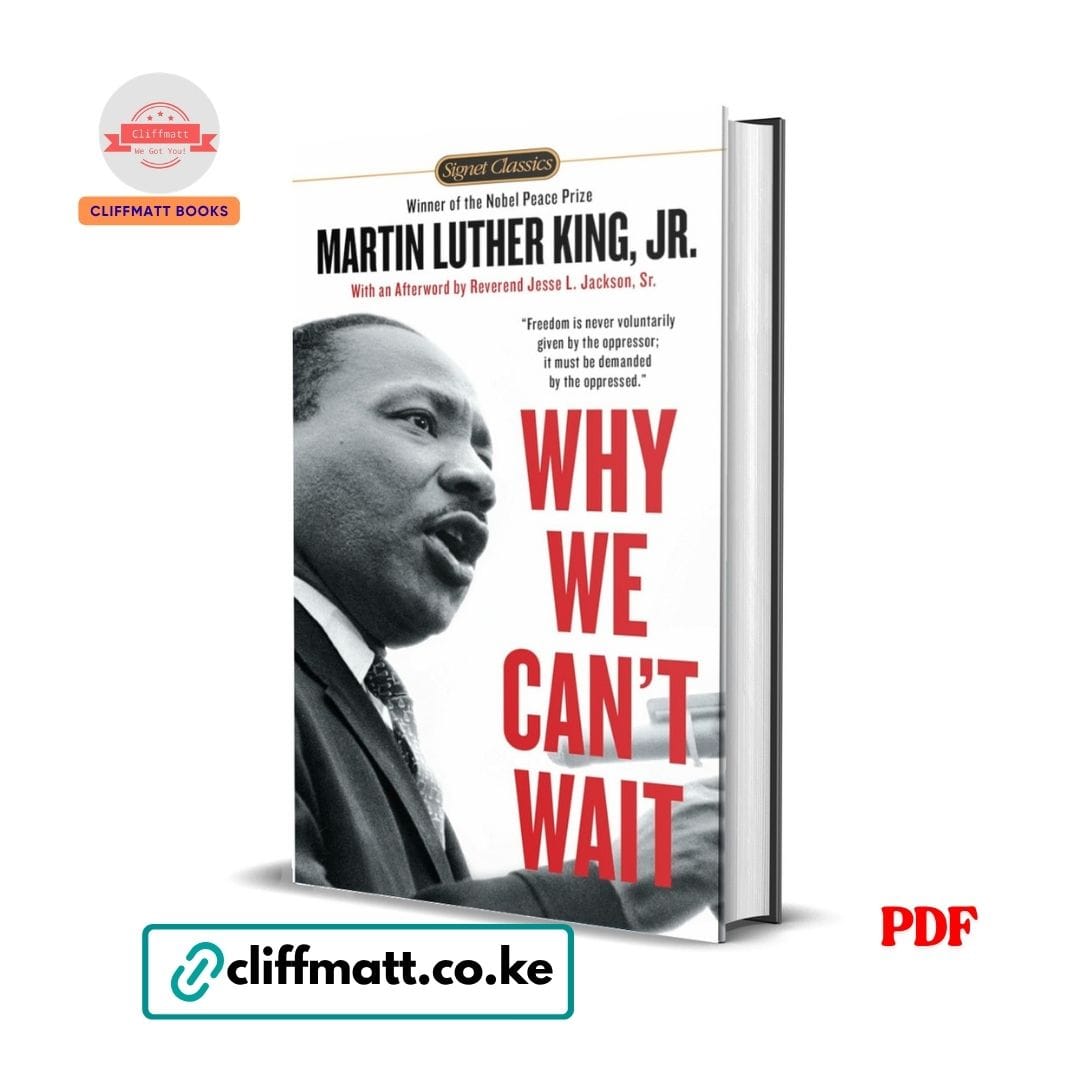
“Freedom is never voluntarily given by the oppressor; it must be demanded by the oppressed.”
These words — written by Martin Luther King, Jr. in a Birmingham jail cell in April 1963, on the margins of a newspaper, on scraps of paper smuggled out by lawyers — are among the most consequential sentences written in the twentieth century. They are the heart of Why We Can’t Wait. They are the heart of the Civil Rights Movement. And they are, for every Kenyan who reads them in the specific context of their own history of colonial rule, liberation struggle, and the specific ongoing work of building a genuinely just society, among the most personally resonant sentences in the literature of human freedom.
Why We Can’t Wait by Martin Luther King, Jr. — Winner of the Nobel Peace Prize, published by Signet Classics, with an Afterword by Reverend Jesse L. Jackson, Sr. — is simultaneously the most important historical document of the American Civil Rights Movement and one of the most profound philosophical, theological, and political texts of the modern era. It is the book that King wrote to explain to the world — and to future generations — not just what happened in Birmingham in 1963 but why it had to happen, why it could not wait, and what the specific strategy, the specific courage, and the specific moral framework that produced it reveal about the nature of genuine justice and the specific demands it makes on every person who claims to care about it.
What This Book Contains:
The Birmingham Campaign — The Turning Point:
- The specific historical context of the Birmingham Campaign of 1963 — why Birmingham was chosen as the specific battleground; the specific nature of the oppression its Black citizens faced; the specific calculation that the specific courage and the specific nonviolent discipline of the specific movement King was leading could crack open the specific resistance that Birmingham represented
- The specific strategic genius of Project C (for Confrontation) — the deliberate, planned, disciplined campaign of sit-ins, marches, and economic boycotts designed not merely to produce local change but to create the specific national and international crisis that would force the specific federal intervention that local resistance could not achieve
- The specific role of Bull Connor — Birmingham’s Commissioner of Public Safety, whose specific willingness to use fire hoses and police dogs against nonviolent demonstrators on national television produced the specific moral shock that turned the specific tide of national public opinion and made federal Civil Rights legislation politically unavoidable
- The specific Children’s Crusade — the remarkable and controversial decision to involve Birmingham’s schoolchildren in the marches; the specific reasoning behind it, the specific courage it required, and the specific impact it produced; why this decision remains one of the most morally and strategically instructive moments in the entire history of nonviolent protest
Letter from Birmingham Jail — The Most Important Document of the Movement:
- The specific context of the letter — King arrested for demonstrating without a permit; eight white Alabama clergymen publishing an open letter calling the demonstrations “unwise and untimely”; King writing his response in the margins of the newspaper on which their letter appeared, in a solitary confinement cell, without books or notes
- The specific argument of the letter — the most complete and most powerful articulation of the moral case for nonviolent direct action that King ever produced; the specific philosophical, theological, and historical argument that demolishes every objection to the specific timing, the specific method, and the specific justification of the Birmingham Campaign
- The specific distinction between just and unjust laws — King’s use of Augustine and Aquinas to establish the specific theological and philosophical basis for civil disobedience; the specific criteria for distinguishing laws that deserve obedience from laws that not only may but must be broken by any person of genuine conscience
- The specific critique of the white moderate — arguably the most important passage in the letter and one of the most permanently relevant passages in all political literature; King’s specific argument that the specific white moderate who “prefers a negative peace which is the absence of tension to a positive peace which is the presence of justice” is a greater obstacle to genuine freedom than the specific overt racist
- Why “Why We Can’t Wait” — the specific argument that the specific demand for patience, for waiting for the right moment, for trusting that things will improve gradually without the specific pressure of direct action, is not a counsel of wisdom but a specific continuation of the injustice it claims to want to end
- The specific theological foundation of King’s entire movement — the specific integration of the Christian gospel of love (agape — the specific love that seeks the welfare of the beloved even at cost to itself) with the specific Gandhian philosophy of nonviolent resistance; why King consistently argued that nonviolence was not the passive absence of violence but the most active and most demanding expression of genuine love available to any person committed to genuine justice
The Philosophy of Nonviolent Direct Action:
- The specific six principles of nonviolent resistance that King articulates — nonviolence as a way of life, seeking to defeat injustice rather than people, willingness to accept suffering without retaliation, refusal to harm the enemy’s spirit as well as body, love rather than hatred as the motive force, and the specific faith that the specific universe bends toward justice
- The specific distinction between nonviolence and passivity — the most persistent and most important misunderstanding of King’s philosophy; why nonviolent direct action requires more courage, more discipline, and more genuine love for the opponent than any available violent alternative
- The specific strategic dimension of nonviolence — not merely an ethical preference but the specific political calculation that in a context where the opposition has overwhelming physical force advantage, nonviolence is the specific strategy that most effectively removes that advantage by placing the moral weight entirely on the side of those who absorb rather than inflict suffering
- Why the specific Gandhian influence on King is so directly relevant to Kenya — whose own independence movement drew explicitly on Gandhi’s philosophy, whose own Mau Mau era raised the same specific questions about violence, nonviolence, and the specific moral demands of genuine liberation that King navigated in Birmingham
The Broader Argument — Justice Cannot Wait:
- King’s specific argument about the Negro’s hour — that 1963 represented a specific, historic moment of readiness; that the specific combination of the specific movement’s discipline, the specific nation’s conscience, and the specific international pressure of decolonising African and Asian nations watching America’s racial contradictions had created the specific window that could not and must not be allowed to close through the specific counsel of gradualism
- The specific economic dimension — King’s prescient analysis of how the specific economic exclusion of Black Americans was not merely an ethical wrong but the specific drag on American prosperity that the specific advocates of patient gradualism were also paying for; the specific argument for reparations-adjacent economic justice that was radical in 1963 and remains contentious today
- The specific international dimension — King’s specific awareness that America’s racial situation was being watched by the specific newly independent African and Asian nations whose specific hearts and minds the specific Cold War geopolitical competition was making critically important; how Birmingham’s moral obscenity was simultaneously an American domestic crisis and a specific American foreign policy liability
The Jesse Jackson Afterword — Legacy and Continuing Relevance:
- Reverend Jesse L. Jackson, Sr.’s specific reflection on the specific legacy of Birmingham, the specific legacy of King, and the specific ongoing relevance of the specific arguments of Why We Can’t Wait to the specific challenges of racial justice that America — and by extension, every society that has inherited the specific structures of racial and colonial hierarchy — continues to navigate
- The specific African dimension of Jackson’s afterword — his specific recognition that the specific liberation struggle King was leading in America was part of the same specific global liberation movement that was simultaneously producing independent African nations; why the specific connection between the Civil Rights Movement and African independence is not incidental but essential
Why Kenyan Readers Are Buying This Book: Kenya’s own history — of colonial subjugation, of independence struggle, of the specific ongoing work of building a just society from institutions that were designed by and for the specific interests of the coloniser — makes King’s arguments not historical artifacts but living documents. The specific question “Why can’t we wait?” — asked about racial justice in America in 1963 — is the same question that has been asked about justice in every society where the specific comfort of those who benefit from injustice is consistently preferred to the specific urgency of those who suffer it.
For every Kenyan who has ever been told to be patient, to trust the process, to wait for the right moment to demand what is right — this is the most powerful answer ever written.
At Ksh 100, the Nobel Peace Prize winner’s most essential book — with the complete Letter from Birmingham Jail — is available to every Kenyan.
Who This Book Is For:
- Every Kenyan who wants to understand the specific philosophical, theological, and strategic genius behind the most successful nonviolent liberation movement in modern history
- Political science, history, and social justice students at Kenyan universities for whom this is essential reading in any serious engagement with civil rights, human rights, and the philosophy of nonviolent resistance
- Kenyan church leaders, pastors, and Christians who want the most powerful articulation of the specific relationship between genuine Christian faith and genuine social justice ever written by one of Christianity’s most consequential practitioners
- Kenyan civil society professionals, human rights advocates, and community organizers who want the specific philosophical and strategic framework that King developed for the specific challenges their own work presents
- Every reader of Gandhi: An Autobiography (Gandhi), Long Walk to Freedom (Mandela), Dreams from My Father (Obama), Team of Rivals (Goodwin), and Dangerous Prayers (which features King on its cover) who wants the specific document that connects all of these stories in the most direct and most philosophically complete way
📖 Author: Martin Luther King, Jr. (Afterword by Reverend Jesse L. Jackson, Sr.) 🏢 Publisher: Signet Classics 📄 Format: PDF eBook (instant download via WhatsApp or email) 💰 Price: Ksh 100 only 🚀 Delivery: Instant after M-Pesa payment confirmation
👉 Order now on cliffmatt.co.ke — Pay via M-Pesa, receive your PDF instantly.












Reviews
There are no reviews yet.