


Description
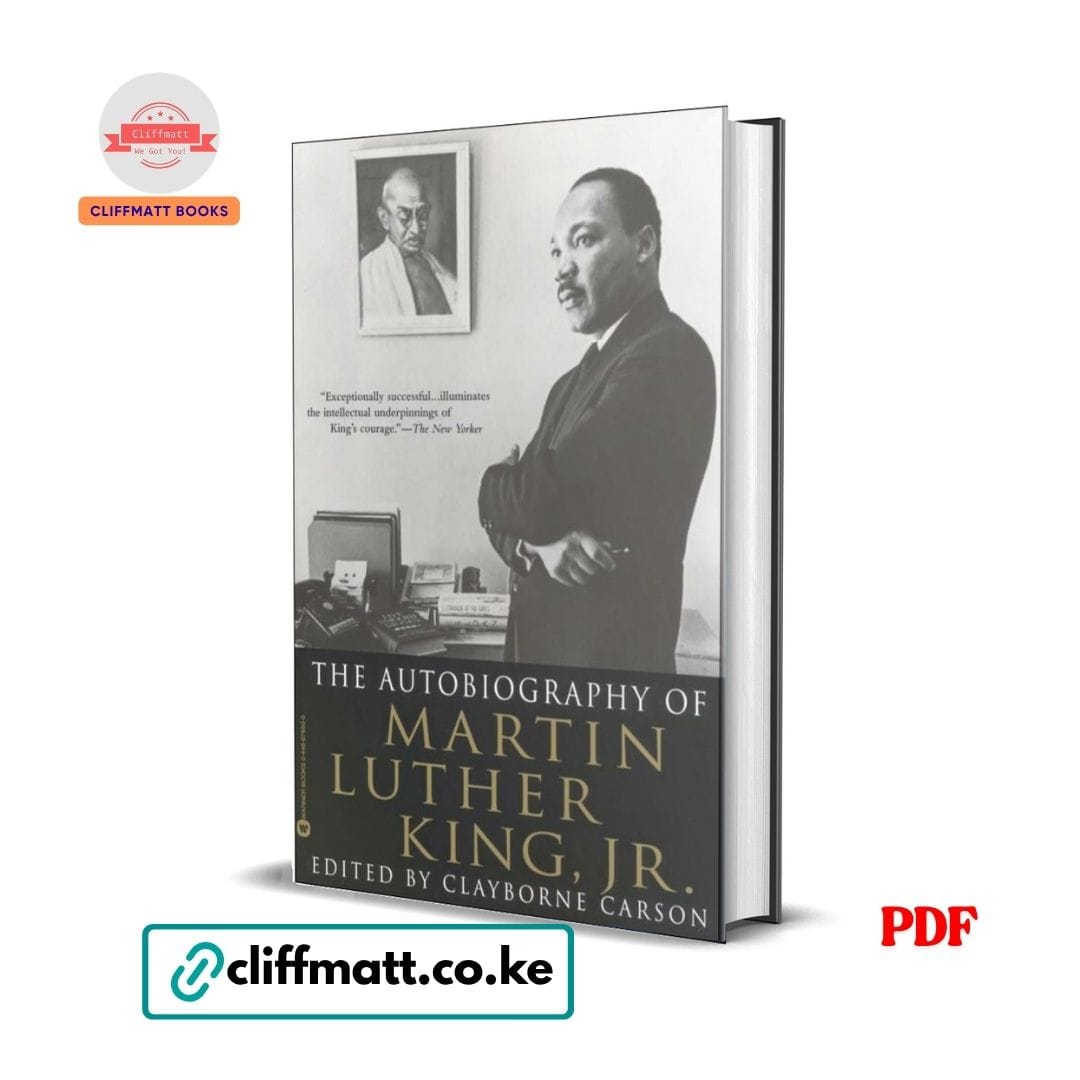
There is a portrait of Gandhi on the wall behind him.
It is the specific detail that the cover photograph captures — and it is the specific detail that tells you everything about who Martin Luther King, Jr. was. The specific young Black minister from Atlanta who read Gandhi in seminary and saw in his philosophy of nonviolent resistance the specific moral framework that the specific American civil rights struggle most needed. The specific man who took the specific most dangerous moral stand of his generation and never flinched from it. The specific leader whose specific combination of intellectual depth, spiritual conviction, rhetorical genius, and personal courage produced the specific most transformative social movement in twentieth-century American history — and whose specific legacy has shaped the specific pursuit of justice, dignity, and human rights on every continent, including Africa, including Kenya, ever since.
The Autobiography of Martin Luther King, Jr. — edited by Clayborne Carson, Director of the Martin Luther King, Jr. Research and Education Institute at Stanford University; praised by The New Yorker as “exceptionally successful…illuminating the intellectual underpinnings of King’s courage” — is not a conventional autobiography. It is the specific compilation of King’s own words — his letters, his speeches, his sermons, his published writings, his private journals, and his personal reflections — assembled by the world’s leading King scholar into the specific narrative of a life that is as relevant to the specific Kenyan reader of 2025 as it was to the specific American reader of 1963.
What This Book Covers:
The Formation — A Leader Is Made:
Childhood and Family:
- The specific Atlanta childhood — the particular world of the specific Black middle-class South that shaped King’s earliest understanding of injustice; the specific first encounter with racial segregation that King describes with the particular precision of a man who has never forgotten the specific moment when the specific white friend’s parents told him they could no longer play together because he was Black; why this specific childhood experience of the specific arbitrary cruelty of the specific racial caste system produced the specific moral indignation that never left him
- The specific family foundation — the particular influence of the specific Reverend Martin Luther King, Sr. (Daddy King) — a man of specific moral authority, specific pastoral dignity, and specific fierce resistance to humiliation; how the specific example of a father who refused to be diminished by the specific racial system he lived within gave the specific son both the specific model and the specific permission to resist with the specific same dignity and the specific greater force that his generation’s specific moment required
- The specific church formation — how the particular experience of growing up in the specific Black Baptist church tradition of the specific American South gave King the specific rhetorical formation, the specific biblical grounding, and the specific understanding of the particular relationship between faith and justice that his entire leadership would be built upon; why the specific Black church was simultaneously the specific most important community institution, the specific most important educational institution, and the specific most important political institution available to the specific Black community that produced him
Education and Intellectual Formation:
- The specific Morehouse College years — King entering college at fifteen; the particular intellectual formation under the specific influence of the specific Morehouse president Benjamin Mays, whose specific combination of academic excellence and social justice commitment gave the specific young King both the specific intellectual permission and the specific institutional model for what a Black man of faith could be in the specific mid-twentieth-century America
- The specific Crozer Theological Seminary — the specific encounter with the specific intellectual tradition of the Social Gospel (the particular theological argument that Christianity’s most specific obligation is the specific transformation of unjust social structures, not merely the specific saving of individual souls); the specific reading of Walter Rauschenbusch that produced the specific social theology that would underpin every subsequent King sermon and every subsequent King campaign
- The specific Gandhi encounter — how the particular lecture by Mordecai Johnson on Gandhi’s campaign of nonviolent resistance in India produced what King describes as the specific most electrifying intellectual experience of his entire formation; the particular Gandhian framework — the specific satyagraha (truth-force), the specific ahimsa (non-harm), and the specific willingness to accept suffering rather than inflict it — that King immediately recognised as the specific moral framework the specific American civil rights movement most needed
- The specific Boston University doctoral years — the particular philosophical deepening; how the specific personalist theology of the specific Boston University school gave King the specific academic philosophical framework for understanding the specific dignity and the specific moral worth of every human person that his subsequent leadership would consistently appeal to
The Movement — A Leader Leads:
Montgomery — The Beginning:
- The specific bus boycott — the particular night that Rosa Parks refused to give up her seat; how the specific 26-year-old pastor of Dexter Avenue Baptist Church became the specific leader of the specific Montgomery Improvement Association not because he sought the role but because the specific community trusted him with it; the specific first mass meeting at Holt Street Baptist Church and the specific address that King delivered with no prepared text — the specific first major speech of his leadership life — that drew the specific longest sustained applause he had ever heard
- The specific nonviolent discipline — how King insisted from the very first days of the boycott on the specific discipline of nonviolent conduct as both a strategic and a moral requirement; how the specific Gandhian framework that he had encountered intellectually now had to be translated into the specific practical guidance for the specific fifty thousand Black Montgomery residents who were walking to work rather than riding segregated buses
- The specific personal cost — the specific bomb thrown at King’s home in January 1956 while Coretta and their infant daughter were inside; how King arrived at the house to find a crowd of angry Black residents ready to retaliate with violence; the specific speech he delivered from his bombed-out porch that dispersed the crowd nonviolently; why this specific moment is the specific most revealing single act of his entire leadership — the specific test of whether the specific philosophy was genuinely held or merely advocated
The Albany Movement, Birmingham, and the March on Washington:
- The specific Albany failure — King’s own honest account of the specific strategic mistakes of the specific Albany campaign; why the specific Albany police chief’s tactic of arresting demonstrators quietly and without visible brutality neutralised the specific media strategy that nonviolent confrontation with violent resistance depended on; how King learned from the specific failure the specific tactical lessons that Birmingham would apply
- The specific Birmingham campaign — the particular strategic genius of Project C (Confrontation); the specific decision to bring children into the marches despite the specific moral anguish it produced; the specific Bull Connor response — fire hoses and police dogs turned on children — that produced the specific global media reaction that the specific Albany strategy had failed to achieve; the specific Birmingham Jail letter, written on the specific margins of newspapers and on scraps of paper smuggled in by supporters, that is simultaneously the specific greatest piece of prose King ever produced and the specific most important document of the civil rights movement
- The specific “Letter from Birmingham Jail” — King’s own account of the specific writing, the specific argument, and the specific intended audience; why the specific letter addressed to the specific “white moderate” — the specific person who preferred “a negative peace which is the absence of tension to a positive peace which is the presence of justice” — is the specific most morally challenging and the specific most permanently relevant document in the entire civil rights literature
- The specific March on Washington — King’s account of the specific planning, the specific political negotiations, the specific enormous logistical challenge of bringing 250,000 people to the specific National Mall; the specific “I Have a Dream” passage — the specific moment when King departed from his prepared text and delivered the specific most famous passage of his entire oratorical career — his own account of what happened in that specific moment and why
Selma, the Voting Rights Act, and the Final Years:
- The specific Selma campaign — the particular focus on voting rights as the specific next frontier after the specific Civil Rights Act; the specific Bloody Sunday on the Edmund Pettus Bridge and how the specific television footage of state troopers attacking peaceful marchers produced the specific national moral shock that delivered the specific political momentum for the Voting Rights Act
- The specific evolution of King’s thinking — how King’s specific moral vision expanded in his final years from the specific formal legal rights of Black Americans to the specific broader economic justice that formal legal equality alone could not deliver; the specific Poor People’s Campaign, the specific opposition to the specific Vietnam War, and the specific King of 1967-68 who was simultaneously more radical, more isolated from former allies, and more morally clear-eyed than the specific King of the March on Washington
- The specific opposition to Vietnam — King’s own account of the specific moral reasoning that led him to publicly oppose the Vietnam War despite the specific advice of virtually every ally and every supporter who warned him it would destroy the specific coalition that the civil rights movement depended on; how he concluded that the specific silence of the specific moral leader in the face of the specific moral outrage is itself a specific moral failure
The Faith — What Made Him Who He Was:
- The specific theology of King’s leadership — the particular understanding that every King speech, every King strategy, and every King personal decision was grounded in the specific theological conviction that the specific universe is on the side of justice; that the specific arc of the moral universe bends toward justice not automatically but through the specific effort of the specific people who are willing to bend it; that the specific God of the specific Exodus — the specific God who brings the specific oppressed out of the specific house of bondage — is the specific God who validates and empowers the specific civil rights movement
- The specific prayer life — how King describes the specific experience of prayer as the specific source of the specific courage that his specific public role required; the specific kitchen table experience in the specific most dangerous night of his leadership when, alone and frightened, he heard what he describes as the specific inner voice of Jesus assuring him that he would never be left alone; how this specific private spiritual experience produced the specific public courage that no audience ever fully witnessed
- The specific relationship between faith and action — King’s specific, consistent argument that the specific faith that does not produce the specific action for justice is not the specific genuine Christian faith; that the specific church that is primarily a thermometer recording the specific social temperature rather than a thermostat changing it has abandoned the specific most important responsibility of the specific institution that claims to follow the specific Jesus who preached good news to the specific poor and liberation to the specific oppressed
Why Kenyan Readers Are Buying This Book: The specific pursuit of justice, the specific dignity of every human person, the specific courage required to resist the specific structures of oppression, and the specific faith that sustains the specific leader who refuses to be silent — these are not specifically American themes. They are the specific themes of every African independence struggle, every Kenyan community organiser, every church leader, and every professional who has ever faced the specific moment where the specific right thing and the specific safe thing are not the same thing. King’s specific life is the specific most fully documented and the specific most powerfully narrated example of what the specific person of faith and the specific person of moral courage looks like in the specific most extreme circumstances — and what they can achieve.
At Ksh 100, the most inspiring leadership biography ever written — now available to every Kenyan.
Who This Book Is For:
- Every Kenyan Christian who wants to understand the specific relationship between faith and justice — between what the specific church believes and what the specific church does — through the specific life of the most powerful example in modern history
- Kenyan leaders, pastors, community organisers, and professionals who want the specific most thoroughly documented account of what genuine moral courage in leadership looks like in practice
- Kenyan students and young people who want the specific biographical foundation for understanding the specific civil rights movement and the specific broader global struggle for human dignity that King’s life represents
- Kenyan readers interested in African and Black history, the specific global anti-colonial and anti-racist movements, and the specific connections between the specific American civil rights struggle and the specific African liberation movements that were happening simultaneously
- Every reader of Long Walk to Freedom (Mandela), Dreams from My Father (Obama), Born a Crime (Trevor Noah), Left to Tell (Ilibagiza), and Unbowed (Maathai) who wants the most intimately personal and most morally profound leadership biography available from any figure of the twentieth-century freedom struggle
📖 Editor: Clayborne Carson 📄 Format: PDF eBook (instant download via WhatsApp or email) 💰 Price: Ksh 100 only 🚀 Delivery: Instant after M-Pesa payment confirmation
👉 Order now on cliffmatt.co.ke — Pay via M-Pesa, receive your PDF instantly.













Reviews
There are no reviews yet.