
Description
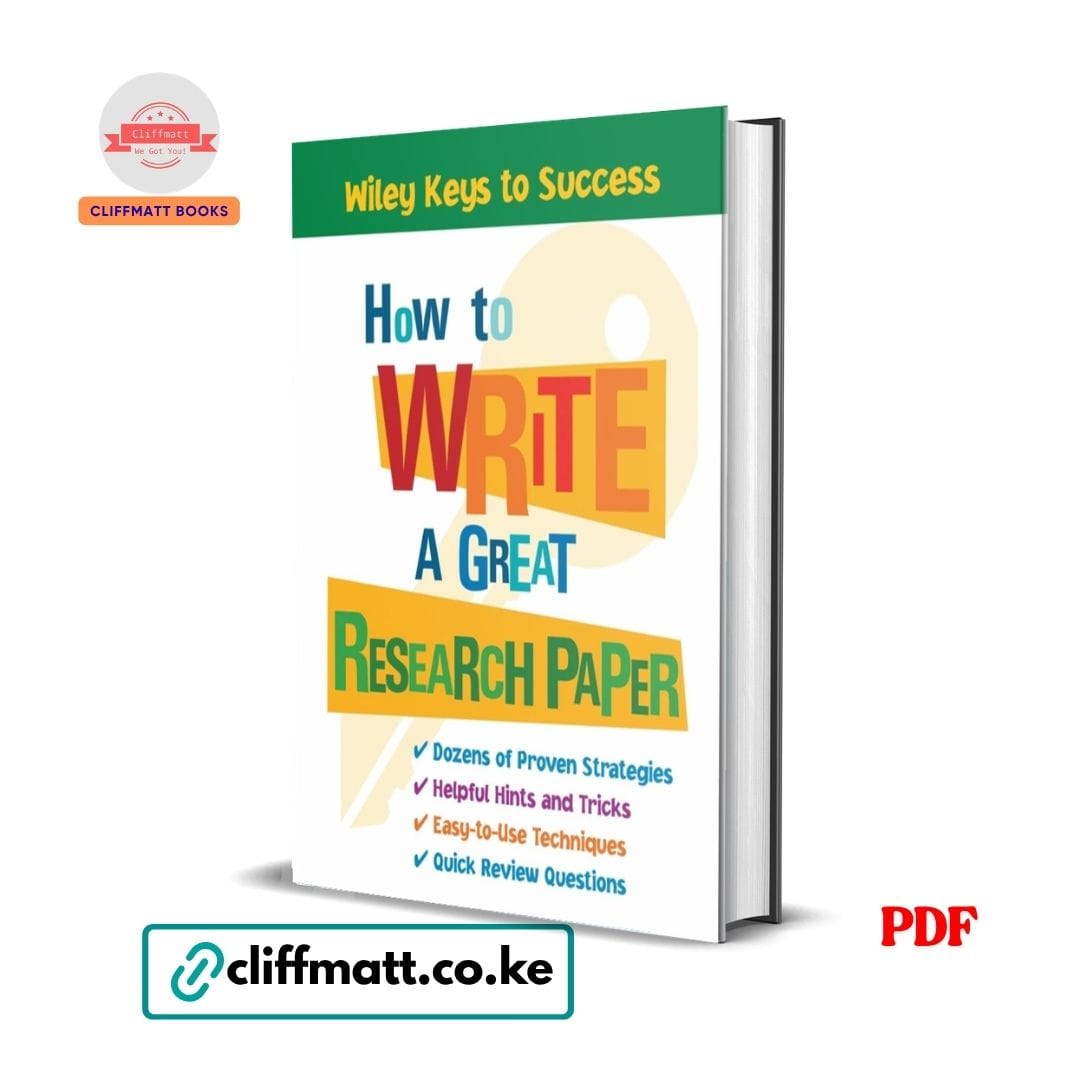
Every university student in Kenya has to write research papers. Most receive very little guidance on how to do it well. The result — across thousands of dissertations, term papers, and journal submissions every year — is research that is technically adequate but academically underwhelming: poorly structured, inadequately sourced, logically unclear, and failing to do justice to the ideas the student actually has. How to Write a Great Research Paper from the Wiley Keys to Success series is the book that changes that — providing every Kenyan student and researcher with the complete, practical, immediately applicable guide to producing genuinely excellent academic research writing.
Published by Wiley — one of the world’s most respected academic publishers — this is not a generic writing guide. It is a research paper writing guide: specific, structured, and built around the specific challenges that research writing presents and the specific standards that academic institutions and journals demand.
What This Book Covers:
Choosing and Developing Your Research Topic:
- How to identify a research question that is genuinely interesting, academically feasible, and sufficiently focused for the paper length required
- The difference between a topic and a research question — and why that distinction determines the quality of everything that follows
- How to conduct a preliminary literature review to understand what has already been written and where the genuine gaps in knowledge exist
- How to narrow a broad topic into a manageable, specific research focus
- Developing a clear, arguable thesis statement — the single most important sentence in any research paper
Conducting Research:
- How to use academic databases, university libraries, and online resources to find credible, relevant sources
- Evaluating sources — the specific criteria for assessing the credibility, relevance, and academic quality of every source you use
- Primary versus secondary sources — when to use each and how to integrate both effectively
- How to take research notes that serve your writing process rather than just recording what you read
- Avoiding plagiarism — understanding what constitutes plagiarism, why it happens, and how to protect yourself through proper note-taking and citation from the very beginning
Organising Your Research:
- How to develop a research outline that structures your argument logically from introduction to conclusion
- The relationship between your thesis, your main arguments, and your supporting evidence — and how to map that relationship before you begin writing
- Creating a logical flow of ideas that guides the reader through your argument without confusion
- How to handle contradictory evidence — the specific academic approach to sources that challenge your thesis
Writing the Research Paper:
The Introduction:
- How to open with a hook that captures academic interest without being sensational
- Providing the necessary background context efficiently — giving the reader what they need to understand your research without overwhelming them
- Stating your thesis clearly, specifically, and arguably
- Signposting — how to tell the reader what they are about to read in a way that aids comprehension
The Literature Review:
- What a literature review actually is — and why it is not a list of summaries but a critical analysis of the scholarly conversation you are entering
- How to organise a literature review thematically, chronologically, or methodologically depending on your research design
- How to synthesise multiple sources into a coherent discussion rather than discussing each one separately
- Identifying gaps in the existing literature — the specific positioning move that justifies your own research contribution
The Methodology:
- How to describe your research design clearly enough for a reader to understand and evaluate it
- Quantitative, qualitative, and mixed methods approaches — how to present each appropriately
- Justifying your methodological choices — why you chose this approach rather than alternatives
- Addressing limitations honestly — the academic maturity that actually strengthens rather than weakens your paper
The Results and Discussion:
- How to present findings clearly, accurately, and without editorialising
- The specific structure of an effective discussion section — what it does that the results section does not
- How to connect your findings back to your research question, your literature review, and your thesis
- How to handle results that do not support your hypothesis — the specific academic response that demonstrates genuine scholarly integrity
The Conclusion:
- What a conclusion actually does — and the specific mistakes that make most conclusions weak
- How to summarise your argument without simply repeating it
- Implications — what your findings mean for theory, practice, or further research
- Recommendations — how to offer actionable suggestions based on your findings without overreaching your evidence
- Directions for future research — how to acknowledge the limitations of your study and point toward what still needs to be done
Citations and References:
- The major citation styles — APA, MLA, Harvard, Chicago — and how to use each correctly
- In-text citations — how to integrate sources smoothly into your own argument rather than dumping quotations
- The reference list — formatting every source type correctly and completely
- Why citation matters — both for academic integrity and for giving your own argument the credibility of its sources
Editing and Proofreading:
- The specific editing strategies that transform a first draft into a polished academic paper
- Common academic writing errors — passive voice overuse, unclear antecedents, hedging language, and structural weaknesses — and how to identify and correct each
- Proofreading techniques — the specific reading approaches that catch errors that spell-check misses
- Peer review — how to give and receive feedback productively
Who This Book Is For:
- University students at Kenyan institutions writing their first research papers and wanting to start with the right foundations
- Masters and PhD students wanting to strengthen their academic writing for dissertations and journal submissions
- Undergraduate students across every discipline — sciences, social sciences, humanities, business, and health sciences — who write research papers as part of their degree requirements
- Lecturers and research supervisors who want a clear, practical resource to recommend to students struggling with academic writing
- Secondary school students preparing extended essays and research projects for A-levels, IGCSE, and IB programmes
- Any Kenyan professional writing reports, policy papers, or research documents who wants to improve their technical writing quality
Why Kenyan Students Are Buying This Book: Research paper writing is a core academic skill at every level of higher education in Kenya — yet it is rarely explicitly taught. Most Kenyan students learn by imitation, by trial and error, and from the feedback of supervisors who do not have time to teach writing fundamentals. How to Write a Great Research Paper fills that gap — giving every Kenyan student a complete, practical, Wiley-quality guide to the skill that will determine the quality of their academic output for their entire educational and professional career.
At Ksh 100, this is the most affordable academic writing investment available anywhere in Kenya.
Book Details:
- 📖 Series: Wiley Keys to Success
- 🏢 Publisher: Wiley
- 📄 Format: PDF eBook (instant download via WhatsApp or email)
- 💰 Price: Ksh 100 only
- 🚀 Delivery: Instant after M-Pesa payment confirmation
👉 Order now on cliffmatt.co.ke — Pay via M-Pesa, receive your PDF instantly.


Reviews
There are no reviews yet.