


Description
We think we understand success. We think it comes from talent, from hard work, from intelligence, from the right choices made at the right times. We watch the Kenyan marathon runner cross the finish line, the Silicon Savannah entrepreneur land their first investment, the student who scores top marks at university, and we tell ourselves a story about exceptional individuals whose exceptional qualities produced exceptional outcomes.
Malcolm Gladwell spent a book demolishing that story. And replacing it with something far more interesting, far more honest, and — for every ambitious Kenyan reading it — far more practically useful.
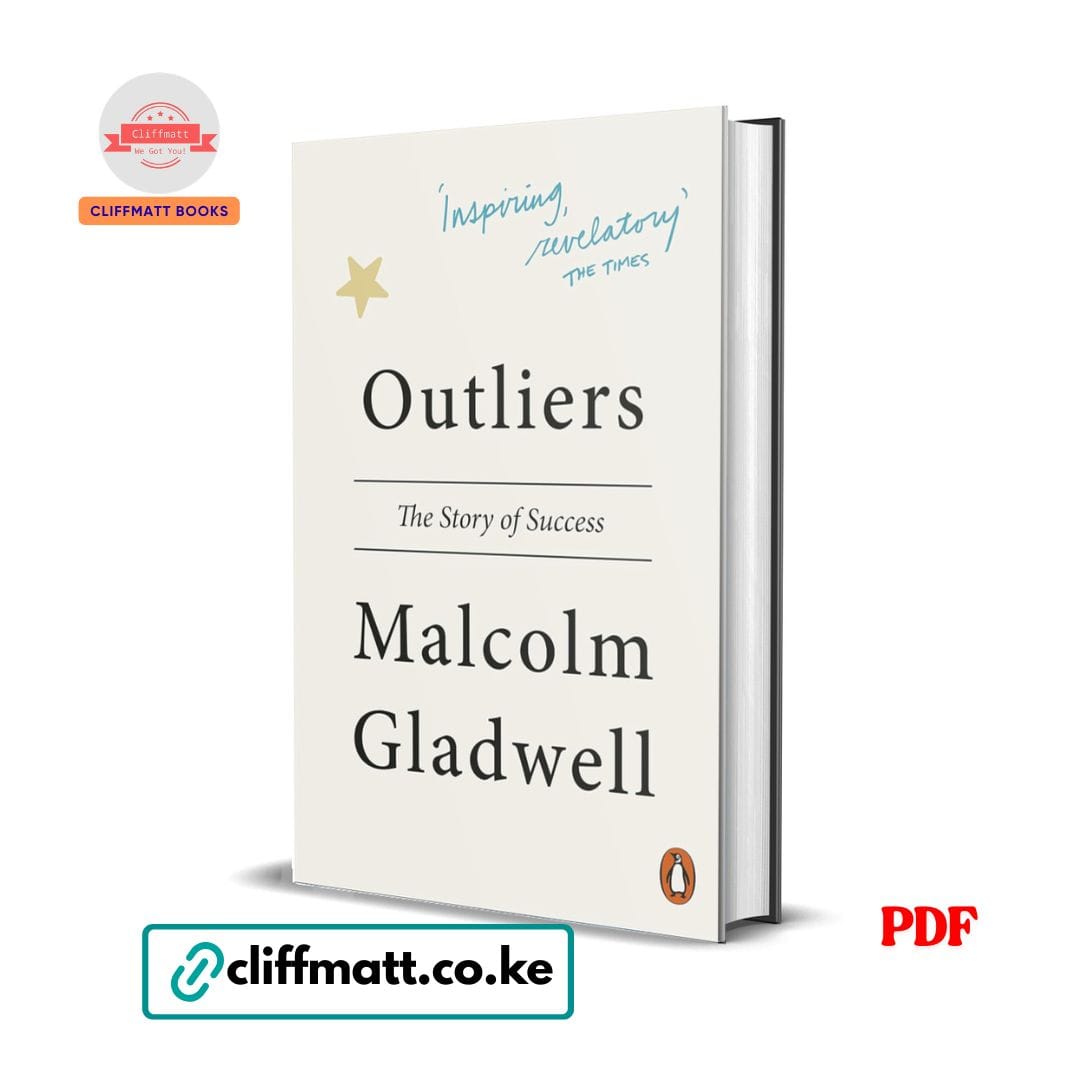
Outliers: The Story of Success by Malcolm Gladwell — published by Penguin, described as “inspiring, revelatory” by The Times, and one of the most widely read and most persistently discussed non-fiction books of the twenty-first century — is the argument that extraordinary success is never simply the product of individual genius and individual effort. It is the product of individual genius and effort operating within a specific set of circumstances, a specific set of opportunities, a specific cultural inheritance, and a specific accumulation of advantages that the conventional success narrative consistently ignores because acknowledging them complicates the story we prefer to tell.
This is not a book that diminishes achievement. It is a book that makes achievement comprehensible — and in making it comprehensible, makes it accessible to far more people than the mythology of pure individual genius ever could.
“Inspiring, revelatory” — The Times
What This Book Argues — and Why It Matters:
Part One: Opportunity — The Hidden Advantages of the Successful:
The Matthew Effect:
- Why the most successful people in almost every field are not just slightly better than everyone else but dramatically better — and why that dramatic gap is almost never explained by individual talent alone
- The Matthew Effect — named from the Gospel of Matthew’s observation that to those who have, more will be given — the specific mechanism by which small initial advantages compound over time into enormous outcome differences
- The specific example of Canadian ice hockey — how players born in the first three months of the year dominate professional rosters at every level; the specific mechanism (age cutoffs, development programmes, practice time) by which a birthday in January rather than December produces a dramatically different developmental trajectory across years of compound advantage
- What the Matthew Effect reveals about every competitive selection system — educational streaming, professional advancement, athletic development — and the specific ways that the systems designed to select the best consistently amplify existing advantages rather than purely identifying talent
- The direct Kenyan application — how the same compounding advantage mechanism operates in Kenya’s educational system, Kenya’s sports development, and Kenya’s professional pathways; what understanding the Matthew Effect reveals about who gets the opportunities that produce the outcomes we admire
The 10,000-Hour Rule:
- The most famous concept in the book — the specific finding from Anders Ericsson’s research that the distinguishing characteristic of elite performers in virtually every domain is not innate talent but approximately 10,000 hours of deliberate practice
- The Beatles — how four years of eight-hour-daily performances in Hamburg produced one of the most technically accomplished rock bands in history before they became famous; the specific hours of practice that preceded the genius
- Bill Gates — how his specific access to a computer terminal in 1968 (at a time when most universities did not have one) produced the specific accumulation of programming hours that made him ready to act when the personal computer revolution arrived; the specific opportunity embedded in the specific accident of his specific environment
- What 10,000 hours actually means — the specific implications for talent, for education, for the specific investment that genuine mastery requires; and the specific role of opportunity in determining who gets access to the specific practice conditions that 10,000 hours requires
- Why the 10,000-hour rule is not discouraging but liberating — the specific reframe from “I lack talent” to “I lack accumulated practice” that makes mastery feel achievable rather than predetermined
The Trouble with Geniuses:
- The case of Christopher Langen — the man with the highest measured IQ in American history, who spent his adult life working as a bouncer and never fulfilled any of the extraordinary potential his intelligence suggested; the specific story of everything that went wrong
- Why IQ, beyond a threshold of adequacy, does not reliably predict exceptional outcomes — the specific research that demolishes the naive equation of intelligence and success
- The concept of practical intelligence — the specific social and interpersonal skills (how to negotiate, how to communicate your needs, how to navigate institutions, how to manage authority figures) that determine outcomes as reliably as cognitive ability and that are more directly transmitted by upbringing and environment than IQ
- The specific difference in parenting philosophy (Annette Lareau’s research on concerted cultivation versus natural growth) that produces dramatically different levels of practical intelligence in children from different backgrounds — and the specific implications for every Kenyan parent
Part Two: Legacy — How Cultural Inheritance Shapes Success:
The Ethnic Theory of Plane Crashes:
- One of the most arresting case studies in the book — how Korean Air’s disproportionate crash rate in the 1990s was traced not to pilot incompetence but to the specific cultural communication patterns that prevented co-pilots from directly challenging the captain’s errors
- The specific cultural dimension of power distance — the degree to which a culture accepts and expects hierarchy to be reflected in communication; how high power-distance cultures produce the specific communication patterns that make aviation, medicine, and organisational leadership simultaneously more deferential and more dangerous
- How Korean Air transformed its safety record by fundamentally changing its cockpit communication culture — the specific training, the specific language policies, and the specific cultural intervention that produced one of the safest airlines in the world from one of the most dangerous
- The direct application to Kenyan professional and organisational contexts — how the specific communication dynamics of hierarchy, deference, and authority that characterise many Kenyan institutional cultures produce the specific outcomes, both functional and dysfunctional, that they consistently produce
Rice Paddies and Math Tests:
- Why students from East Asian cultures consistently outperform students from Western cultures on mathematical assessments — and why the explanation is neither genetic nor simply cultural in the shallow sense, but specifically agricultural
- The specific relationship between rice paddy cultivation (which requires year-round attention, precise seasonal management, and the specific cognitive habits of careful measurement and sequential problem-solving) and the specific mathematical aptitude that has made East Asian students the highest-performing in global educational assessments
- The persistence dimension — the specific finding that mathematical performance differences between Asian and Western students can be almost entirely explained by differential persistence on difficult problems, not differential ability; what this reveals about the relationship between cultural inheritance and academic achievement
- The implications for Kenyan mathematical education — what the specific cultural and pedagogical practices that produce mathematical excellence in East Asia suggest about the specific changes to how mathematics is taught and learned in Kenyan schools
Marita’s Bargain:
- The KIPP Academy case study — the specific educational intervention that produced extraordinary academic outcomes for students from disadvantaged backgrounds by addressing not just curriculum but the specific hours, the specific culture, and the specific accumulated learning time that middle-class students experience and disadvantaged students do not
- The specific calculation of the school year length differences between American students from different socioeconomic backgrounds — how the summer learning loss that compounds across years explains the specific achievement gap that no amount of better teaching during the school year can close if the time outside school is not also addressed
- What Marita’s story (a KIPP student whose extraordinary achievement required an extraordinary personal sacrifice of time and conventional childhood) reveals about the true cost of educational excellence for students who do not benefit from accumulated advantage
The Epilogue — Gladwell’s Own Outlier Story:
- The personal epilogue in which Gladwell traces his own success back through its specific historical contingencies — his mother’s specific educational opportunity in colonial Jamaica, the specific legal changes that made that opportunity available, and the specific chain of circumstances that produced the conditions in which his own gifts could be recognised and developed
- What his own story reveals about the argument the book has been making — that acknowledging the specific circumstances that contributed to your success is not self-diminishment but intellectual honesty; and that understanding those circumstances is the specific prerequisite for designing systems, policies, and institutions that make the conditions for success available to more people rather than fewer
Why This Book Is Essential for Kenya: Outliers asks the most important question in development, education, and social policy: What actually produces exceptional human outcomes? And it answers that question with the specific evidence that demolishes the comfortable narrative of pure meritocracy and replaces it with the specific, complicated, actionable understanding that exceptional outcomes require exceptional opportunity — that talent without access to the right environment, the right timing, and the right accumulated practice will not produce the results that talent with those advantages consistently produces.
For Kenya — a country where the specific distribution of educational opportunity, of professional access, of accumulated advantage, and of the cultural inheritance that either enables or constrains achievement directly determines who becomes an outlier and who does not — this is among the most important books any Kenyan engaged with questions of development, education, policy, and personal achievement can read.
At Ksh 100, this is world-class social science, masterfully written, that will permanently change how you understand success — your own and everyone else’s.
Who This Book Is For:
- Every Kenyan who wants to understand success more honestly — their own potential, the systems around them, and the specific factors that determine who achieves extraordinary outcomes and why
- Parents and educators who want to understand the specific environmental and developmental factors that produce high achievement — and what they can do to provide or improve access to those factors for the children they teach and raise
- Policymakers, civil society leaders, and anyone engaged with Kenya’s development agenda who wants the most evidence-based and most practically instructive analysis of what produces human excellence available
- Students who want to understand the specific role of deliberate practice in their own development — and who want the specific motivation of knowing that mastery is available to anyone willing to put in the specific hours it requires
- Entrepreneurs and professionals who want the specific understanding of how opportunity, timing, and cultural inheritance interact with individual effort to produce extraordinary outcomes — and how to position themselves within those dynamics
- Every reader of Grit (Duckworth), So Good They Can’t Ignore You (Newport), Atomic Habits (Clear), The Tipping Point (Gladwell’s earlier book), and Mental Models (Taylor) who wants Gladwell’s most practically and most socially challenging book to complete their intellectual performance library
📖 Author: Malcolm Gladwell 🏢 Publisher: Penguin 📄 Format: PDF eBook (instant download via WhatsApp or email) 💰 Price: Ksh 100 only 🚀 Delivery: Instant after M-Pesa payment confirmation
👉 Order now on cliffmatt.co.ke — Pay via M-Pesa, receive your PDF instantly.










Reviews
There are no reviews yet.