

Description
Everyone wants to know what is going to change next. Which industry. Which technology. Which country. Which investment. The entire global forecasting industry — the analysts, the economists, the strategists, the futurists — is built on the specific promise of telling you what is coming next.
Morgan Housel asks a completely different question.
Not what will change. But what will never change.
Because the specific things that never change — the particular patterns of human psychology, the specific recurring features of risk and opportunity, the particular constants of how people behave under uncertainty, under pressure, under success, and under failure — are the specific things that most reliably determine how every person’s financial life, professional life, and personal life actually unfolds. And they are the specific things that the specific obsession with prediction and novelty consistently causes people to overlook.
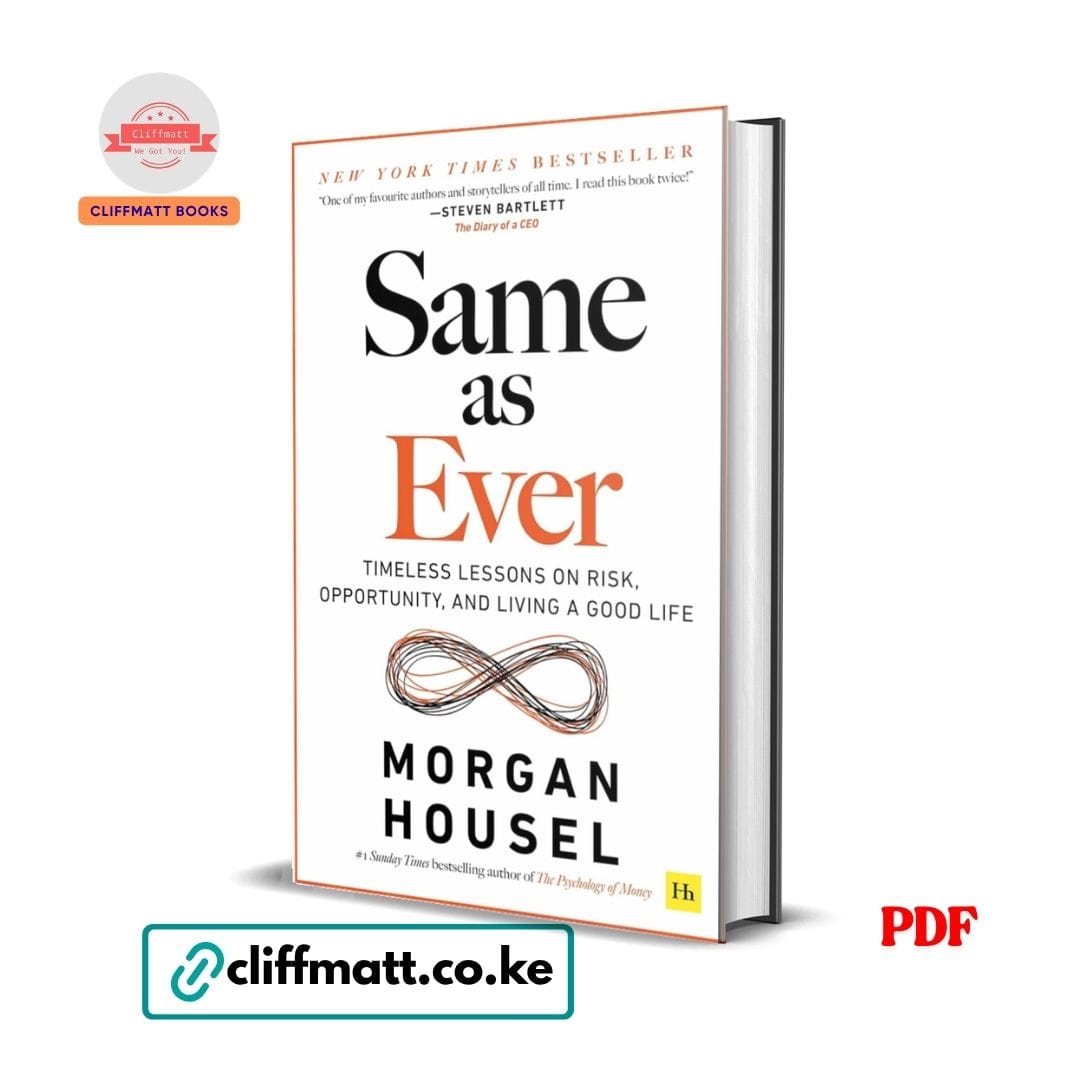
Same as Ever: Timeless Lessons on Risk, Opportunity, and Living a Good Life — New York Times Bestseller, from the #1 Sunday Times bestselling author of The Psychology of Money — is Morgan Housel at his most expansive, most historically grounded, and most genuinely wise. Where The Psychology of Money examined how people think about money, Same as Ever examines how people think about everything: risk, happiness, ambition, resilience, time, stories, and the specific pursuit of a life well lived. It is the book that Steven Bartlett — one of the most widely listened-to business voices in the world — read twice.
At Ksh 100, it is available to every Kenyan who wants to think more clearly about the world that never really changes as much as it seems to.
What This Book Covers:
The Central Insight — What Never Changes:
- The specific framing of the book — Morgan Housel’s foundational argument that the specific pursuit of predicting what will change is both endlessly seductive and fundamentally unreliable; that the specific understanding of what never changes is both consistently available and consistently more useful for navigating every domain of life that matters; why the specific investor, the specific entrepreneur, the specific professional, and the specific person seeking a good life all benefit more from understanding the specific constants of human nature than from the specific forecasts that financial media, business media, and technology commentary are built around
- The specific historical method — how Housel uses the particular pattern of history not to predict the future (which it cannot reliably do) but to identify the specific recurring features of human behaviour that history does reliably reveal; why the specific story of a crisis from fifty years ago is more useful for understanding today than today’s specific news; how the particular long view of human behaviour that history provides is the specific most reliable guide to navigating the specific unpredictable future that every person in every generation has always faced
- The specific universality claim — why the specific patterns that Housel identifies apply as directly to the specific Kenyan entrepreneur navigating the specific uncertainty of the Kenyan business environment as to the specific American investor navigating the specific volatility of global markets; how the particular constants of human psychology that the book documents are not culturally specific but genuinely universal
The Lessons — Timeless Patterns of Risk and Opportunity:
Risk — What People Get Wrong:
- The specific tail risk insight — Housel’s compelling documentation of how the specific most consequential events in financial history, business history, and personal history are consistently the specific events that nobody predicted, nobody prepared for, and nobody considered likely; why the specific most important risk is almost never the specific risk that is most discussed; how this specific insight should change the way every Kenyan investor, every Kenyan business owner, and every Kenyan professional thinks about preparation and resilience
- The specific optimism and pessimism asymmetry — the particular finding that pessimistic narratives spread faster, receive more attention, and feel more intellectually serious than optimistic ones — even when the specific evidence for long-term optimism is substantially stronger; why the specific Kenyan professional who reads financial news is systematically exposed to more negative information than the specific reality of long-term progress justifies; how to calibrate the specific appropriate response to short-term pessimism without losing the specific long-term optimism that sustained effort requires
- The specific cost of certainty — how the particular human need for certainty and narrative consistency consistently causes people to underestimate the specific genuine uncertainty of the future; why the specific most confident forecaster is almost never the specific most reliable one; the particular intellectual humility about the future that the specific study of how often confident predictions have failed consistently produces
- The specific survivorship bias — the particular tendency to see only the specific successes and to draw the specific lessons from them that the specific failures would have complicated or contradicted; why the specific business model, the specific investment strategy, and the specific personal approach that appears to have worked is frequently the specific one that happened to survive rather than the specific one that was genuinely superior
Opportunity — What People Miss:
- The specific compounding insight extended beyond money — how the particular power of compounding that The Psychology of Money applied specifically to financial investment applies with equal force to knowledge, to relationships, to reputation, to skill, and to every other domain of life where the specific consistent, patient accumulation of the specific small improvements consistently produces the specific results that seem disproportionately large relative to the specific effort invested; why the specific Kenyan who understands compounding in the context of money and applies it to the context of their professional development, their relationships, and their personal growth is specifically better positioned for the specific long-term outcomes that matter
- The specific long game versus the short game — how the particular human preference for immediate gratification and the specific short-term feedback that social media, quarterly reporting, and the specific always-on information environment consistently provides systematically biases people away from the specific long-term behaviours and long-term thinking that the specific best outcomes in every domain of life consistently require; why the specific ability to extend time horizons is the specific most valuable competitive advantage available to any Kenyan professional, investor, or entrepreneur in a market environment where the specific short-term thinking of the majority creates the specific long-term opportunities of the minority
- The specific narrative power — how the specific stories that people tell themselves and each other about what is happening consistently shape reality more powerfully than the specific facts alone; why the specific most compelling story — not the specific most accurate one — consistently wins the specific attention, the specific investment, and the specific loyalty that determines outcomes in business, politics, and personal relationships; the specific implications for how every Kenyan communicator, every Kenyan leader, and every Kenyan entrepreneur should think about the specific narrative dimension of their work
Human Behaviour — The Constants:
- The specific happiness and wanting paradox — Housel’s genuinely moving exploration of how the specific human capacity for wanting consistently outpaces the specific human capacity for satisfaction; why the specific person who achieves their goal almost always discovers that the specific goal post has moved; how the particular hedonic adaptation that psychology has consistently documented means that the specific external achievements that most people are pursuing will produce less lasting happiness than the specific internal orientations — gratitude, relationships, purpose, the specific reduction of unnecessary desire — that the specific research on genuine wellbeing most consistently identifies
- The specific enough concept — one of the most practically important ideas in the entire book; the specific argument that the particular failure to define “enough” — enough money, enough success, enough status, enough recognition — is the specific most common and the specific most destructive source of unhappiness among people who by every objective measure have more than enough; why the specific Kenyan professional who defines enough early and specifically is consistently better positioned for both financial security and genuine personal satisfaction than the one who does not
- The specific time as the ultimate currency — Housel’s consistent return to the specific theme that the specific autonomy over how one spends one’s time is the specific most valuable resource that financial independence, career choices, and life design can produce; why the specific Kenyan who optimises their working life for the specific money-to-time conversion rather than the specific money-to-prestige conversion is consistently making the specific trade that the specific research on happiness and the specific wisdom of the specific most contented people most reliably supports
- The specific generational amnesia of risk — how each generation consistently underestimates the specific risks that the previous generation experienced because they did not personally experience those risks; why the specific Kenyan who grew up after the specific great economic disruptions of the 1990s has a systematically different and systematically incomplete risk perception compared to the specific Kenyan who experienced them; the particular value of studying history not as a prediction tool but as the specific most reliable available antidote to the specific complacency that the specific absence of lived experience with catastrophe consistently produces
Stories and Reality — How Narratives Shape the World:
- The specific role of stories in financial markets — how the particular narratives about specific companies, specific economies, and specific technologies consistently drive market prices further and faster than the specific underlying fundamentals alone justify; why the specific investor who understands that markets are as much narrative engines as they are valuation mechanisms is specifically better equipped to navigate the specific extreme movements that narrative-driven markets consistently produce
- The specific personal narrative dimension — how the particular story each person tells about their own situation, their own capabilities, and their own prospects consistently determines their behaviour more powerfully than the specific objective facts of their situation; why the specific Kenyan who consciously examines and deliberately refines the specific internal narrative they carry about their own professional prospects, their own financial capabilities, and their own life trajectory is specifically engaging in the specific most powerful form of personal development available
- The specific historian’s advantage — why the particular person who has read widely in history — the specific economic history, the specific political history, the specific social history of how people have navigated the specific recurring challenges that every generation faces — is specifically better equipped to maintain the specific equanimity, the specific perspective, and the specific long-term orientation that every uncertain environment consistently demands; why Housel’s specific approach to the specific present through the specific lens of the particular past is the specific most intellectually honest and the specific most practically useful approach available
Living a Good Life — The Synthesis:
- The specific contentment philosophy — how the entire book builds toward the specific understanding that the particular good life is less a matter of the specific external achievements that most people are pursuing and more a matter of the specific internal orientations — toward enough, toward time, toward relationships, toward the specific reduction of unnecessary complexity — that the specific most consistently contented people have always understood and that the specific research on human happiness most consistently confirms
- The specific role of humility in good decision-making — why the particular acknowledgement of what one does not and cannot know consistently produces better decisions than the specific confident assertion of what will happen; how the specific intellectual humility that genuine historical study produces is simultaneously the specific most important quality for good investing, good business decision-making, and the specific good life navigation that the book is ultimately about
- The specific specific advice — not prescriptive steps but the particular orientations and the specific framings that Housel consistently models throughout the book; why the most useful takeaway from Same as Ever is not a specific action list but a specific way of seeing the world — the particular lens of the specific things that never change — that makes every subsequent decision, every subsequent risk assessment, and every subsequent pursuit of opportunity specifically clearer and specifically more grounded
Why Kenyan Readers Are Buying This Book: The specific uncertainty of the Kenyan investment environment, the specific volatility of the Kenyan business landscape, and the specific pressure on every Kenyan professional to navigate the specific rapidly changing economic conditions of a developing economy make the specific wisdom of Same as Ever not merely interesting but genuinely essential. The particular understanding that human nature does not change — that the specific patterns of risk, the specific dynamics of opportunity, and the specific requirements of genuine contentment are the same in Nairobi today as they were in New York in 1929 or London in 1873 — is the specific most useful and the specific most practically applicable insight that any Kenyan professional, investor, or entrepreneur can carry into every decision they face.
At Ksh 100, the most wisdom-per-page of any business and personal finance book published in the last five years — now available to every Kenyan.
Who This Book Is For:
- Every Kenyan who read The Psychology of Money and wants the specific natural continuation of Housel’s exploration of human behaviour, risk, and the good life that Same as Ever provides
- Kenyan investors and financial professionals who want the specific most historically grounded and most behaviourally sophisticated framework for thinking about risk and opportunity available in a single accessible volume
- Kenyan entrepreneurs and business leaders who want the specific most practically applicable wisdom about navigating uncertainty, building resilience, and sustaining long-term thinking in the specific short-term-obsessed environment that every business leader faces
- Kenyan professionals at every career stage who want the specific most thoughtful and most genuinely wise framework for thinking about their careers, their finances, and their personal lives available from any contemporary business writer
- Every reader of The Psychology of Money (Housel), The Almanack of Naval Ravikant (Jorgenson), Essentialism (McKeown), Atomic Habits (Clear), and Outliers (Gladwell) who wants the most expansive and most genuinely wise exploration of the specific timeless patterns that govern every human life to complete their personal development and business wisdom library
📖 Author: Morgan Housel 🏢 Publisher: Harriman House 📄 Format: PDF eBook (instant download via WhatsApp or email) 💰 Price: Ksh 100 only 🚀 Delivery: Instant after M-Pesa payment confirmation
👉 Order now on cliffmatt.co.ke — Pay via M-Pesa, receive your PDF instantly.










Reviews
There are no reviews yet.