


Description
Most SPSS guides teach you how to run tests. This one teaches you how to run the right tests — for the specific research designs, the specific data types, and the specific analytical questions that management and business research consistently presents. There is a significant difference between those two things, and that difference is exactly what separates the management researcher who produces results that genuinely answer their research questions from the one who produces technically correct output that does not serve their study.
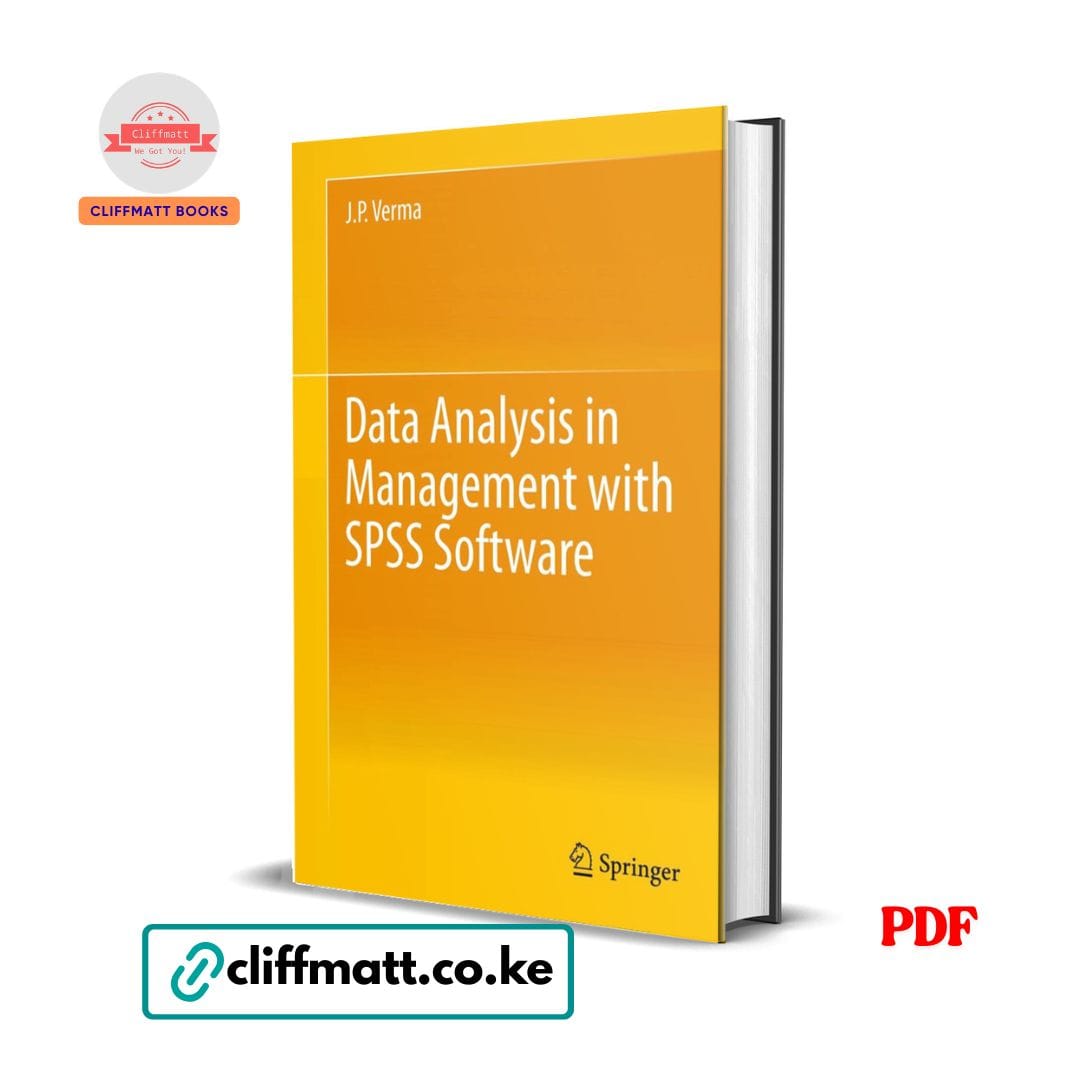
Data Analysis in Management with SPSS Software by J.P. Verma — published by Springer, one of the world’s most rigorous and most respected academic publishers — is the definitive guide to SPSS for management research. It is the book that Kenyan MBA students, business school faculty, management consultants, and organisational researchers have needed — a Springer-quality academic treatment of statistical analysis that never loses sight of the specific management research context in which every technique is being applied.
This is the third SPSS title in your catalogue — and it occupies a distinct and essential niche that your other SPSS resources do not: the management and business research context specifically, at the highest academic level available.
What This Book Covers:
Foundations — Research Design and Data Management for Management Research:
- The specific research designs most commonly used in management and business research — survey-based cross-sectional studies, longitudinal studies, experimental and quasi-experimental designs, and case study research — and the specific statistical approaches appropriate to each
- Measurement scales in management research — nominal, ordinal, interval, and ratio data; how the measurement level of your variables determines which statistical tests are appropriate and which are not; the specific measurement decisions in survey design that determine your analytical options before data collection begins
- Data entry, data cleaning, and data transformation in SPSS — the specific procedures for preparing management research data for analysis; handling missing data, recoding variables, computing new variables, and the data management operations that every management researcher performs before any analysis begins
- Sampling and sample size in management research — the specific statistical considerations that determine whether your sample is adequate for the analyses you plan; how to assess sample adequacy and how to address inadequacy before it undermines your research conclusions
- Reliability and validity in management research — the specific statistical procedures (Cronbach’s alpha, factor analysis, convergent validity, discriminant validity) that establish whether your measurement instruments are measuring what they claim to measure; essential for every management researcher using Likert-scale surveys
Descriptive Statistics and Data Exploration:
- Frequency distributions and descriptive statistics — generating and interpreting the foundational summary statistics (means, standard deviations, frequencies, percentages) that describe your management research sample and your key variables
- Graphical data exploration — using SPSS charts and graphs to identify patterns, outliers, and distributional characteristics in management data before formal statistical analysis begins
- Normality testing — the specific SPSS procedures (Kolmogorov-Smirnov, Shapiro-Wilk, P-P plots, Q-Q plots, histograms, skewness and kurtosis statistics) for assessing whether your data meets the distributional assumptions of parametric statistical tests
- Outlier detection and management — how to identify extreme values in management data, how to evaluate whether they represent genuine observations or data entry errors, and the specific SPSS procedures for handling them appropriately
- Cross-tabulation and chi-square — describing the relationship between categorical variables in management data; how to produce, interpret, and report crosstab tables and chi-square statistics in management research publications
Comparing Means — Group Difference Analysis:
- Independent samples t-test — comparing mean scores between two independent groups; the specific management research applications (comparing performance between departments, comparing attitudes between demographic groups, comparing outcomes between treatment and control conditions)
- Paired samples t-test — comparing means within the same group at two time points; the specific management research applications (pre-post training evaluations, before-after intervention studies, test-retest reliability assessments)
- One-way ANOVA — comparing means across three or more independent groups; the specific management research applications (comparing performance across divisions, comparing satisfaction across job categories, comparing outcomes across intervention conditions)
- Post-hoc tests — identifying which specific group pairs differ following a significant ANOVA result; Tukey HSD, Bonferroni, and Scheffé post-hoc procedures and their appropriate management research applications
- Two-way ANOVA — testing the effects of two categorical independent variables and their interaction on a continuous dependent variable; the specific management research designs that require two-way ANOVA and how to interpret interaction effects
- ANCOVA — analysis of covariance; how to statistically control for confounding variables in group comparison studies; the specific management research applications where controlling for covariates is essential for valid conclusions
- MANOVA — multivariate analysis of variance; testing group differences on multiple dependent variables simultaneously; the specific management research applications and the specific advantages of MANOVA over multiple separate ANOVAs
- Non-parametric alternatives — Mann-Whitney U, Kruskal-Wallis, Wilcoxon Signed-Ranks, and Friedman tests; when to use non-parametric approaches in management research and how to execute and report them in SPSS
Correlation and Regression — Relationship Analysis:
- Pearson correlation — measuring the strength and direction of linear relationships between continuous variables; the foundational relationship analysis in virtually every management research study; how to produce, interpret, and report a correlation matrix
- Spearman’s rho and Kendall’s tau — non-parametric correlation for ordinal data or data that violates normality assumptions; the specific management research situations that require non-parametric correlation
- Partial correlation — measuring the relationship between two variables while statistically controlling for a third; how partial correlation is used in management research to isolate the specific relationship of interest from confounding variables
- Simple linear regression — modelling the linear relationship between one predictor and one outcome variable; the specific SPSS output (R², F-statistic, regression coefficients, standard errors, t-statistics) and how to interpret and report each element
- Multiple linear regression — the most widely used analytical technique in management research; modelling the relationship between multiple predictors and a single outcome variable; the specific regression approaches (simultaneous, hierarchical, stepwise) and when to use each; assumptions testing (multicollinearity, homoscedasticity, normality of residuals, independence) and how to assess each in SPSS; interpreting and reporting standardised and unstandardised coefficients, R², adjusted R², and the F-test
- Moderation analysis — testing whether the relationship between a predictor and an outcome variable differs across levels of a third variable (the moderator); how to set up and run moderation analysis in SPSS; how to interpret and plot interaction terms; the specific management research questions that require moderation analysis
- Mediation analysis — testing whether the relationship between a predictor and an outcome variable is transmitted through an intermediate variable (the mediator); the Baron and Kenny approach and the more contemporary bootstrapping approach; how to conduct mediation analysis in SPSS and how to report indirect effects
- Logistic regression — modelling binary outcome variables in management research; the specific SPSS procedures, the interpretation of odds ratios, and the reporting conventions for logistic regression results in management journals
Factor Analysis — Scale Development and Validation:
- Exploratory Factor Analysis (EFA) — identifying the underlying factor structure of a set of observed variables; the specific management research application to scale development and questionnaire validation; how to determine the appropriate number of factors (eigenvalue criterion, scree plot, parallel analysis); rotation methods (varimax, oblimin) and when to use each; factor loadings, communalities, and the specific criteria for interpreting EFA results
- Confirmatory Factor Analysis (CFA) — testing a hypothesised factor structure against observed data; how to conduct CFA in SPSS Amos or through alternative approaches; fit indices (CFI, RMSEA, SRMR, chi-square) and the specific benchmarks that indicate acceptable model fit in management research
- Reliability analysis — Cronbach’s alpha as the standard measure of internal consistency for Likert-scale instruments; how to assess and improve scale reliability; item-total correlations and item deletion decisions; the specific reliability reporting conventions of management research journals
- Validity assessment — content validity, construct validity (convergent and discriminant), and criterion validity; the specific statistical procedures that establish each type of validity for management research instruments
Advanced Techniques for Management Research:
- Cluster analysis — identifying natural groupings or market segments in management data; hierarchical and k-means clustering approaches; how to determine the appropriate number of clusters; the specific management research applications (customer segmentation, employee typologies, market segmentation)
- Discriminant analysis — classifying observations into groups based on predictor variables; the management research applications and the relationship between discriminant analysis and logistic regression
- Principal Component Analysis (PCA) — data reduction for management research; how PCA differs from factor analysis and when each is appropriate; how to use PCA to create composite variables for subsequent analyses
- Structural Equation Modelling (SEM) — the most powerful analytical framework for testing complex theoretical models in management research; the conceptual foundations of SEM, the relationship between measurement models and structural models, and the SPSS Amos interface for building and testing SEM models
- Time series analysis — analysing management data that is collected over time; trend analysis, seasonal decomposition, and forecasting in SPSS; the specific management research applications in operations management, financial analysis, and marketing research
Reporting SPSS Results in Management Research:
- APA and journal-specific reporting conventions for every statistical technique covered in the book — the exact format, the exact statistics to report, and the specific tables that management journals expect
- How to write results sections for management dissertations and journal articles that accurately communicate what the analysis produced without overclaiming or underclaiming what the statistics demonstrate
- Table construction — how to build publication-ready tables in Word from SPSS output; the specific formatting conventions of the major management research journals
- Presenting statistical results to non-statistical audiences — how to communicate SPSS findings clearly in management reports, in boardroom presentations, and in policy documents where technical statistical language is inappropriate
Why Kenyan Management Researchers Are Buying This Book: Kenya’s MBA programmes, business school doctoral programmes, and management research community produce thousands of dissertations, theses, and journal submissions every year — all requiring quantitative data analysis. The specific combination of Springer’s academic rigour, Verma’s management research focus, and the SPSS execution guidance throughout every chapter makes this book uniquely valuable for Kenyan researchers at every level — from MBA students running their first regression to doctoral candidates building structural equation models.
The Springer publisher brand is among the most respected in global academic publishing — it communicates quality, rigour, and peer-reviewed authority that every Kenyan academic institution recognises.
At Ksh 100, this is Springer-level management research statistical guidance at a price every Kenyan researcher can access.
Who This Book Is For:
- MBA students at Kenyan business schools completing research dissertations that require quantitative data analysis in SPSS
- PhD and DBA candidates in management, business administration, organisational behaviour, marketing, and human resource management at Kenyan universities
- Business school faculty and research supervisors who want the most rigorous SPSS reference available for their own research and for recommending to their students
- Management consultants and organisational researchers conducting quantitative studies for Kenyan organisations and wanting the academic-level statistical guidance that professional research demands
- HR professionals, marketing researchers, and operations analysts at Kenyan corporations who use SPSS for organisational data analysis and want a comprehensive reference that goes beyond basic descriptives
- Every reader of Basic SPSS Tutorial (te Grotenhuis), SPSS Statistics for Dummies (McCormick), and How to Write a Great Research Paper (Wiley) who wants the most advanced, most management-specifically focused SPSS reference to complete their research skills library
📖 Author: J.P. Verma 🏢 Publisher: Springer 📄 Format: PDF eBook (instant download via WhatsApp or email) 💰 Price: Ksh 100 only 🚀 Delivery: Instant after M-Pesa payment confirmation
👉 Order now on cliffmatt.co.ke — Pay via M-Pesa, receive your PDF instantly.









Reviews
There are no reviews yet.