
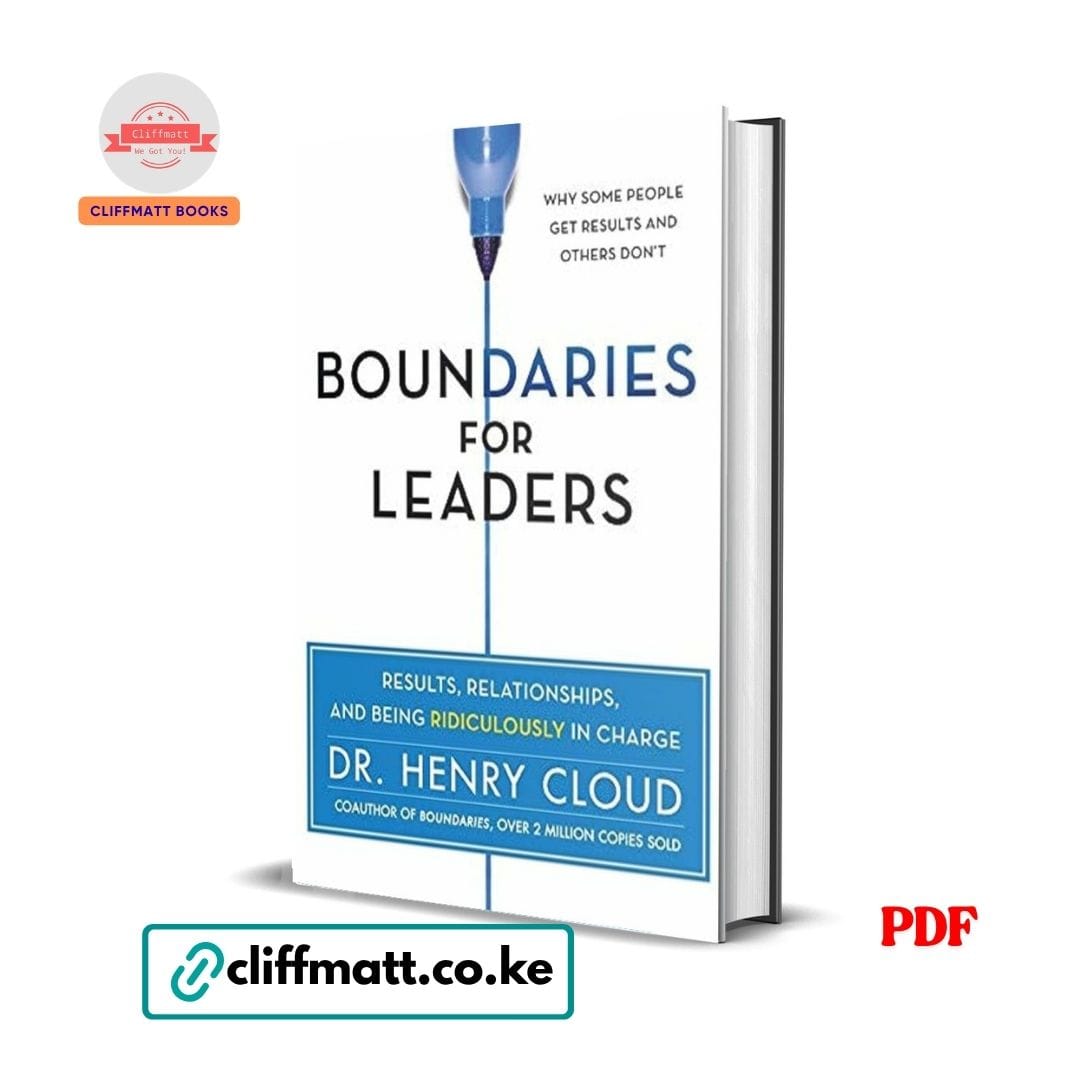
Boundaries for Leaders: Results, Relationships, and Being Ridiculously in Charge – Dr. Henry Cloud
KSh100
From the coauthor of Boundaries — over 2 million copies sold. Dr. Henry Cloud’s Boundaries for Leaders is the most practically powerful, most psychologically grounded, and most directly applicable leadership book available for every leader who wants to understand why some teams get extraordinary results and others do not — and what the leader’s specific behaviour has to do with the answer. Instant PDF for only Ksh 100.


Readers of this book also bought...
Description
Every leader wants results. Every leader wants a high-performing team, a healthy culture, and an organisation that achieves what it sets out to achieve. And most leaders, if they are honest, have experienced the specific frustration of wanting all of that and consistently getting something less — not because the vision was wrong, not because the people were unqualified, but because something in the specific way the organisation was being led was producing outcomes that leadership could not quite diagnose or fix.
Dr. Henry Cloud — co-author of Boundaries, the most widely read personal boundaries book in history with over two million copies sold — spent years working as an executive coach with the specific leaders who were experiencing exactly that frustration. And what he consistently found was that the specific gap between what their organisations could produce and what they were producing was almost always traceable to the same source: the leader’s failure to set and hold the specific boundaries that create the specific conditions for high performance.
Boundaries for Leaders: Results, Relationships, and Being Ridiculously in Charge is the book that translates the foundational insights of the Boundaries framework into the specific language of organisational leadership — applying the specific psychological wisdom of boundaries to the specific challenges of building teams, managing culture, producing results, and being genuinely, effectively, ridiculously in charge.
Why some people get results and others don’t. That is the question on the cover — and the specific, scientifically grounded, practically demonstrated answer is the content of this book.
What This Book Covers:
The Leadership Boundaries Framework — The Foundation:
- What boundaries actually mean in a leadership context — not rules, not authoritarian control, not rigidity — but the specific structure of clarity, accountability, and consequence that defines what is acceptable, what is expected, and what happens when those expectations are not met
- Why boundaries are not about the leader’s personal comfort but about the organisation’s specific performance requirements — the specific business case for the boundaries that most leaders avoid having because having them feels difficult
- The specific relationship between a leader’s internal life — their own fears, their own need for approval, their own discomfort with conflict — and the specific boundary failures that produce the specific performance problems their organisations experience
- Why leaders who avoid boundaries in the name of being liked consistently produce the specific team dysfunction, the specific accountability failures, and the specific culture problems that make them ultimately less liked — and far less effective — than the leaders who set and hold the specific boundaries that performance requires
- The neuroscience of boundaries in leadership — how the specific experience of clarity, accountability, and predictable consequence affects the brain function and the performance of the people being led; why the human brain performs better in structured, boundaried environments than in ambiguous, consequence-free ones
Boundaries That Leaders Must Set — The Specific Domains:
What You Allow in Your Culture:
- The specific mechanism by which a leader’s behaviour — what they tolerate, what they reward, what they ignore, and what they address — defines the specific culture of their organisation more powerfully than any values statement, any training programme, or any strategic initiative
- Why culture is not what a leader declares but what a leader allows — the specific daily behaviours, the specific interpersonal dynamics, and the specific performance standards that a leader consistently permits are the actual culture of the organisation, regardless of what the posters on the wall say
- The specific cultural boundaries that high-performing organisations have and underperforming organisations consistently lack — around accountability, around negativity, around the specific interpersonal behaviours that poison team dynamics and that leaders consistently fail to address because addressing them is uncomfortable
- How to diagnose the specific culture your boundaries (or lack thereof) have created — the specific questions to ask, the specific observations to make, and the specific honest assessment of what you have been permitting that the performance evidence is already answering
What You Allow Into Your Own Brain:
- The specific ways that a leader’s habitual thinking patterns — their default orientation toward problems, toward people, and toward their own limitations — produce the specific organisational outcomes they are experiencing; why changing the outcomes requires first changing the thinking
- The concept of negativity bias in leadership — how the brain’s evolutionary tendency to weight negative information more heavily than positive information produces the specific fear-based, defensive, risk-averse leadership patterns that consistently suppress organisational performance
- The specific boundaries a leader must set around their own mental inputs — what they read, what they attend to, who they listen to, and how they talk to themselves about their own performance and their organisation’s potential; why mental boundaries are the least discussed and most consequential boundaries in leadership
- How to build the specific cognitive practices — gratitude, reframing, deliberate attention direction — that produce the specific leadership mindset that generates high-performance culture
What You Allow in Your Relationships:
- The specific relational patterns that produce the specific performance outcomes in organisations — the specific triangulation, the specific avoidance, the specific conflict management failures that leaders consistently engage in that produce the specific dysfunction they are trying to solve
- Triangulation — the specific pattern of allowing two-person conflicts to be managed through a third party rather than directly; why this pattern is the single most culture-destroying interpersonal dynamic in most organisations and why leaders who permit it pay an enormous ongoing price in team dysfunction and wasted energy
- The specific boundary of direct feedback — why the leader who consistently delivers direct, honest, caring feedback to their people produces dramatically better individual and team performance than the leader who avoids difficult conversations in the name of kindness; what genuine leadership kindness actually looks like
- Energy vampires and toxic behaviours — the specific people and the specific behaviours that drain organisational energy, suppress team performance, and that leaders consistently fail to address because addressing them requires the specific boundaries most leaders have not set
What You Allow Around Focus:
- The specific boundary of organisational focus — why organisations that try to do everything consistently achieve nothing at an excellent level; how the leader’s specific inability to say no to interesting opportunities, to stakeholder requests, and to their own desire to be liked by everyone produces the specific overextension that prevents genuine excellence in any direction
- How to identify the specific highest-leverage activities in your role as a leader — the specific things that only you can do, that produce the most value, and that are most consistently displaced by the reactive, approval-seeking, boundary-free leadership that most leaders default to
- The pruning principle — the specific leadership practice of actively removing activities, initiatives, relationships, and commitments that are consuming organisational energy without producing proportionate results; why growth requires elimination as much as it requires addition
- How to build the specific decision-making boundaries that protect the specific priorities that your organisation’s performance most depends on
The Brain Science of Leadership — Why Boundaries Work:
- The specific neuroscience behind the leadership behaviours Cloud recommends — how clarity, structure, and predictable consequence affect the specific brain functions (prefrontal cortex activity, amygdala regulation, dopamine systems) that determine how effectively people think, collaborate, and perform
- The threat response — how the specific absence of clarity, the specific experience of unpredictable leadership behaviour, and the specific fear of arbitrary consequence trigger the specific neurological state that most suppresses human performance; why psychological safety is not a nice-to-have but a neurological prerequisite for the specific cognitive functions that high performance requires
- Why connection is the neurological precondition for performance — how the specific experience of being genuinely known, genuinely valued, and genuinely held accountable by a leader activates the specific brain states that produce creativity, risk-taking, and sustained effort; why the connected team consistently outperforms the fearful team
- The specific leadership behaviours that produce psychological safety without sacrificing accountability — the specific combination of genuine care and genuine clarity that the neuroscience of peak performance consistently identifies as the optimal leadership environment
Being Ridiculously in Charge — What Genuine Authority Looks Like:
- What it means to be genuinely, fully, effectively in charge — not the authoritarian control that produces compliance without commitment, but the specific quality of clear, boundaried, caring leadership that produces genuine followership and genuine performance
- Why many leaders are secretly afraid of being genuinely in charge — the specific fears (of being wrong, of being disliked, of overstepping) that produce the specific authority abdication that leaves organisations without genuine direction and genuine accountability
- The specific practices of ridiculously in charge leadership — making decisions clearly, communicating expectations specifically, holding people accountable consistently, and doing all of this within a relationship of genuine care and genuine respect that makes accountability feel safe rather than threatening
- Why the leader who is genuinely in charge is consistently more popular with high performers than the leader who avoids being in charge — because high performers consistently want to work in environments where excellence is expected, recognised, and protected from the specific mediocrity that boundary-free leadership always produces
Specific Leadership Scenarios — Practical Application:
- The underperforming team member — the specific boundary conversation that addresses performance problems directly, clearly, and early enough to produce change rather than waiting until the problem has become too large to solve without termination
- The toxic high performer — the specific and most difficult boundary challenge in most organisations; the person who produces exceptional individual results while destroying team culture; why the specific decision to hold or release this person is among the most consequential boundary decisions any leader makes
- The conflict-avoidant culture — how to diagnose the specific symptoms of a culture where direct feedback has been replaced by behind-the-back conversations, where performance problems are not addressed because they are uncomfortable to address, and what specifically changes when a leader begins to hold the specific relational boundaries that direct communication requires
- The overextended organisation — how to conduct the specific focus conversation with a board, a team, or a set of stakeholders that results in the specific strategic clarity and the specific prioritisation that turns an overextended, underperforming organisation into a focused, high-performing one
Why Kenyan Leaders Are Buying This Book: Kenya’s most effective organisations — in business, in public service, in church ministry, in NGOs, and in every community institution — are led by people who create the specific conditions for high performance. Boundaries for Leaders gives every Kenyan leader the most practically applicable, most psychologically grounded, and most immediately implementable framework for creating those conditions — through the specific boundaries that define clear expectations, that protect healthy relationships, and that hold people accountable in the specific way that produces sustained excellence rather than sustained mediocrity.
At Ksh 100, this is world-class leadership psychology from one of the most trusted and most widely read voices in the field of Christian leadership development.
Who This Book Is For:
- Kenyan organisational leaders — in business, in ministry, in public service, in NGOs — who want to understand why their organisations are not performing at the level they are capable of, and what specific leadership behaviour changes would produce different outcomes
- Managers and team leaders who want the specific psychological framework for creating high-performing teams through the specific clarity, accountability, and relationship quality that genuine boundaries produce
- Church leaders and pastors who want the specific leadership tools to build the specific culture of healthy accountability that most church organisations desperately need and most pastors have never been taught to create
- Leaders who have read Boundaries (Cloud and Townsend) in the personal context and want the specific application of the same principles to their professional leadership
- Every reader of Leaders Eat Last (Sinek), Dare to Lead (Brown), The CEO Next Door (Botelho), SOAR! (T.D. Jakes), and Just Listen (Goulston) who wants the most psychologically grounded and most practically specific leadership boundaries framework to complete their leadership library
📖 Author: Dr. Henry Cloud (coauthor of Boundaries, over 2 million copies sold) 📄 Format: PDF eBook (instant download via WhatsApp or email) 💰 Price: Ksh 100 only 🚀 Delivery: Instant after M-Pesa payment confirmation
👉 Order now on cliffmatt.co.ke — Pay via M-Pesa, receive your PDF instantly.
Related products
-

It: How Churches and Leaders Can Get It and Keep It – Craig Groeschel
KSh100 DOWNLOAD Buy via WhatsApp -

No limits – John C. Maxwell
KSh100 DOWNLOAD Buy via WhatsApp -

Dare to Lead: Brave Work. Tough Conversations. Whole Hearts- Brené Brown
KSh100 DOWNLOAD Buy via WhatsApp -

Make Today Count: The Secret of Your Success Is Determined by Your Daily Agenda – John C Maxwell
KSh100 DOWNLOAD Buy via WhatsApp










Reviews
There are no reviews yet.