
Description
Every organisation has a strategy. Most organisations do not execute theirs. The specific gap between the strategy document that leadership approves, the goals that middle management acknowledges, and the specific daily activities that actually produce results — or fail to — is one of the most consistently costly and consistently unaddressed problems in organisational life. Consultants are hired to develop strategies that are never implemented. Planning retreats produce documents that are never opened after the retreat ends. Executives announce priorities that the organisation never organises itself to actually pursue.
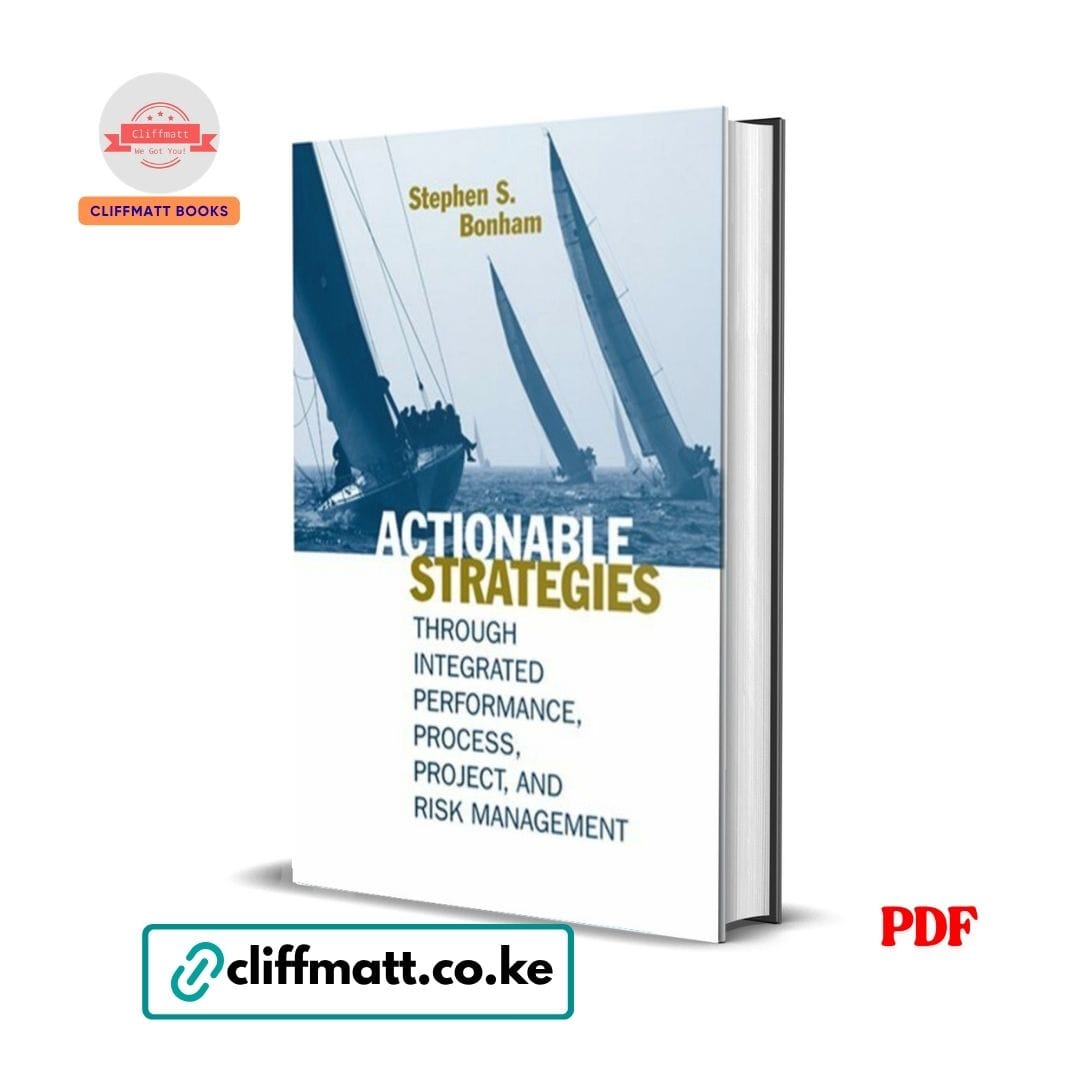
Stephen S. Bonham has spent a career studying, teaching, and solving exactly this problem — the specific gap between strategic intent and strategic execution — and in Actionable Strategies: Through Integrated Performance, Process, Project, and Risk Management, he provides the most systematically structured, the most practically applicable, and the most integration-focused framework for closing that gap available in contemporary management literature.
The title is both a description and a commitment: actionable strategies — not aspirational statements, not inspiring visions, but specific, structured, measurable, executable plans that can actually be implemented by real organisations with real constraints and real resource limitations.
What This Book Covers:
The Strategy Execution Problem — Why Most Strategies Fail:
- The specific, documented failure rate of strategy execution — the research evidence that the majority of well-designed strategies are poorly executed or not executed at all; the specific reasons that leadership consistently attributes strategy failure to external factors when the specific cause is almost always internal execution failure
- The four management disciplines that Bonham identifies as the specific components of successful strategy execution — performance management, process management, project management, and risk management — and the specific, consistently fatal error of treating each as a separate organisational function rather than an integrated system
- Why the specific integration of these four disciplines is the most important and most consistently overlooked element of successful strategy execution; how the disconnection between them produces the specific organisational fragmentation that makes strategy execution impossible regardless of the quality of the strategy itself
- The specific organisational anatomy of strategy failure — the specific decision points, the specific communication breakdowns, and the specific accountability gaps where well-designed strategies consistently collapse between intent and action
The Integrated Framework — How Actionable Strategies Work:
Performance Management — Measuring What Matters:
- The specific understanding of performance management not as the HR function of evaluating individual employees but as the organisational discipline of measuring whether the specific activities being performed are producing the specific outcomes the strategy requires
- The Balanced Scorecard framework — its specific construction (financial perspective, customer perspective, internal process perspective, and learning and growth perspective) and its specific role as the performance measurement architecture that makes strategy visible, measurable, and therefore manageable
- The specific Key Performance Indicators (KPIs) that translate high-level strategic goals into the specific, measurable, time-bound performance targets that operational teams can actually work toward; the specific discipline of identifying the right KPIs rather than the easily measured ones
- Strategy maps — the specific visual tool that shows how the specific performance outcomes in one perspective of the Balanced Scorecard causally connect to outcomes in other perspectives; how strategy maps make strategic logic explicit rather than assumed
- The specific failure modes of performance management — measuring the wrong things, measuring too many things, measuring without consequence, and the specific performance management theatre in which elaborate measurement systems produce no behaviour change because the specific accountability and the specific consequence for non-performance are absent
Process Management — The Operating System of Strategy:
- The specific understanding of process management as the operational dimension of strategy — the specific, repeatable, documented activities through which an organisation produces its products and services; why the specific quality of these processes determines whether the specific performance outcomes the strategy requires can actually be achieved
- Business Process Mapping — the specific tools and techniques for making organisational processes visible; the specific value stream mapping, process flow diagramming, and swimlane analysis that reveal how work actually flows through an organisation rather than how leadership believes it flows
- Process improvement methodologies — the specific application of Lean, Six Sigma, and continuous improvement principles to the specific processes that most directly affect the specific strategic outcomes the organisation is pursuing; the specific prioritisation of process improvement effort based on strategic impact rather than operational convenience
- The specific relationship between process standardisation and process flexibility — how to determine which processes should be standardised for consistency and which should be designed for adaptability; the specific mistake of over-standardising processes in domains where the strategy requires innovation and under-standardising processes where consistency is the specific competitive advantage
- How process management connects to performance management — the specific causal relationship between process quality and performance outcome; why organisations that measure outcomes without managing processes consistently produce the specific frustrating pattern of knowing their performance is inadequate without being able to change it
Project Management — Delivering Strategic Initiatives:
- The specific understanding of project management as the change-delivery dimension of strategy — the specific mechanism through which an organisation implements the specific new capabilities, the specific new processes, and the specific new products or services that its strategy requires
- The specific portfolio management approach to projects — how to ensure that the specific projects the organisation is undertaking are the specific projects that most directly advance the specific strategic priorities the organisation has declared; why most organisations waste enormous project capacity on initiatives that are disconnected from strategy
- The specific project management disciplines — scope management, schedule management, cost management, quality management, resource management, communication management, risk management, and stakeholder management — and how each connects to the specific strategic context within which the project is being executed
- The specific stage-gate framework — the specific decision points at which projects are evaluated against their strategic alignment, their resource requirements, and their risk profile before proceeding to the next stage; how stage gates prevent the specific escalating commitment to failing projects that consume enormous resources without delivering strategic value
- The specific relationship between project management maturity and strategy execution capability — why organisations that lack structured project management consistently fail to deliver the specific strategic initiatives that would close the specific performance gaps their strategy addresses
Risk Management — Protecting Strategy:
- The specific understanding of risk management not as compliance or audit function but as the strategic discipline of identifying, assessing, and managing the specific uncertainties that could prevent the specific strategy from being achieved
- The specific risk register — the specific tool for documenting, assessing, and tracking the specific risks that threaten the specific strategic objectives the organisation is pursuing; how to build one that is genuinely useful rather than the specific compliance exercise that most organisational risk registers become
- Risk assessment — the specific probability and impact analysis that prioritises the specific risks that deserve the most specific management attention; the specific quantitative and qualitative approaches to risk assessment that are appropriate for different risk categories
- Risk response strategies — the specific options (avoid, transfer, mitigate, accept) for each category of risk and the specific criteria for choosing between them; how risk responses connect to the specific project and process activities through which risks are actually managed
- The specific integration of risk management with the other three management disciplines — how performance risk, process risk, project risk, and strategic risk interact; why managing each in isolation consistently produces the specific unpleasant surprises that integrated risk management is designed to prevent
Integration — The Book’s Central Contribution:
- The specific architecture of integration — how performance management, process management, project management, and risk management connect to each other in the specific ways that Bonham documents; the specific information flows, the specific decision dependencies, and the specific governance structures that make the four disciplines work as a single system rather than four separate functions
- The Strategy Execution Framework — Bonham’s complete integrated model; how strategic goals cascade through performance targets, through process improvement priorities, through project portfolio decisions, and through risk management activities in a coherent, mutually reinforcing system
- The specific organisational structures — governance bodies, reporting rhythms, cross-functional integration roles, and the specific escalation and decision-making processes — that enable the four management disciplines to operate as an integrated system rather than separate organisational silos
- The specific implementation roadmap — how to begin building the integrated execution capability in a real organisation with real constraints; the specific sequencing, the specific quick wins, and the specific long-term capability building that transforms a strategy-executing aspiration into a strategy-executing reality
Applications — For Kenyan Organisations:
- How the integrated strategy execution framework applies to the specific institutional contexts that Kenyan organisations inhabit — the specific challenges of public sector strategy execution, of NGO programme delivery, of private sector growth strategy implementation, and of the specific hybrid organisations that populate Kenya’s development landscape
- The specific balanced scorecard adaptations for Kenyan public sector and non-profit organisations — how to construct performance frameworks that measure the specific outcomes these organisations exist to produce rather than the purely financial metrics that private sector balanced scorecards emphasise
- The specific project portfolio management applications for Kenyan organisations navigating multiple donor-funded programmes, multiple government priorities, and the specific resource constraint environment that makes prioritisation both more important and more politically difficult than in better-resourced organisational contexts
- The specific risk management applications for the Kenyan operating environment — political risk, regulatory risk, infrastructure risk, talent risk, and the specific risks that make operating in Kenya uniquely challenging and uniquely demanding of the specific integrated risk management that this book describes
Why Kenyan Organisational Leaders Are Buying This Book: Kenya’s most ambitious organisations — in the private sector, in government, in NGOs, and in the growing institutional landscape of a rapidly developing nation — consistently articulate strategies they consistently fail to execute. The specific gap between Vision 2030, between county development plans, between corporate strategic plans, and the specific daily activities that either advance or undermine those plans is precisely the gap that Actionable Strategies is designed to close. Every Kenyan leader who has experienced the specific frustration of a well-designed strategy failing in execution will find in this book the most systematically structured and most practically applicable framework for preventing that failure.
At Ksh 100, this is world-class strategic management expertise at a price every Kenyan organisation and every Kenyan professional can access.
Who This Book Is For:
- Kenyan senior executives and strategic leaders who want the most integrated and most practically structured strategy execution framework available to move their organisations from strategic intent to strategic delivery
- Kenyan middle managers who are responsible for implementing strategies they did not design and who want the specific tools for connecting their operational activities to the strategic priorities they are meant to serve
- Public sector managers and county government officials who want the specific framework for moving from strategic planning documents to measurable service delivery outcomes
- NGO programme managers and development sector professionals who want the most structured approach to integrated performance, process, project, and risk management for complex multi-stakeholder programmes
- MBA students and management professionals at Kenyan universities and business schools who want the most comprehensively integrated strategy execution textbook available
- Every reader of 100+ Management Models (Fischler), Built to Last (Collins), The CEO Next Door (Botelho), and Leaders Eat Last (Sinek) who wants the most operationally specific and most technically rigorous strategy execution framework to complete their management library
📖 Author: Stephen S. Bonham 📄 Format: PDF eBook (instant download via WhatsApp or email) 💰 Price: Ksh 100 only 🚀 Delivery: Instant after M-Pesa payment confirmation
👉 Order now on cliffmatt.co.ke — Pay via M-Pesa, receive your PDF instantly.













Reviews
There are no reviews yet.