


Description
The human mind is the most complex, most extraordinary, and most consequential object in the known universe. It perceives reality, stores experience, constructs language, solves problems, makes decisions, and generates the entire subjective inner world that every human being inhabits from birth to death. Understanding how it does all of this — the specific processes, the specific mechanisms, and the specific methodological tools that cognitive science has developed to study them — is not merely an academic exercise.
It is the foundation of every field that works with human beings.
Psychology. Counselling. Education. Nursing. Medicine. Social work. Organisational management. Human-computer interaction. Artificial intelligence. Every discipline that takes human cognition seriously depends on the specific theoretical frameworks, the specific research findings, and the specific methodological rigour that cognitive psychology provides.
Cognitive Psychology: Theory, Process, and Methodology (Second Edition) by Dawn M. McBride of Illinois State University and J. Cooper Cutting — published by SAGE Publications, one of the world’s most respected academic publishers — is the most student-friendly, most research-current, and most methodologically comprehensive undergraduate cognitive psychology textbook available. Updated in its second edition to incorporate the most recent research developments in the field, it gives every Kenyan psychology student the complete theoretical and methodological foundation they need to understand, evaluate, and apply cognitive psychological research across every professional context they will encounter.
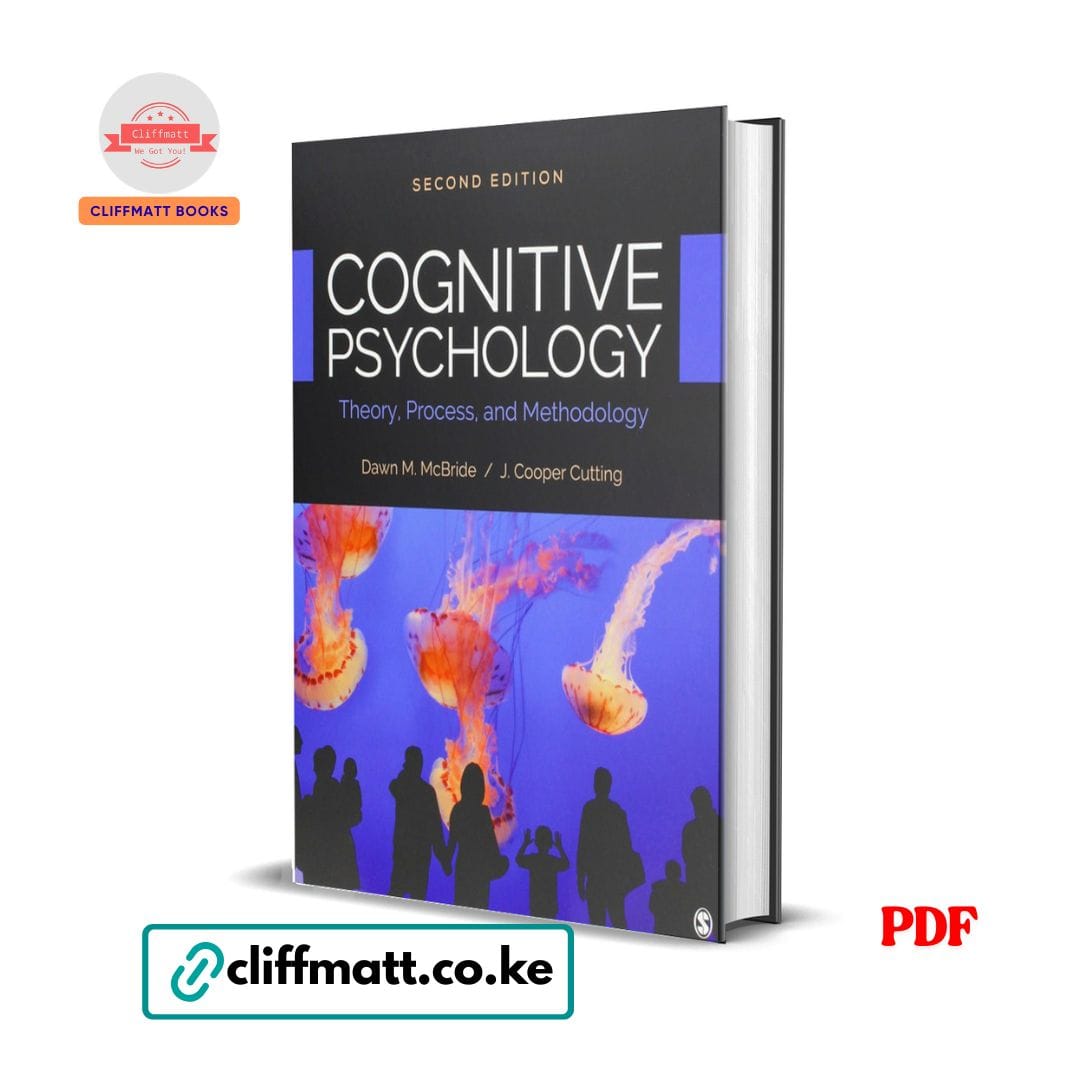
The cover communicates the book’s central question with striking visual elegance — silhouetted human figures gazing upward at luminous, translucent jellyfish suspended in deep blue water; the image of human beings confronting something beautiful, complex, and incompletely understood. That is exactly what cognitive psychology is: the disciplined scientific attempt to understand the beautiful, complex, and still incompletely understood processes of the human mind.
What This Textbook Covers:
Foundations of Cognitive Psychology:
- The history of cognitive psychology — from the behaviourist rejection of mental processes, through the cognitive revolution of the 1950s and 1960s, to the contemporary cognitive neuroscience that integrates psychological and neurological levels of explanation
- Research methods in cognitive psychology — the experimental, quasi-experimental, and correlational approaches that cognitive researchers use to study processes that cannot be directly observed, with specific attention to the methodological rigour that distinguishes valid cognitive research from mere speculation
- Reaction time methodology, signal detection theory, and the specific measurement approaches that cognitive psychology has developed to make the invisible processes of the mind empirically tractable
- Cognitive neuroscience methods — neuroimaging techniques (fMRI, PET, EEG, TMS), lesion studies, and single-cell recording; how each method contributes differently to our understanding of the neural basis of cognitive processes
- The information processing framework — the foundational metaphor of the mind as a system that takes in, processes, stores, and outputs information; its strengths, its limitations, and its continuing influence on cognitive research
- Connectionist and embodied cognition approaches — the major theoretical alternatives to the classical information processing framework and what they contribute to a more complete understanding of how minds actually work
Perception and Attention:
- Visual perception — the journey from photons striking the retina to the rich, meaningful visual experience of a three-dimensional world; the specific processes of feature detection, object recognition, and scene perception that make visual experience possible
- Pattern recognition — template matching, feature analysis, and prototype theories; how the mind recognises familiar objects, faces, words, and patterns with a speed and accuracy that no artificial system has yet replicated
- Attention — the cognitive bottleneck that determines which of the overwhelming flood of sensory information reaches conscious processing; selective attention, divided attention, sustained attention, and the specific limitations of the human attentional system
- Early versus late selection models of attention — the specific theoretical debate about where in the processing stream attention filters occur, and what the evidence from dichotic listening studies, visual search tasks, and neuroimaging reveals
- Automatic versus controlled processing — the distinction between the fast, effortless, unconscious processing of familiar stimuli and the slow, effortful, conscious processing of novel or complex ones; its implications for learning, skill acquisition, and the design of safe human-machine interfaces
- Inattentional blindness, change blindness, and the limits of visual awareness — the specific phenomena that reveal just how much of the visual world goes unprocessed even when our eyes are open and apparently looking
Memory — The Architecture of Experience:
- Sensory memory — iconic and echoic storage; the specific capacity and duration limitations that determine what reaches short-term memory from the initial sensory registration
- Short-term and working memory — Miller’s magical number seven, the phonological loop, the visuospatial sketchpad, the central executive, and the episodic buffer; Baddeley’s working memory model in its most current form and its implications for understanding learning, reading, and cognitive load
- Long-term memory — the distinction between explicit (declarative) and implicit (non-declarative) memory; episodic, semantic, and procedural memory; the specific neural systems that support each memory type and the specific conditions that produce each type of memory failure
- Encoding — levels of processing, elaborative rehearsal, encoding specificity, and the specific study strategies that produce durable, retrievable memories; direct implications for how Kenyan students should approach their study practices
- Retrieval — recall versus recognition, the tip-of-the-tongue phenomenon, retrieval cues, context-dependent and state-dependent memory; why the conditions of retrieval matter as much as the conditions of encoding
- Forgetting — decay theory, interference theory, retrieval failure, motivated forgetting, and the specific conditions that produce the most severe memory loss; practical implications for understanding both everyday forgetting and clinical amnesia
- False memories — the misinformation effect, source monitoring errors, and the constructive nature of memory; why eyewitness testimony is far less reliable than courts and juries have historically assumed, with specific implications for Kenya’s legal and criminal justice system
- Memory in everyday life — prospective memory, autobiographical memory, flashbulb memories, and the specific ways that emotional arousal, stress, and trauma affect what is remembered and how
Language and Cognition:
- Language structure — phonology, morphology, syntax, semantics, and pragmatics; the multiple levels at which language is simultaneously structured and how the cognitive system processes each level in real time
- Language comprehension — word recognition, sentence parsing, discourse comprehension, and the specific cognitive processes that allow a fluent reader or listener to extract meaning from the stream of speech or text with remarkable speed and accuracy
- Language production — lexical access, syntactic encoding, phonological encoding, and the specific stages of the production process that can be disrupted to produce the speech errors, tip-of-the-tongue states, and fluency failures that reveal the architecture beneath fluent speech
- Bilingualism and language processing — how knowing more than one language affects cognitive processing; of particular relevance to Kenyan students who navigate multiple languages (English, Kiswahili, and various mother tongues) in their daily cognitive and academic lives
- Language and thought — the Sapir-Whorf hypothesis and the evidence for and against the claim that the language you speak shapes the thoughts you can think; the specific research findings on colour perception, spatial reasoning, and numerical cognition that bear on this question
Problem Solving, Reasoning, and Decision Making:
- Problem solving — problem space theory, means-ends analysis, analogical problem solving, and the specific mental representations and search strategies that distinguish effective problem solvers from ineffective ones
- Insight and creativity — the specific cognitive processes underlying the “aha” moment of sudden problem solution; why incubation works, why set effects impede creative problem solving, and how cognitive flexibility enables creative thinking
- Deductive reasoning — syllogistic reasoning, conditional reasoning, and the specific systematic errors that human reasoners make when formal logic conflicts with intuitive plausibility
- Inductive reasoning — the processes by which we go from specific observations to general conclusions; the specific biases — confirmation bias, availability heuristic, representativeness heuristic — that consistently distort human inductive reasoning
- Decision making under uncertainty — Kahneman and Tversky’s prospect theory, the framing effect, the sunk cost fallacy, and the specific ways that human decision making systematically departs from the predictions of rational choice theory; directly relevant to financial decisions, medical decisions, and every high-stakes choice that Kenyan professionals and organisations make
- Judgement and heuristics — the fast-and-frugal heuristics that allow humans to make reasonable decisions quickly under uncertainty, and the conditions under which those same heuristics produce systematic, predictable errors
Knowledge Representation and Expertise:
- Concepts and categories — how the mind organises knowledge into categories; prototype theory, exemplar theory, and theory-based categorisation; the specific ways that categorical knowledge shapes perception, memory, and reasoning
- Schemas, scripts, and mental models — the organised knowledge structures that shape how we interpret new experiences, what we remember from them, and how we reason about familiar domains
- Semantic memory and conceptual knowledge — how factual knowledge about the world is stored, organised, and retrieved; the specific neural organisation of semantic knowledge and what neurological disorders reveal about that organisation
- Expertise — what distinguishes expert from novice performance; chunking, pattern recognition, procedural knowledge, and the specific learning processes through which novices become experts; directly relevant to professional development in every Kenyan field
- Mental imagery — the cognitive processes underlying the ability to see with the mind’s eye; mental rotation, image scanning, and the debate about whether mental images are picture-like or propositional representations
Consciousness, Metacognition, and Applied Cognitive Psychology:
- Consciousness — the hard problem, the easy problems, and the specific cognitive neuroscience research that bears on the relationship between neural processes and conscious experience
- Metacognition — knowing what you know and don’t know; monitoring and control of cognitive processes; the specific metacognitive skills that distinguish effective from ineffective learners and that can be explicitly taught and developed
- Applied cognitive psychology — how cognitive psychological research findings apply to education, clinical practice, human factors engineering, legal testimony, and the design of information systems; the specific translation from laboratory finding to real-world application that makes cognitive psychology practically valuable
- Cognitive development — how cognitive processes change across the lifespan; Piagetian and information-processing approaches to cognitive development; the specific implications for educational practice at every level of the Kenyan education system
- Cognitive neuroscience of learning and memory — what neuroimaging studies of students actually learning reveal about the neural basis of effective study strategies; the specific sleep, spacing, and retrieval practice findings that every Kenyan student should know
Why Kenyan Students Are Buying This Textbook:
Psychology is one of Kenya’s fastest-growing university disciplines. The University of Nairobi, Kenyatta University, Moi University, Strathmore, and Kenya’s growing private university sector all offer psychology programmes — and cognitive psychology is a core unit in virtually every undergraduate psychology curriculum. Beyond psychology programmes, cognitive psychology content is directly relevant to counselling, education, nursing, social work, and every other discipline that engages with how human beings think, learn, remember, and decide.
A SAGE Publications textbook of this quality would cost Ksh 5,000–15,000 in physical form if available at all in Kenya. As a PDF eBook at Ksh 100, it is the most accessible, most affordable, and most immediately useful cognitive psychology course resource available to any Kenyan student.
Who This Book Is For:
- Undergraduate psychology students at Kenyan universities for whom cognitive psychology is a required or elective course unit
- Counselling and clinical psychology students who need the cognitive theoretical foundation beneath evidence-based therapeutic approaches including CBT, ACT, and schema therapy
- Education students and practising teachers who want the cognitive science foundation that underlies effective pedagogy, assessment design, and learning environment creation
- Nursing and healthcare students who want the cognitive psychology framework for understanding patient communication, health behaviour, clinical decision making, and the cognitive demands of healthcare work
- Postgraduate psychology and counselling students who need a comprehensive cognitive psychology reference to inform their research and clinical practice
- Researchers and academics in Kenyan universities who want the most current undergraduate-level cognitive psychology text to inform their teaching and recommend to their students
- Every reader of Educating People to Be Emotionally Intelligent (Bar-On et al.), Raising an Emotionally Intelligent Child (Gottman), The Yes Brain (Siegel), and How to Memorize Anything who wants the academic cognitive psychology foundation that explains the science beneath those more accessible titles
📖 Authors: Dawn M. McBride & J. Cooper Cutting | Publisher: SAGE Publications | Edition: Second Edition 📄 Format: PDF eBook (instant download via WhatsApp or email) 💰 Price: Ksh 100 only 🚀 Delivery: Instant after M-Pesa payment confirmation 👉 Order now on cliffmatt.co.ke — Pay via M-Pesa, receive your PDF instantly.













Reviews
There are no reviews yet.