

Description
Academic performance. Career success. Leadership effectiveness. Mental health. Relationship quality. Parenting outcomes. Organisational productivity. Community resilience. The research on every single one of these domains points to the same conclusion: the single most consistent predictor of success across all of them is not IQ, not technical skill, and not socioeconomic background. It is emotional intelligence — the specific set of capacities that allow human beings to recognise, understand, manage, and effectively use emotions in themselves and in their relationships with others.
The question that every educator, every counsellor, every parent, every organisational leader, and every policy-maker needs to answer is not whether emotional intelligence matters. That question has been settled by decades of rigorous research. The question is: how do you teach it?
Educating People to Be Emotionally Intelligent — edited by Dr. Reuven Bar-On, one of the pioneers of emotional intelligence theory and the creator of the EQ-i assessment; Professor J.G. Maree of the University of Pretoria, one of Africa’s foremost educational psychologists; and Professor Maurice Jesse Elias of Rutgers University, a global leader in social and emotional learning — is the most complete, most research-grounded, and most practically structured answer to that question ever assembled in a single volume.
Drawing on contributions from leading researchers, practitioners, and educators across multiple continents and disciplines, this book brings together the cutting edge of emotional intelligence education in a form that is simultaneously academically rigorous and directly applicable to the classrooms, counselling rooms, leadership programmes, and family environments where EI development actually happens.
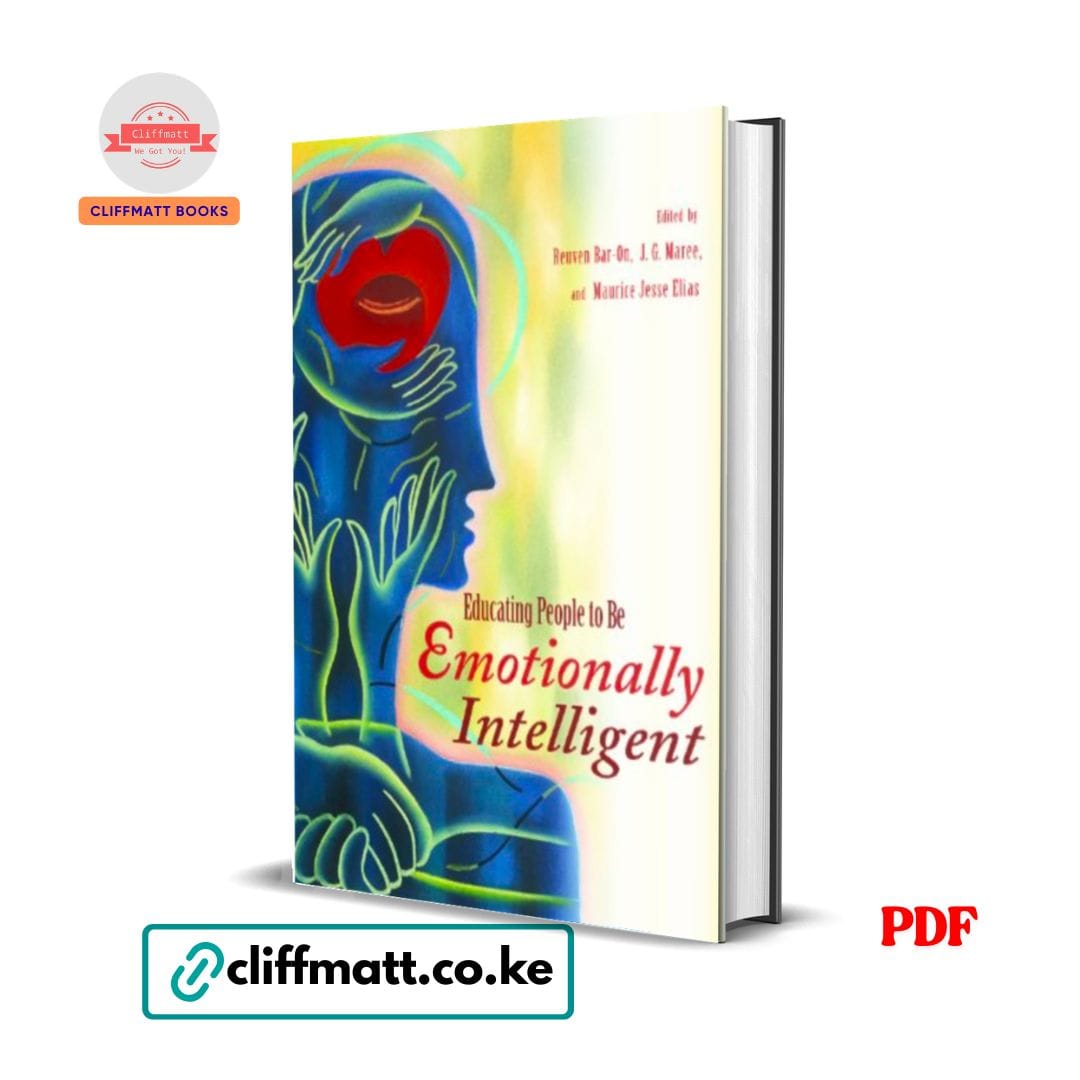
The cover — a luminous illustration of a human profile with a glowing heart at its centre, surrounded by reaching hands — is the perfect visual statement of this book’s argument: that the heart — the emotional, relational, empathic core of every human being — is not separate from the mind but its most important partner, and that education that ignores this partnership is incomplete regardless of how technically excellent it is.
What This Book Covers:
Theoretical Foundations — Understanding Emotional Intelligence:
- The major models of emotional intelligence — Bar-On’s EQ-i model, the Mayer-Salovey-Caruso ability model, Goleman’s competency framework — compared, contrasted, and evaluated for their respective strengths and educational implications
- The neuroscience of emotional intelligence — how the brain processes emotional information, how that processing interacts with cognitive functioning, and what the neuroscientific evidence tells us about the teachability and developmental trajectory of EI across the lifespan
- Why emotional intelligence is distinct from personality, from IQ, and from general social skill — the specific definitional clarity that separates EI from the vague “soft skills” category and establishes it as a measurable, developable, evidence-based construct
- The Bar-On model in detail — the five composite scales (intrapersonal, interpersonal, stress management, adaptability, and general mood) and fifteen subscales that constitute the most widely used EI assessment framework in the world, and their specific relevance to educational and developmental contexts
Measuring Emotional Intelligence:
- The major EI assessment instruments — EQ-i, MSCEIT, SEIS, and others — their respective theoretical bases, psychometric properties, and appropriate uses in educational, clinical, and organisational contexts
- How to assess EI in children, adolescents, and adults — the developmental considerations that determine which instruments are appropriate at which life stages
- Using EI assessment data to design targeted development programmes — the specific link between measurement and intervention that transforms assessment from a labelling exercise into a genuine developmental tool
- The ethical considerations in EI assessment — the specific precautions that responsible practitioners take to ensure that EI measurement is used to support development rather than to sort, rank, or limit individuals
Teaching Emotional Intelligence in Schools:
- Social and Emotional Learning (SEL) — the evidence base, the major programme frameworks, and the specific implementation strategies that have produced the most consistent, most durable EI development outcomes in school settings internationally
- Curriculum integration versus standalone EI programmes — the research on which approach produces more sustainable outcomes and the specific conditions that determine which is most appropriate for a given school context
- Teaching EI to young children — the developmentally appropriate approaches for early childhood and primary school settings, where the foundations of emotional self-awareness, empathy, and regulation are established
- Teaching EI to adolescents — the specific developmental challenges of the teenage years that make EI development both more difficult and more urgently important, and the programme approaches that navigate those challenges most effectively
- The role of the teacher as emotional model — why the most important EI intervention in any classroom is the emotional intelligence of the teacher themselves, and what that means for teacher training and professional development
- Whole-school EI cultures — how to build an institutional environment where emotional intelligence is modelled, valued, and developed at every level from leadership to classroom to playground
Emotional Intelligence in Higher Education and Professional Training:
- Why university and professional training environments have historically neglected EI — and the specific evidence for why that neglect is producing graduates and professionals who are technically competent but relationally and emotionally underprepared for the complexity of modern professional life
- EI in medical and healthcare education — of direct relevance to Kenyan nursing, medical, and allied health training programmes; the specific EI competencies that predict clinical effectiveness, patient satisfaction, team functioning, and professional resilience in healthcare settings
- EI in teacher education — how to develop the emotional intelligence of educators themselves so that they can model and teach it authentically
- EI in leadership and management development — the specific EI competencies most predictive of leadership effectiveness, and the programme approaches that develop them in corporate, government, and non-profit contexts
- EI in counselling and psychotherapy training — how emotional self-awareness, empathy, and regulation are the specific therapeutic skills that all effective helping relationships require, and how to develop them systematically rather than assuming they will emerge through general clinical experience
Emotional Intelligence in Families and Communities:
- Parenting and EI — how parents’ emotional intelligence shapes children’s EI development, and what parents can do deliberately to support their children’s emotional learning at every developmental stage
- Family systems and EI — how the emotional climate of a family — the degree to which emotions are named, discussed, validated, and regulated rather than suppressed, dismissed, or weaponised — is the primary EI learning environment for every child
- Community-level EI development — how entire communities can build the collective emotional intelligence that produces social cohesion, conflict resolution, and community resilience; of particular relevance to Kenya’s community development and peacebuilding contexts
- Cultural considerations in EI education — how different cultural contexts — including specifically African cultural contexts — both support and challenge EI development, and how EI programmes must be culturally adapted to be genuinely effective
Emotional Intelligence and Mental Health:
- The relationship between EI and psychological wellbeing — the specific evidence that higher emotional intelligence predicts lower rates of depression, anxiety, and stress-related illness across populations
- EI as a protective factor — how EI skills buffer individuals against the psychological impact of adversity, trauma, and chronic stress; directly relevant to the Kenyan context of significant community-level adversity and limited mental health resources
- EI in counselling and therapeutic contexts — how EI frameworks inform assessment, case conceptualisation, and therapeutic intervention in ways that complement and enhance established clinical approaches
- School counsellors and EI — how school-based counselling professionals can use EI frameworks to identify students at risk, design targeted interventions, and build the school-wide emotional climate that supports all students’ development
Emotional Intelligence in African Contexts:
- The specific relevance of EI research and education to African educational, organisational, and community development contexts — how Ubuntu philosophy, communal identity frameworks, and African relational values both align with and extend the Western EI literature
- South African contributions to EI research — J.G. Maree’s own extensive research in African educational contexts provides the volume with a specifically African research perspective that is largely absent from most EI literature
- How Kenyan educators, counsellors, and organisational leaders can adapt the programme frameworks in this volume to the specific cultural, institutional, and resource contexts of Kenya’s education system, healthcare sector, and business environment
Research Directions and Future Applications:
- The frontiers of EI research — the specific questions that the field’s leading researchers are currently pursuing and what their answers are likely to mean for EI education practice
- Technology and EI development — how digital and online learning environments can support EI development, and what the specific limitations of technology-mediated EI education are
- Policy implications — what governments, education ministries, and international development organisations need to understand about EI education to make informed investment and policy decisions
Why Kenyan Professionals Are Buying This Book:
Kenya’s education system, healthcare sector, corporate environment, and community development landscape are all grappling with the same fundamental challenge: developing human beings who are not only technically capable but emotionally equipped for the complexity, the relational demands, and the adversity that every significant professional and personal role in Kenya requires.
For Kenyan teachers, school counsellors, educational psychologists, nurses, doctors, social workers, HR professionals, organisational leaders, parents, and anyone working in community development — this book provides the most complete, most research-grounded, and most practically applicable EI education resource available at any price.
At Ksh 100, it is the most affordable professional development investment available to any Kenyan practitioner who understands that emotional intelligence is not optional — it is foundational.
Who This Book Is For:
- Kenyan teachers and school administrators who want the research-based frameworks to implement genuine SEL programmes in their classrooms and institutions
- School counsellors and educational psychologists who want the most comprehensive academic EI resource available to inform their practice
- Nurses, doctors, clinical officers, and healthcare educators for whom emotional intelligence is a direct clinical competency — patient communication, team dynamics, professional resilience — and not merely a personal development topic
- HR managers, organisational development professionals, and leadership coaches who want the academic foundation beneath every EI-based corporate training programme
- University lecturers in education, psychology, counselling, nursing, and social work who want the most comprehensive EI education text for their courses
- Parents who want to understand the research on how emotional intelligence develops in children and what they can do deliberately to support it
- Policy-makers, NGO leaders, and community development professionals who want the evidence base for EI-informed programming in Kenyan educational and community contexts
- Readers of Raising an Emotionally Intelligent Child (Gottman), Building Emotional Intelligence (Lantieri), The Yes Brain (Siegel), and How to Memorize Anything who want the academic and professional-level complement to those practical parenting and education titles
📖 Editors: Reuven Bar-On, J.G. Maree & Maurice Jesse Elias 📄 Format: PDF eBook (instant download via WhatsApp or email) 💰 Price: Ksh 100 only 🚀 Delivery: Instant after M-Pesa payment confirmation 👉 Order now on cliffmatt.co.ke — Pay via M-Pesa, receive your PDF instantly.











Reviews
There are no reviews yet.