


Description
There is one English grammar book that every English language teacher in the world knows by name.
Not because it is the most comprehensive grammar reference available. Not because it covers the most advanced material. But because it is the specific book that works — the specific combination of the specific clear explanation, the specific immediately applicable practice exercise, and the specific self-check answer that has produced more genuine, measurable improvement in more English learners’ grammar than any other single grammar resource ever published.
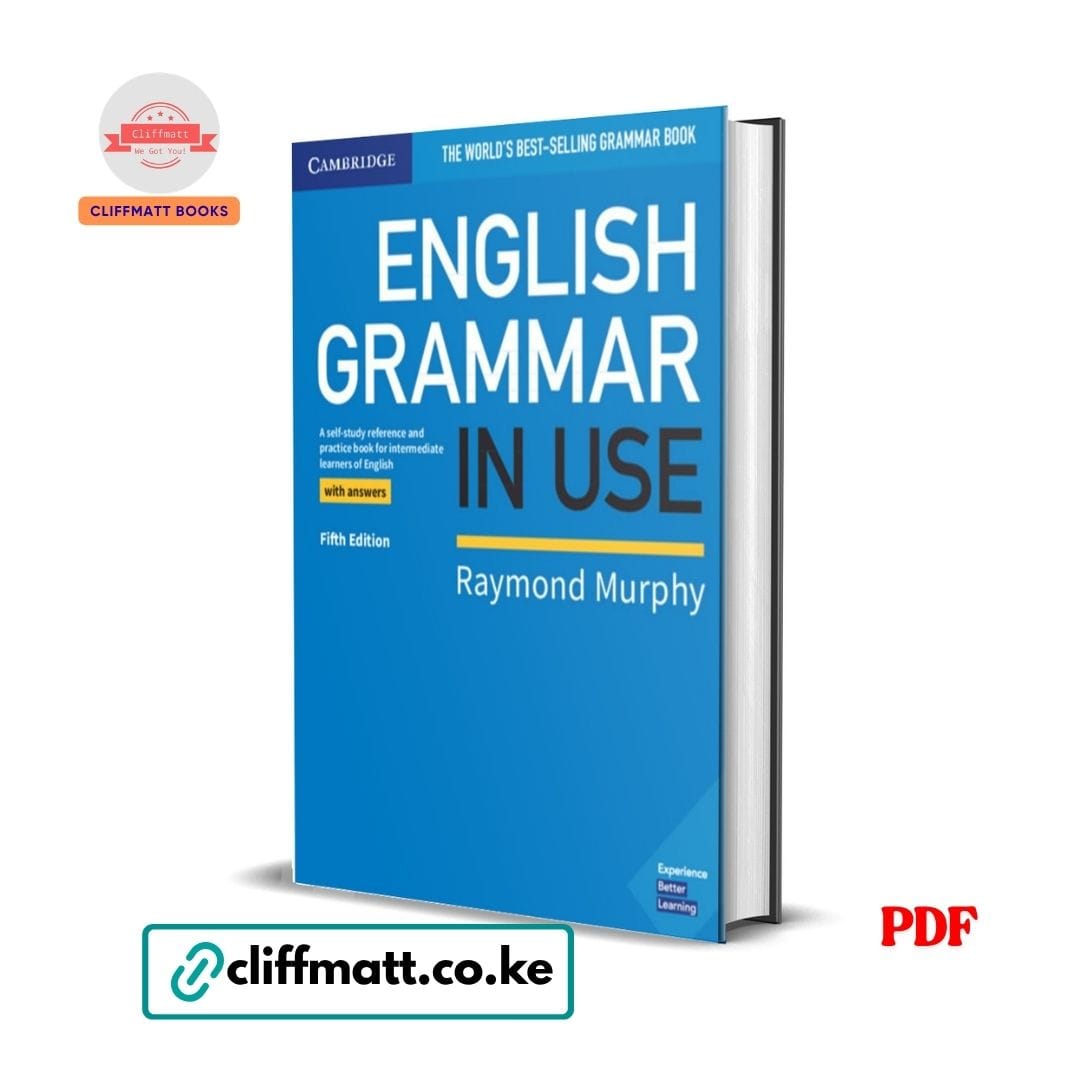
Raymond Murphy’s English Grammar in Use — The World’s Best-Selling Grammar Book; published by Cambridge University Press, the world’s most trusted academic publisher; now in its Fifth Edition; with answers included — has sold tens of millions of copies in every country where English is taught as a second or additional language. In Kenya, it is the specific grammar book that English teachers recommend, that language schools use, and that the specific self-directed Kenyan English learner who is serious about genuinely improving their grammar most consistently reaches for.
At Ksh 100, the world’s best-selling grammar book — Fifth Edition with answers — is available to every Kenyan who wants to use it.
What This Book Covers:
The Structure — How Murphy Works:
- The specific two-page unit format — the particular design that has made English Grammar in Use the most effective self-study grammar resource available: every grammar point is presented in a self-contained two-page unit; the specific left-hand page presents the specific clear explanation with the specific colour-coded examples; the specific right-hand page presents the specific practice exercises with the specific answer key at the back; why this specific format allows the specific learner to study, practise, and check their understanding of every grammar point independently, without a teacher, at their own pace, and in the specific order that their specific needs most require
- The specific intermediate level — what “intermediate” means in the context of English Grammar in Use; the particular grammar territory that intermediate covers (the specific tenses, the specific articles, the specific modals, the specific conditionals, the specific passive voice, the specific reported speech, and the specific sentence structure elements that are simultaneously the most important and the most commonly misused in the specific Kenyan learner’s English); why intermediate is the specific level where the specific most impactful grammar improvement is available for the specific majority of Kenyan English users
- The specific with-answers edition — the particular value of the specific included answer key for the specific self-directed Kenyan learner who does not have the specific access to the specific teacher’s correction that formal study provides; how the specific answer key enables the specific genuine self-assessment that the specific unanswered exercise cannot produce; why the specific Murphy with answers is the specific most practically useful edition for the specific independent Kenyan learner
The Grammar Content — Unit by Unit:
Present Tenses:
- The specific present simple — the particular uses (habitual actions, general truths, permanent states) and the specific forms (he works, she doesn’t work, does he work?); the specific common errors in Kenyan English (the specific “he is working in a bank” when “he works in a bank” is the specific correct form for a permanent situation; the specific “I am knowing” when “I know” is the specific only correct form for stative verbs); the specific exercise sets that practise the specific distinctions until they become automatic
- The specific present continuous — the particular uses (actions happening now, temporary situations, changing situations, future arrangements) and the specific forms; the specific non-continuous verbs (know, believe, want, seem, understand, remember) that the specific Kenyan learner most consistently uses incorrectly in the continuous form; the specific “I am believing” (incorrect) versus “I believe” (correct) distinction and the specific twenty-plus similar constructions the unit addresses
- The specific present perfect — the particular most complex and most consistently misused tense in Kenyan English; the specific uses (experience, recent past with present relevance, unfinished time periods) and the specific critical distinction between the present perfect and the simple past; the specific “I have seen him yesterday” (incorrect) versus “I saw him yesterday” (correct) with the specific clear rule that eliminates this specific error permanently
Past Tenses:
- The specific past simple — the particular regular and irregular verb forms; the specific question formation and negative construction; the specific use with specific past time expressions (“yesterday”, “last week”, “in 2020”) that distinguishes it from the specific present perfect
- The specific past continuous — the particular use for actions in progress at a specific past time and for background actions interrupted by another event; the specific “I was reading when he called” construction and the specific specific common errors that the specific Kenyan learner most consistently makes with this specific tense
- The specific past perfect — the particular use for the earlier of two past actions; the specific “I had finished before she arrived” construction; why the specific past perfect is the specific most under-used tense in Kenyan academic writing and how the specific Murphy units make its specific use automatic
Future Forms:
- The specific will versus going to distinction — the specific most consistently misunderstood future distinction in intermediate English; the specific “will” for the specific prediction and the specific spontaneous decision (“I’ll answer the phone”); the specific “going to” for the specific intention and the specific evidence-based prediction (“Look at those clouds — it’s going to rain”); the specific exercises that practise the specific distinction until the specific choice becomes instinctive
- The specific present continuous for future — the specific use of the present continuous for the specific fixed future arrangement (“I’m meeting him tomorrow”); why this specific use confuses the specific Kenyan learner who has been taught that the present continuous is only for the specific present moment; the specific clear explanation and the specific practice that resolves the specific confusion
- The specific future perfect and future continuous — the particular advanced future forms that the specific intermediate learner needs for the specific formal writing and the specific precise time reference that the specific intermediate-to-advanced transition requires
Modals:
- The specific modal verbs — can, could, will, would, shall, should, may, might, must, ought to, need — and their specific range of meanings (ability, permission, obligation, deduction, possibility, advice); why the specific modal system is the specific most semantically complex area of intermediate English grammar and why the specific Murphy treatment of it is the specific most clearly explained available
- The specific must versus have to distinction — the specific “must” for the specific personal obligation or the specific logical deduction (“You must be tired” — deduction; “You must study” — personal obligation from the speaker); the specific “have to” for the specific external obligation (“I have to wear a uniform at work”); the specific common errors that the specific Kenyan learner most consistently makes with these specific modals
- The specific should and ought to — the specific advice and the specific mild obligation meanings; the specific “should have done” for the specific past advice and past regret (“You should have told me” — it would have been a good idea but you didn’t); the specific exercises that practise the specific range of modal meanings in the specific authentic contexts that the specific intermediate learner most needs
The Passive Voice:
- The specific passive construction — the specific be + past participle form in all tenses (is made, was made, has been made, will be made, is being made, had been made); why the specific passive is the specific most important grammatical construction for the specific academic writing, the specific news writing, and the specific formal professional writing that the specific Kenyan intermediate learner most needs to master
- The specific active-to-passive transformation — the specific systematic practice of converting the specific active sentence to the specific passive equivalent and vice versa; the specific by-phrase and when to include or omit it; the specific passive with the specific reporting verbs (“It is said that…”, “He is believed to…”) that are the specific most commonly required passive constructions in the specific Kenyan academic writing context
Conditionals:
- The specific zero conditional — the specific general truth and the specific habitual situation (“If you heat water to 100 degrees, it boils”); the specific if-versus-when distinction in the specific zero conditional
- The specific first conditional — the specific real future possibility (“If it rains tomorrow, I will stay home”); the specific unless, provided that, as long as variations that the specific intermediate learner needs for the specific variety in their specific writing
- The specific second conditional — the specific unreal present/future situation (“If I had more money, I would travel”); the specific “I were” form (“If I were you…” — the specific only grammatically correct form that many Kenyan learners incorrectly render as “If I was you”)
- The specific third conditional — the specific unreal past situation and the specific past regret (“If I had studied harder, I would have passed”); why the specific third conditional is the specific most complex and the specific most consistently incorrectly formed conditional in Kenyan learner English; the specific extensive practice that the specific Murphy exercises provide
Articles and Nouns:
- The specific a/an/the rules — the specific complete intermediate-level treatment of the specific article system that is the specific most consistently problematic grammatical category for the specific Kenyan learner whose specific first language has no articles; the specific 8+ units dedicated to the specific article system in English Grammar in Use reflect the specific complexity of this specific area and the specific amount of practice it requires
- The specific countable and uncountable nouns — the specific which nouns are countable (chair, idea, suggestion) and which are uncountable (information, advice, furniture, news) and the specific grammatical consequences of each category; the specific “informations” (incorrect), “an advice” (incorrect), “furnitures” (incorrect) errors and the specific large number of similar errors that the specific Murphy units systematically address
- The specific noun phrases — the specific singular and plural, the specific possessives, the specific compound nouns, and the specific other noun phrase constructions that the specific intermediate English user needs for the specific precise and the specific unambiguous communication that the specific professional and academic contexts most require
Relative Clauses:
- The specific defining relative clauses — the specific “The man who called yesterday is my uncle” construction; the specific who/which/that choice; the specific relative clause with the specific preposition at the end (“the company I work for” versus “the company for which I work”)
- The specific non-defining relative clauses — the specific comma-separated relative clause that adds non-essential information (“My brother, who lives in Mombasa, is a doctor”); why the specific non-defining clause requires the specific who or which (never that) and why it must be separated from the specific main clause by the specific commas that the specific Kenyan learner most consistently omits
- The specific reduced relative clauses — the specific active participle reduction (“The man standing by the door”) and the specific passive participle reduction (“The book written by Ngũgĩ”) that the specific advanced-intermediate learner needs for the specific stylistic variety and the specific concision that the specific academic and professional writing most values
Reported Speech:
- The specific tense back-shifting in reported speech — the specific systematic change from the specific direct speech tense to the specific reported speech tense; the specific “He said he would come” (from “I will come”), the specific “She told me she had finished” (from “I have finished”), and the specific twenty-plus similar back-shifted constructions that the specific Murphy units practise exhaustively
- The specific reporting verbs — the specific “said”, “told”, “asked”, “advised”, “promised”, “warned”, and the specific other reporting verbs with their specific grammatical patterns; the specific “He advised me to study” (not “He advised me that I study”) and the specific other reporting verb construction errors that the specific Kenyan learner most consistently makes
The Answer Key — Self-Assessment Made Complete:
- The specific complete answer key — every exercise in English Grammar in Use has its specific correct answers provided in the specific back of the book; how the specific answer key enables the specific genuine self-assessment that transforms the specific exercise into the specific learning opportunity that teacher-checked work provides; why the specific “with answers” edition is the specific only edition that the specific self-directed Kenyan learner should use
Why Kenyan Learners Are Buying This Book:
Raymond Murphy’s English Grammar in Use is not a book that needs to be explained to the specific Kenyan English teacher, the specific Kenyan language learner, or the specific Kenyan professional who has ever seriously tried to improve their grammar. It is the specific book they already know is the best. It is the specific book their English teacher recommended. It is the specific book that the specific English language improvement community worldwide uses as the specific baseline against which every other grammar resource is measured. At Ksh 100, the world’s best-selling grammar book — Fifth Edition, with answers, published by Cambridge — is available to every Kenyan who wants to finally master the specific intermediate English grammar that every other aspect of their English communication depends on.
Who This Book Is For:
- Every Kenyan secondary school student who wants the specific most authoritative and most practically structured self-study grammar reference available for their specific KCSE and beyond
- Kenyan university students who want to systematically eliminate the specific intermediate-level grammar errors from their specific academic writing using the specific world’s most proven grammar practice resource
- Kenyan professionals who want to improve the specific grammar of their specific professional communication using the specific world’s most trusted grammar reference at their own pace
- Kenyan English teachers who want the specific world-standard grammar practice resource for their specific classroom or the specific most authoritative reference for their specific professional development
- Every reader of English Grammar Rules & Mistakes (Jacobs), Academic Writing: A Handbook for International Students (Bailey), and the English Grammar Workbook for Adults who wants the most universally authoritative and most thoroughly practised intermediate English grammar reference to complete their English language development library
📖 Author: Raymond Murphy
🏢 Publisher: Cambridge University Press
📄 Format: PDF eBook (instant download via WhatsApp or email)
💰 Price: Ksh 100 only
🚀 Delivery: Instant after M-Pesa payment confirmation
👉 Order now on cliffmatt.co.ke — Pay via M-Pesa, receive your PDF instantly.


Reviews
There are no reviews yet.