

Description
English is Kenya’s language of opportunity.
It is the language of the specific job interview that determines the specific career trajectory. The specific university essay that determines the specific academic outcome. The specific business proposal that determines the specific funding decision. The specific professional email that determines the specific impression. The specific public presentation that determines the specific credibility. In every domain of Kenyan professional and academic life where the specific outcome matters, the specific quality of the specific English — its grammar, its punctuation, its structure, and its freedom from the specific common errors that consistently mark writing as less than professional — is the specific most visible and the specific most consistently judged dimension of the specific communication.
Most Kenyan students and professionals know their English has weaknesses. Most have never been given the specific, clearly documented, error-by-error guide that tells them precisely where those weaknesses are and exactly what the correct alternative looks like.
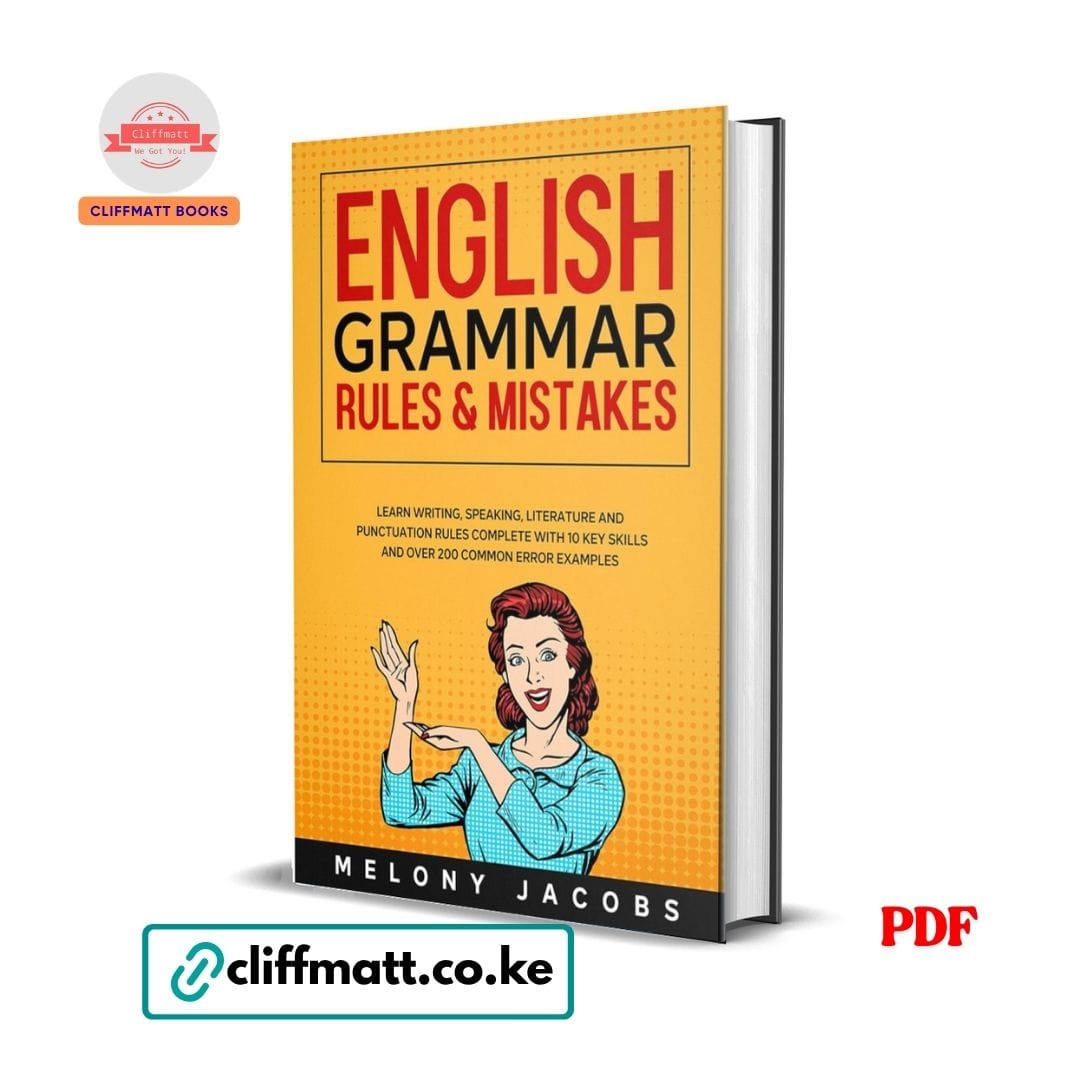
Melony Jacobs’ English Grammar Rules & Mistakes is that guide. Ten key skills. Over 200 common error examples. Writing, speaking, literature, and punctuation rules — all in one accessible, practically organised, immediately applicable reference that every Kenyan student, professional, and English learner can use from the first page.
What This Book Covers:
The 10 Key Grammar Skills — The Complete Framework:
Skill 1 — Parts of Speech:
- The specific eight parts of speech — nouns, pronouns, verbs, adjectives, adverbs, prepositions, conjunctions, and interjections — and the specific role each plays in the specific sentence; the particular common errors that the specific misidentification or misuse of each produces; why the specific professional who cannot identify a preposition is the specific professional most likely to misuse one in the specific business document that matters most
- The specific noun categories — common nouns versus proper nouns, the specific count nouns versus mass nouns, the specific concrete versus abstract nouns, and the specific collective nouns (team, committee, staff) that produce the specific most consistent subject-verb agreement errors in Kenyan professional writing; the particular specific “the staff are” versus “the staff is” distinction and how to resolve it correctly every time
- The specific pronoun errors — the specific “between you and I” (incorrect) versus “between you and me” (correct) distinction; the specific “who” versus “whom” resolution; the specific reflexive pronoun misuse (“myself will attend” is incorrect; “I will attend” is correct); and the specific pronoun-antecedent agreement errors that are among the specific most commonly made and the specific most consistently unmarked errors in Kenyan written English
Skill 2 — Sentence Structure:
- The specific sentence types — simple sentences (one independent clause), compound sentences (two independent clauses joined by a coordinating conjunction), complex sentences (an independent clause with a dependent clause), and compound-complex sentences — and the specific rules governing each; why the specific professional whose writing consists entirely of simple sentences reads as simplistic and why the specific professional whose writing consists entirely of compound-complex sentences reads as congested; how to achieve the specific variety of sentence structures that produces genuinely professional prose
- The specific fragment errors — the particular incomplete sentences that are presented as complete ones; why the specific dependent clause standing alone (“Because he was late.”) is the specific most common fragment error in Kenyan student writing; how to identify and correct every fragment type with the specific 200+ examples that the book provides
- The specific run-on sentence errors — the particular two or more independent clauses joined without the specific correct punctuation or the specific correct conjunction; the specific comma splice (the specific most commonly made run-on error: “He came, she left.” — incorrect) and how to correct it using the specific four available methods; why the specific run-on sentence is simultaneously the specific most common and the specific most consistently penalised error in Kenyan examination essays
Skill 3 — Subject-Verb Agreement:
- The specific agreement rules — the particular fundamental requirement that the specific singular subject takes the specific singular verb and the specific plural subject takes the specific plural verb; the specific common agreement errors that the specific intervening phrase between the specific subject and the specific verb most consistently produces (“The quality of the reports are poor” is incorrect — the subject is “quality”, not “reports”; “The quality of the reports is poor” is correct)
- The specific indefinite pronoun agreement — how the particular indefinite pronouns (everyone, someone, nobody, each, either, neither) are singular and require the specific singular verb despite the specific plural feel they produce in some Kenyan writers; the specific “everyone are welcome” (incorrect) versus “everyone is welcome” (correct) distinction and the specific thirty-plus similar constructions that the book documents
- The specific collective noun agreement — how the particular collective nouns (government, committee, family, team) can take either singular or plural verbs depending on the specific context; the particular Kenyan professional English convention versus the specific American convention and how to apply each correctly in the specific relevant context
Skill 4 — Tense and Aspect:
- The specific twelve English tenses — the particular present simple, present continuous, present perfect, and present perfect continuous; the past simple, past continuous, past perfect, and past perfect continuous; the future simple, future continuous, future perfect, and future perfect continuous — and the specific use and the specific form of each; the particular common tense errors in Kenyan writing (the specific mixing of present and past tense within the same narrative, the specific overuse of the present continuous for habitual actions, and the specific misuse of the past perfect) with the specific correct alternatives for each
- The specific present perfect versus simple past distinction — the specific most consistently confused tense distinction in Kenyan English; the particular “I have seen him yesterday” (incorrect — the present perfect cannot be used with specific past time expressions) versus “I saw him yesterday” (correct); why this specific error appears in the writing of the specific most educated Kenyan professionals and how the specific clear rule eliminates it
- The specific conditional tenses — the particular first conditional (real/possible future: “If it rains, I will stay home”), the second conditional (unreal present/future: “If it rained, I would stay home”), and the third conditional (unreal past: “If it had rained, I would have stayed home”) with the specific form-and-meaning explanation that makes the specific most commonly confused conditional constructions reliably correct
Skill 5 — Articles and Determiners:
- The specific article rules — the particular “a” and “an” (indefinite articles) and “the” (definite article) with the specific complete rules for their use and omission; why the specific article system is the specific most consistently error-prone grammatical category for the specific Kenyan writer whose specific first language (Kiswahili, Kikuyu, Dholuo, or any of Kenya’s other indigenous languages) has no article system; the specific 50+ article error examples and corrections that address the specific most common Kenyan article mistakes
- The specific “a” versus “an” rule — the particular rule that depends on the specific initial sound rather than the specific initial letter; “an hour” (correct — “h” is silent), “a university” (correct — “u” sounds like “you”), “an MBA” (correct — “M” sounds like “em”); the specific common exceptions that the specific particular rule produces
- The specific determiner system — the particular “this/that/these/those”, “some/any/no”, “much/many/little/few”, and the specific other determiners that the specific precise use of requires the specific precise understanding of the specific count/non-count noun distinction; the specific “much informations” (incorrect — “information” is non-count) versus “much information” (correct) distinction and the specific twenty-plus similar constructions
Skill 6 — Punctuation:
- The specific comma rules — the particular nine specific comma uses: after introductory elements, to separate items in a series, before coordinating conjunctions in compound sentences, to set off non-essential information, after transitional expressions, in direct address, in dates and addresses, to separate coordinate adjectives, and in quotations; with the specific 30+ comma error examples that the specific most common Kenyan comma mistakes produce
- The specific apostrophe rules — the particular possessive apostrophe (“the manager’s decision” — singular; “the managers’ decision” — plural possessive) and the specific contraction apostrophe (“it’s” = “it is”; “its” = possessive — the specific most commonly confused pair in all of written English); why the specific “its/it’s” confusion is simultaneously the specific most common and the specific most professionally embarrassing punctuation error available
- The specific colon and semicolon rules — the particular precise uses of each mark; the specific colon (to introduce a list, a quotation, or an elaboration — and only after an independent clause); the specific semicolon (to join two closely related independent clauses without a conjunction, or to separate items in a list when those items contain commas); the specific 20+ examples showing correct and incorrect use of each
- The specific quotation mark rules — the specific direct speech punctuation, the specific block quotation format, the specific single versus double quotation marks in the specific British English convention that Kenyan English most specifically follows
Skill 7 — Common Word Errors:
- The specific homophones and confusables — the particular word pairs and groups that sound alike or look alike but mean different things and are used in different contexts; the specific “affect/effect”, “their/there/they’re”, “your/you’re”, “its/it’s”, “then/than”, “principal/principle”, “complement/compliment”, “practice/practise” (British convention), “licence/license” (British convention), and the specific thirty-plus similar pairs that produce the specific most common word-choice errors in Kenyan professional writing
- The specific preposition errors — the particular “discuss about” (incorrect — “discuss” takes a direct object, not “about”), “congratulate for” versus “congratulate on”, “different from” versus “different than”, and the specific other preposition collocations that produce consistent errors in Kenyan written and spoken English; the particular list of the specific most common Kenyan preposition errors with the specific correct alternatives
- The specific redundancy and wordiness errors — the particular “free gift” (all gifts are free), “past history” (all history is past), “completely finished” (finished means complete), “end result” (results are always at the end), and the specific twenty-plus similar redundant constructions that clutter Kenyan professional writing; how to identify and eliminate them
Skill 8 — Speaking and Oral Grammar:
- The specific formal spoken English rules — how the particular grammar rules of the specific formal written English apply to the specific formal spoken contexts — the specific job interview, the specific business presentation, the specific academic seminar — that require the specific same precision that the specific formal writing requires; the specific common spoken errors (“I don’t got” versus “I don’t have”, “between you and I” versus “between you and me”) that the specific professional context most specifically penalises
- The specific question formation rules — the particular inversion of subject and auxiliary verb in questions (“Are you ready?” not “You are ready?”), the specific indirect question word order (“Can you tell me where the office is?” not “Can you tell me where is the office?” — the specific most common Kenyan indirect question error), and the specific tag question formation that the specific Kenyan English speaker most frequently gets wrong
- The specific reported speech rules — the particular tense back-shifting, the specific pronoun changes, and the specific time expression changes that the specific conversion from direct to reported speech requires; the specific “He said he will come tomorrow” (incorrect) versus “He said he would come the next day” (correct) distinction and the specific twenty-plus similar reported speech constructions
Skill 9 — Literary and Academic Language:
- The specific literary terms and their specific uses — the particular figurative language terms (metaphor, simile, personification, hyperbole, irony, alliteration) that the specific Kenyan secondary school and university student is required to identify and use in literature analysis; the specific definitions, the specific examples, and the specific common confusions between closely related terms
- The specific academic writing register — the specific formal vocabulary and the specific grammatical constructions that the specific academic essay requires; the specific active versus passive voice choices in the specific academic context; the specific hedging language (the specific “suggests”, “indicates”, “appears to”) that the specific academically appropriate qualification of claims requires; the specific transition and connective language that the specific logically structured academic argument demands
- The specific essay structure language — the specific introductory phrases, the specific body paragraph connectives, and the specific concluding expressions that produce the specific fluent, the specific well-signalled, and the specific clearly structured academic essay that the specific KCSE examination and the specific university assessment most consistently reward
Skill 10 — Editing and Proofreading:
- The specific editing strategy — the particular systematic approach to reviewing one’s own writing for the specific grammar errors, the specific punctuation errors, and the specific word choice errors that self-editing most commonly misses; why the specific editing pass that focuses on one specific error type at a time (first the specific subject-verb agreement, then the specific tense consistency, then the specific punctuation) is more effective than the specific general read-through that most writers default to
- The specific proofreading checklist — the particular specific items that the specific professional proofreader checks in the specific sequence that produces the specific most thorough error elimination available; how to apply this specific checklist to every significant piece of written English before it leaves the specific Kenyan professional’s desk
- The specific self-correction habits — how to build the specific daily habit of noticing and correcting the specific personal error patterns that every writer has; why the specific writer who keeps the specific personal error log and the specific regular review practice is the specific most rapidly improving writer available
Over 200 Common Error Examples — The Error Library:
- The specific error documentation format — how each of the specific 200+ error examples is presented as the specific incorrect version and the specific correct version with the specific rule that distinguishes them; why the specific error-and-correction format is the specific most effective grammar learning tool available compared to the specific rule-first approach of the specific conventional grammar textbook
- The specific Kenyan English error patterns — how the specific error examples in this book specifically include the specific most common errors that the specific Kenyan writer produces rather than the specific errors most common in other English-learning contexts; why this specific Kenyan relevance is the specific most immediately applicable dimension of the specific error library
Why Kenyan Students and Professionals Are Buying This Book:
English grammar competence is the specific most directly assessable and the specific most universally valued professional skill in Kenya’s English-medium economy. The specific Kenyan student who eliminates the specific twenty most common grammar errors from their specific writing produces the specific KCSE essay, the specific university assignment, and the specific job application letter that creates the specific most favourable impression available from their specific level of education. The specific Kenyan professional who eliminates the same errors from their specific business communication produces the specific most credible and the specific most trustworthy professional impression available from their specific position.
At Ksh 100, the most practically structured and most error-focused English grammar guide available — 10 key skills, 200+ error examples, immediate applicability.
Who This Book Is For:
- Kenyan secondary school students preparing for KCSE who want the specific most practically applicable grammar reference for the specific essay and composition components of their specific examinations
- Kenyan university students who want the specific most immediately applicable guide to the specific grammar, the specific punctuation, and the specific academic language that the specific university essay and the specific research paper require
- Kenyan professionals who want to eliminate the specific grammar errors from their specific professional writing — emails, reports, proposals, and presentations — that are consistently undermining their specific professional credibility
- Kenyan teachers of English who want the specific most error-focused and most practically structured grammar reference for their specific classroom teaching
- Every reader of Academic Writing: A Handbook for International Students (Bailey), English Grammar Workbook for Adults, How to Write a Great Research Paper, and How to Memorize Anything who wants the most specific and most error-documented English grammar reference to complete their English language development library
📖 Author: Melony Jacobs
📄 Format: PDF eBook (instant download via WhatsApp or email)
💰 Price: Ksh 100 only
🚀 Delivery: Instant after M-Pesa payment confirmation
👉 Order now on cliffmatt.co.ke — Pay via M-Pesa, receive your PDF instantly.



Reviews
There are no reviews yet.