


Description
Most businesses fail for the same reason. Not because the founder lacked intelligence, energy, or commitment. Not because the market was too competitive or the timing was wrong. But because someone built something that customers did not want — and discovered that fact only after investing months of time, significant financial resources, and enormous personal capital into a product that the market was never going to buy.
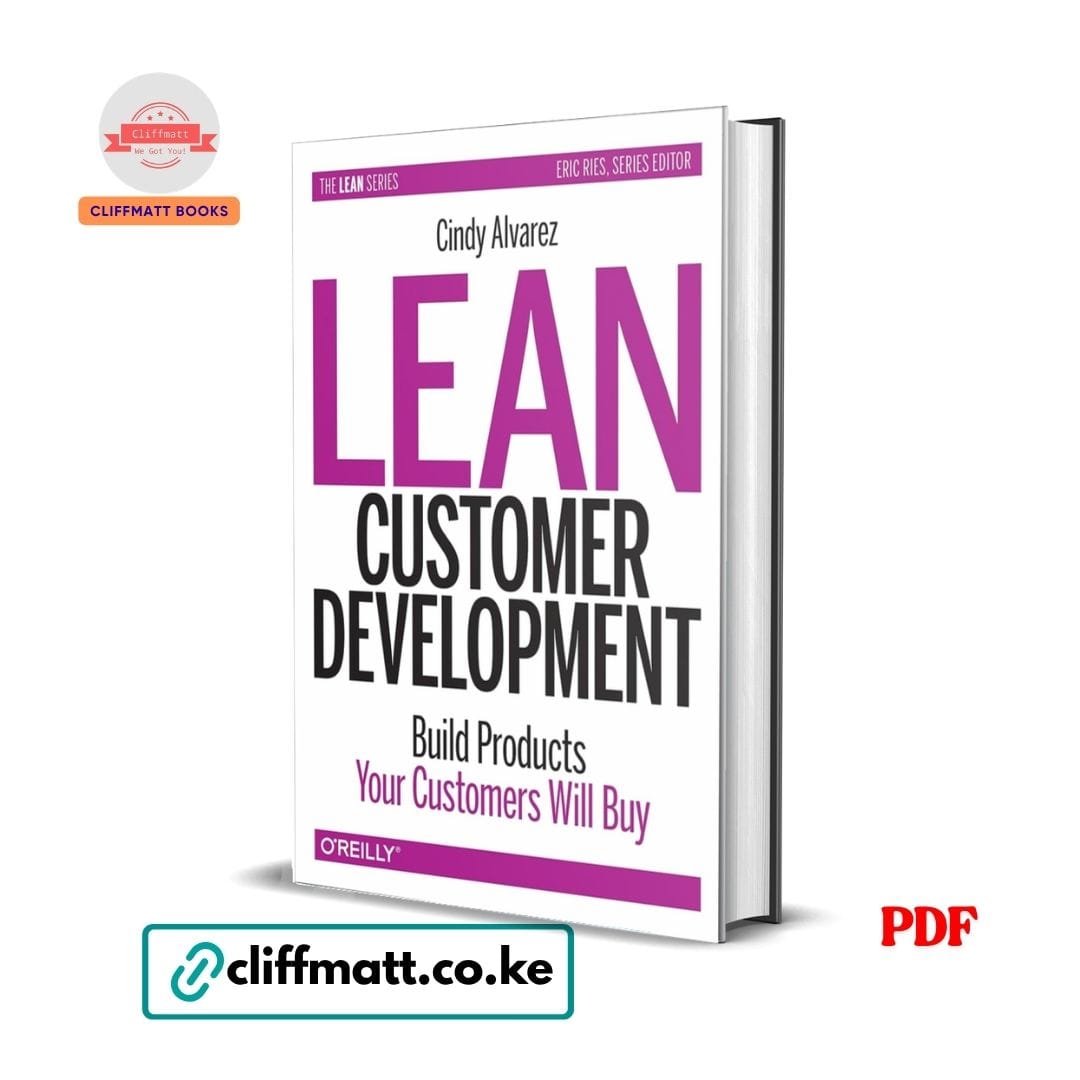
This is the most preventable failure in business. And Lean Customer Development: Build Products Your Customers Will Buy by Cindy Alvarez — published by O’Reilly and part of the acclaimed Lean Series edited by Eric Ries, creator of the Lean Startup methodology — is the most practical, most honestly written guide to preventing it.
The premise is simple, counterintuitive, and backed by everything that the most successful startup ecosystem in the world has learned about building products that sell: talk to your customers before you build anything. Not after you have launched. Not during your beta test. Before. In the earliest, most uncertain phase of a business or product idea — before you have written a single line of code, before you have designed a single feature, before you have committed to a single solution — the most valuable thing you can possibly do is have specific, structured, honest conversations with the people you hope will one day be your customers.
Cindy Alvarez knows this not as a theoretical proposition but as a practitioner. She has led product management and user research at companies including Yammer, Lean Startup Co., and GitHub — organisations at the forefront of the product development revolution. Lean Customer Development is the distilled wisdom of that practice: specific, honest, immediately executable, and built for entrepreneurs and product teams who need to validate their assumptions in the real world, not in the conference room.
What This Book Covers:
Why Customer Development Changes Everything:
- The specific, documented pattern of startup and product failure — what the post-mortems of failed companies consistently reveal about the relationship between assumption-driven development and market rejection
- Why building first and asking later is not boldness — it is the most expensive form of ignorance available to an entrepreneur, and why the cost of that ignorance scales with every feature added, every hire made, and every month of development completed before the first customer conversation
- The Build-Measure-Learn loop at the heart of Lean methodology — and why the specific order matters: most companies build, then measure failure, then learn what they should have known before they started; lean customer development reverses that order
- Why customer development is not market research — the specific differences between surveys, focus groups, and the direct, structured customer conversations that Alvarez teaches, and why the differences matter enormously for the quality and the actionability of what you learn
- How customer development changes the relationship between a founder’s vision and market reality — not by replacing the vision but by testing the specific assumptions embedded in it before those assumptions become expensive commitments
Finding and Recruiting the Right Customers to Talk To:
- How to identify the specific people whose opinions and behaviours are most relevant to your product hypothesis — why talking to everyone produces noise and talking to the right people produces signal
- The specific customer segmentation thinking that customer development requires — who are the early adopters most likely to need your solution most urgently, to have the least tolerance for the problem you are solving, and to be most willing to use an imperfect early version to get relief from their pain
- How to find and recruit those people for conversations — the specific outreach strategies, the specific framing of requests, and the specific incentive structures that produce willing, honest participants rather than polite non-responders or motivated sycophants
- The specific challenge of recruiting for B2B customer development in Kenya’s business environment — how to reach decision-makers, how to frame the conversation as valuable to them rather than extractive, and how to build the relationships that turn research participants into early customers
- Why your existing network is both your greatest asset and your greatest liability in customer development — how to use it effectively while guarding against the specific biases it introduces into your research
Conducting Customer Development Interviews — The Core Skill:
- The specific structure of a customer development interview — how to open, how to progress, how to probe, and how to close in ways that produce honest, specific, behavioural information rather than polite, aspirational, hypothetical responses
- The most important distinction in customer development interviewing: the difference between what people say they do, what they think they do, and what they actually do — and why designing products based on the first two rather than the third is one of the most consistent paths to building something no one buys
- The specific questions that unlock genuine customer insight — and the specific questions that produce the misleading enthusiasm that fools founders into building the wrong thing with complete confidence
- Why “would you buy this?” is one of the least useful questions you can ask — and what to ask instead to get the specific information that actually predicts purchase behaviour
- How to listen actively and without defending your idea — the specific discipline of sitting with information that challenges your assumptions rather than instinctively reframing it as confirmation of what you already believe
- How to take notes that capture the most important information — the specific recording and synthesis practices that turn conversation transcripts into actionable product insights
What to Listen For — Extracting Insight from Conversation:
- The specific signals in customer conversations that indicate a genuine problem worth solving — the language of frustration, workaround behaviour, and the specific emotional register that distinguishes a real pain point from a mild inconvenience
- The signals that indicate your hypothesis is wrong — and why those signals are the most valuable thing a customer development conversation can produce, even though they are the hardest to hear
- How to identify the difference between a customer’s stated problem and their actual problem — the deeper need beneath the surface request that, when addressed, produces the kind of loyalty and enthusiasm that no amount of feature development can manufacture
- The job to be done framework applied to customer development conversations — how to understand what outcome customers are actually trying to achieve, rather than what solution they think they want
- Pattern recognition across multiple conversations — how to synthesise findings from ten, twenty, fifty customer conversations into the specific insights that should shape your product decisions
Validating Your Hypotheses — Before You Build:
- How to structure your product assumptions as testable hypotheses — the specific translation from “I think customers will want X” to “I believe that [specific customer] experiencing [specific problem] will [take specific action] because [specific reason]”
- The minimum viable product as a learning tool — not the smallest thing you can build that still functions, but the smallest thing you can create that will tell you whether your most critical assumption is true or false
- How to test your value proposition, your customer segment, your pricing, and your go-to-market assumptions separately and sequentially — prioritising the tests that address your most uncertain and most consequential assumptions first
- The specific Kenyan market validation tools available — from WhatsApp group feedback to informal prototype testing to structured pilot programmes — that produce real market signal at minimal cost before committing to full development
- How to know when you have enough validation to proceed — the specific threshold of evidence that justifies moving from learning mode to building mode, and why moving too early is the most common and most costly customer development mistake
Applying Customer Development at Every Stage:
- Pre-product customer development — for entrepreneurs still in the idea phase; how to validate that a problem worth solving exists before investing in any solution
- Early-stage customer development — for founders who have built a minimum viable product and need to understand why some customers use it and others do not
- Growth-stage customer development — for companies with an established product who want to understand why customers churn, why certain segments adopt more readily than others, and what product changes would produce the most meaningful improvement in retention and expansion
- Enterprise customer development — the specific adaptations required when your customers are organisations rather than individuals; how to navigate the complex internal politics of corporate buying decisions and identify the specific stakeholders whose problems your product must solve
- Customer development for the Kenyan market — the specific considerations for conducting customer research in Kenya’s unique business environment: the role of trust and relationship in Kenyan business culture, the specific communication preferences that affect how Kenyan customers respond to direct questioning, and the market-specific assumptions that every Kenyan entrepreneur must validate before treating Western startup wisdom as directly applicable
Building the Customer Development Habit — Ongoing Practice:
- Why customer development is not a phase that ends when the product launches — it is an ongoing practice that the best product companies embed into every stage of their operation
- How to build a customer development culture in a team or organisation — the specific processes, rituals, and expectations that keep customer insight at the centre of product decisions rather than gradually displacing it with internal opinion and competitive pressure
- The specific ways that customer development practice degrades over time in growing companies — how initial customer focus erodes as organisations scale, and what specifically keeps it alive
- How to make customer development efficient — the specific systems for conducting conversations, synthesising insights, sharing findings, and translating research into decisions without creating bureaucratic friction that the organisation eventually routes around
Why Kenyan Entrepreneurs Are Buying This Book: Kenya’s startup ecosystem — one of the most vibrant on the African continent — has produced remarkable innovation. It has also produced a consistent pattern of technically impressive products that fail to find sustainable markets because their builders assumed rather than validated customer demand. Lean Customer Development addresses that pattern directly — giving every Kenyan entrepreneur, product manager, and startup team the specific methodology to build what customers will actually buy, in a market they have genuinely understood, rather than one they have imagined.
At Ksh 100, this is the most affordable insurance policy against building the wrong thing available anywhere in Kenya.
Who This Book Is For:
- Kenyan entrepreneurs at every stage — from idea validation to product-market fit to growth — who want to base their product decisions on customer insight rather than founder assumption
- Product managers and product teams at Kenyan startups and tech companies who want the most practical customer research methodology available
- Nairobi’s Silicon Savannah community — developers, designers, and founders building products for Kenyan and African markets who need to understand their customers at a level that goes beyond user surveys and analytics dashboards
- Business school students and entrepreneurship programme participants at Kenyan universities who want the most current and most practically applicable product development methodology to complement their academic training
- Investors and startup accelerator participants — iHub, Nailab, Antler Kenya, and similar ecosystem players — who want founders they work with to have a rigorous customer validation framework from day one
- Every reader of Traffic Secrets (Brunson), Swim with the Sharks (Mackay), Built to Last (Collins), and Marketing and Sales Management who wants the upstream customer understanding that makes every downstream marketing and sales investment more effective
- Anyone who has ever built something and discovered too late that customers did not want it — and who refuses to let that happen again
📖 Author: Cindy Alvarez 🏢 Publisher: O’Reilly (The Lean Series — Eric Ries, Series Editor) 📄 Format: PDF eBook (instant download via WhatsApp or email) 💰 Price: Ksh 100 only 🚀 Delivery: Instant after M-Pesa payment confirmation
👉 Order now on cliffmatt.co.ke — Pay via M-Pesa, receive your PDF instantly.













Reviews
There are no reviews yet.