


Description
Maize is Kenya’s most important food crop. It is what most Kenyan farmers grow first, what most Kenyan families eat daily, and what determines food security — or food crisis — for millions of households every season. And yet, season after season, the majority of Kenyan maize farmers harvest a fraction of what their land is capable of producing — through avoidable variety mistakes, preventable disease losses, poor soil management, and the absence of the specific technical knowledge that separates subsistence maize growing from genuinely profitable commercial production.
The Maize Production Guide Kenya by Graduate Farmer — the agribusiness publishing brand that has made practical farming knowledge accessible to thousands of Kenyan farmers — delivers everything you need to change that outcome. This is not a generic crop science textbook. It is a Kenya-specific, field-ready, commercially oriented production manual built around the climates, soils, varieties, pests, and market conditions of Kenya — the guide that every serious Kenyan maize farmer needs and that most have never had access to at any price, let alone Ksh 100.
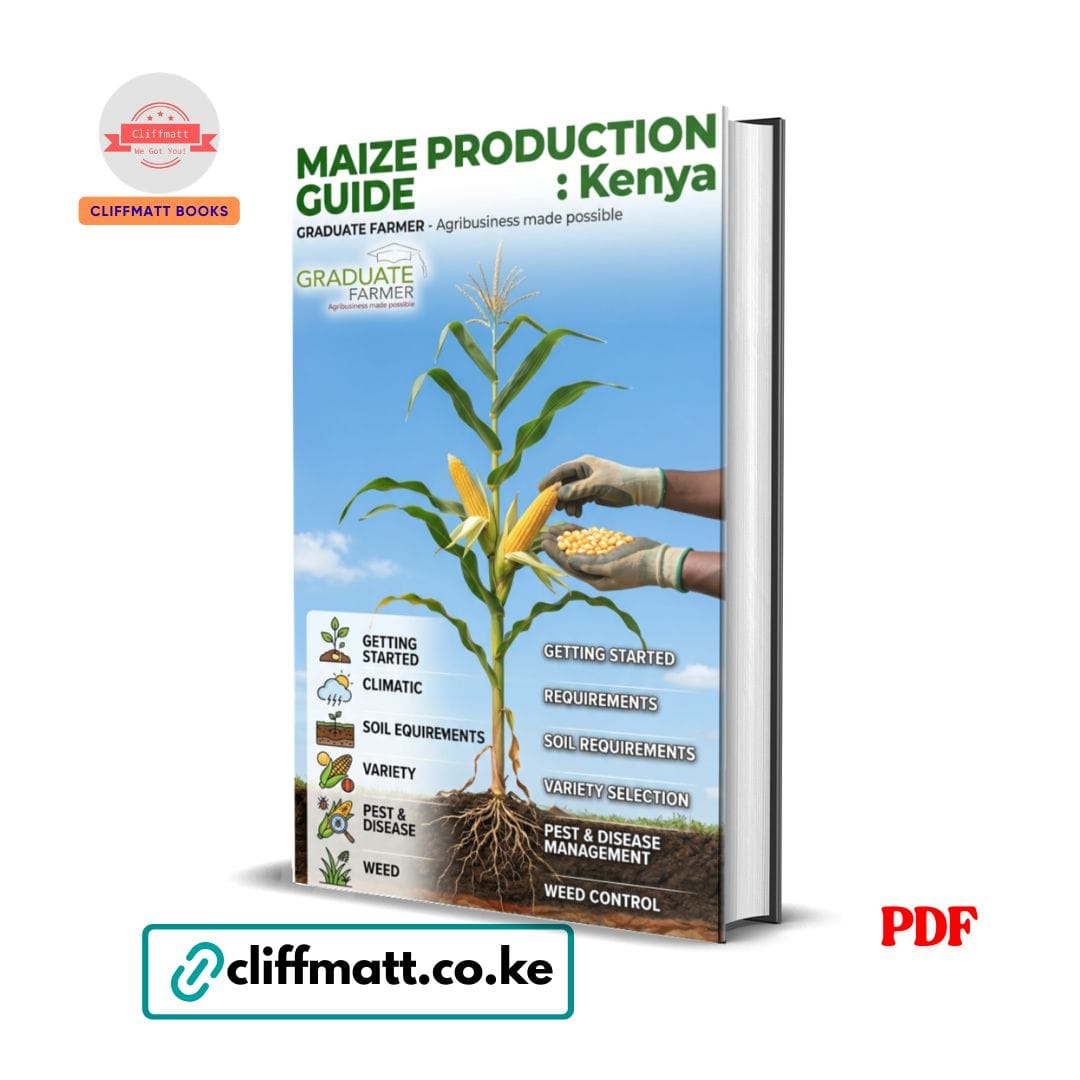
The cover shows you what this guide is about: a farmer’s gloved hands holding freshly shelled maize grain against a thriving, full-canopy maize plant — the image of a crop that has been managed correctly from planting to harvest. The chapter icons on the cover tell you exactly what is inside: Getting Started, Climatic Requirements, Soil Requirements, Variety Selection, Pest and Disease Management, and Weed Control. Every topic. Every stage. Nothing left out.
What This Guide Covers:
Getting Started — The Business Case for Commercial Maize in Kenya:
- Why maize remains Kenya’s most strategically important crop and the specific market conditions that make well-managed commercial maize production consistently viable
- The fundamental difference between growing maize for food and growing maize as an agribusiness — the planning, input management, and market orientation that determines which outcome you achieve
- How to calculate realistic yield targets and revenue projections for your specific land size, agro-ecological zone, and input budget before you plant a single seed
- The planning framework that serious commercial maize farmers use — and that most smallholder farmers in Kenya have never been taught
Climatic Requirements — Matching Your Farm to the Crop:
- The specific temperature, rainfall, altitude, and sunshine requirements of commercial maize production — and how to assess whether your location’s climate is suited to the yield targets you are pursuing
- Kenya’s major maize-growing agro-ecological zones — the highlands of Rift Valley, Western Kenya, Central Kenya, and the transitional zones — and the specific management adjustments that optimise production in each
- How to use seasonal rainfall forecasts from the Kenya Meteorological Department to make better planting date decisions — the single most important timing call of the entire season
- Climate change adaptation for Kenyan maize farmers — the practical variety selection and soil management responses that protect yields in the face of increasingly erratic rainfall patterns
Soil Requirements — The Foundation of Every Yield:
- The ideal soil characteristics for commercial maize production — pH range, organic matter content, drainage, and depth — and how to assess whether your soils meet them
- Soil testing for Kenyan maize farmers — where to test, what to test for, how to interpret results, and how to translate test results into a practical soil amendment and fertilisation programme
- pH correction — the liming protocols that bring acidic Kenyan highland soils into the optimal range for maize production, with specific rates and timing for different soil types
- Soil organic matter management — the crop residue, manure, and composting practices that build long-term soil health and reduce fertiliser dependency season over season
- Drainage management for maize on heavy clay soils — the tillage and field design approaches that prevent waterlogging, the most common cause of yield loss in Kenya’s wetter growing zones
Variety Selection — The Most Consequential Decision of Your Season:
- The major commercial maize varieties available to Kenyan farmers — H614D, H6213, DK8031, SC403, PH1, WH507, and the leading hybrid varieties from SEEDCO, Pioneer, Kenya Seed Company, and others — with their specific yield potential, days to maturity, disease resistance, and agro-ecological zone suitability
- How to match variety selection to your specific zone, season length, rainfall reliability, and market target — the decision framework that prevents the most common and most costly variety mistake Kenyan farmers make
- Early, medium, and late-maturing varieties — when each is appropriate, and how planting date and season length interact with variety maturity to determine final yield
- Open-pollinated versus hybrid varieties — the honest trade-off analysis between seed cost, yield performance, replanting flexibility, and market value for Kenyan farmers at every scale
- Drought-tolerant varieties for Kenya’s drier and more rainfall-unreliable zones — the specific varieties that protect yield when rains underperform, and why selecting them is not pessimism but commercial wisdom
- Where to buy certified, quality-tested maize seed in Kenya — and why seed source is the single most important input decision you make
Fertiliser and Soil Nutrition Management:
- The specific nutrient requirements of maize at each growth stage — and the basal and top-dressing fertiliser programmes that meet those requirements for Kenya’s different soil types
- DAP versus CAN versus NPK blends — the fertiliser selection logic that matches product choice to your soil test results and production targets rather than habit or availability
- How to calculate fertiliser application rates for your specific target yield and soil test results — the practical agronomy that prevents both yield-limiting under-fertilisation and profit-destroying over-application
- Micronutrient management for Kenyan maize — the zinc, boron, and sulphur deficiencies most commonly limiting yields in Kenya’s major growing zones
- Organic fertilisation options — manure, compost, and green manure approaches for farmers building long-term soil health or managing constrained input budgets
Pest and Disease Management — Protecting Every Bag You Grow:
- The major maize pests in Kenya — Fall Armyworm (the most devastating recent arrival), stem borers, aphids, and storage pests — with identification, damage assessment, economic threshold principles, and integrated management protocols
- Fall Armyworm management — the specific monitoring, early detection, and rapid response approaches that prevent this pest from destroying an otherwise well-managed crop; still the most important single pest challenge facing Kenyan maize farmers
- The critical maize diseases in Kenya — Grey Leaf Spot, Maize Streak Virus, Northern Corn Leaf Blight, Common Rust, and Fusarium ear rot — their identification, the conditions that favour their development, and the varietal, cultural, and chemical management approaches that protect yield
- Aflatoxin management — the pre- and post-harvest practices that prevent aflatoxin contamination, protect your family’s health, and maintain market access in an environment of increasingly strict food safety requirements
- Integrated Pest Management for Kenyan maize — the sequence of cultural, biological, and chemical interventions that provides the most cost-effective, resistance-resistant protection for commercial crops
- Registered agro-chemical products for maize in Kenya — active ingredients, application rates, timing, safety precautions, and pre-harvest intervals
Weed Control — Defending Your Yield from the First Week:
- Why weed competition is most damaging in the first six weeks after planting — the critical window where weed pressure reduces final yield more severely than at any other growth stage
- The major weeds in Kenyan maize fields — Striga (witchweed), broadleaf weeds, and grass weeds — their identification, the specific threat each poses, and the management approach each requires
- Striga management — Kenya’s most persistent and most damaging parasitic weed; the integrated management approaches that reduce Striga pressure over multiple seasons, including resistant varieties, soil health improvement, and targeted herbicide use
- Mechanical and manual weed control — the timing, frequency, and implement choice that gives effective control without damaging shallow maize roots
- Herbicide options registered for maize in Kenya — pre-emergent and post-emergent products, their application timing, rates, and the precautions that protect the crop while eliminating competition
- Minimum tillage and conservation agriculture — how reduced tillage approaches manage weed pressure while building the soil health that sustains long-term productivity
Harvesting and Post-Harvest Management:
- Identifying harvest maturity — the specific visual and physical indicators that tell you your crop is ready and that early harvest will cost you yield while late harvest risks field losses and quality deterioration
- Harvesting methods for different scales — manual shelling, hand-powered shellers, and mechanised threshers; their relative costs, throughput rates, and grain quality outcomes
- Drying to safe moisture content — the most important and most neglected post-harvest step for Kenyan maize farmers; how improper drying causes aflatoxin, grain quality loss, and storage failures that destroy the value of an otherwise successful season
- Storage options for Kenyan farmers — traditional cribs, metal silos, PICS bags, and warehouse receipt systems; their relative costs, performance, and suitability for different farm sizes and marketing strategies
- Using post-harvest storage to time your market sales — the financial management approach that allows farmers to sell when prices are high rather than at the harvest-time glut that most Kenyan farmers are forced into
Marketing and Agribusiness Profitability:
- Cost of production per bag — the financial management foundation that every profitable Kenyan maize farmer must calculate before selling a single bag at any price
- Market channels for Kenyan maize — NCPB, local millers, posho mills, brokers, direct consumer sales, and farmer cooperative marketing — with honest assessments of each channel’s pricing, reliability, and requirements
- How to negotiate at the farm gate from knowledge rather than desperation — the market information and financial clarity that shifts power from the middleman back to the farmer
- Record-keeping for commercial maize farming — the simple but essential farm records that identify your most profitable practices and build the evidence base for better decisions every season
Why Kenyan Farmers Are Buying This Guide:
Kenya’s national average maize yield is approximately 1.5 tonnes per acre. Properly managed commercial production using the right variety, the right soil management, and the right crop protection can achieve 3–5 tonnes per acre on the same land. The difference between those two outcomes is entirely a matter of knowledge and its application.
This guide provides that knowledge — every piece of it, Kenya-specific and field-ready — for Ksh 100.
Who This Guide Is For:
- Kenyan smallholder and commercial farmers who want to maximise the productivity and profitability of their maize enterprise
- Young agripreneurs entering commercial maize production and wanting the technical foundation that transforms ambition into consistent results
- Agricultural extension officers and county government advisors who want a comprehensive, Kenya-specific reference to support their farmer clients
- Agricultural college and university students who want the practical, applied complement to their academic crop science training
- Investors and agribusiness entrepreneurs evaluating large-scale maize production as a commercial venture
- Every Kenyan farmer who grows maize and wants to grow more of it, lose less of it, and sell it better — starting this season
📖 Publisher: Graduate Farmer — Agribusiness Made Possible 📄 Format: PDF eBook (instant download via WhatsApp or email) 💰 Price: Ksh 100 only 🚀 Delivery: Instant after M-Pesa payment confirmation 👉 Order now on cliffmatt.co.ke — Pay via M-Pesa, receive your PDF instantly.














Reviews
There are no reviews yet.