


Description
English is Kenya’s language of professional opportunity. Of academic advancement. Of business contracts, of job interviews, of university essays, of courtroom arguments, of medical notes, of the specific written and spoken communication that determines — more than almost any other single factor — whether a Kenyan professional is taken seriously, promoted, hired, or published.
And yet the specific rules that govern correct English — the particular grammar conventions, the specific punctuation requirements, the precise usage distinctions that separate confident, credible English from the specific errors that undermine the otherwise excellent work of otherwise excellent Kenyan communicators — are rarely taught systematically, rarely explained clearly, and almost never available in a single, immediately usable reference that a busy professional can reach for when they need the right answer right now.
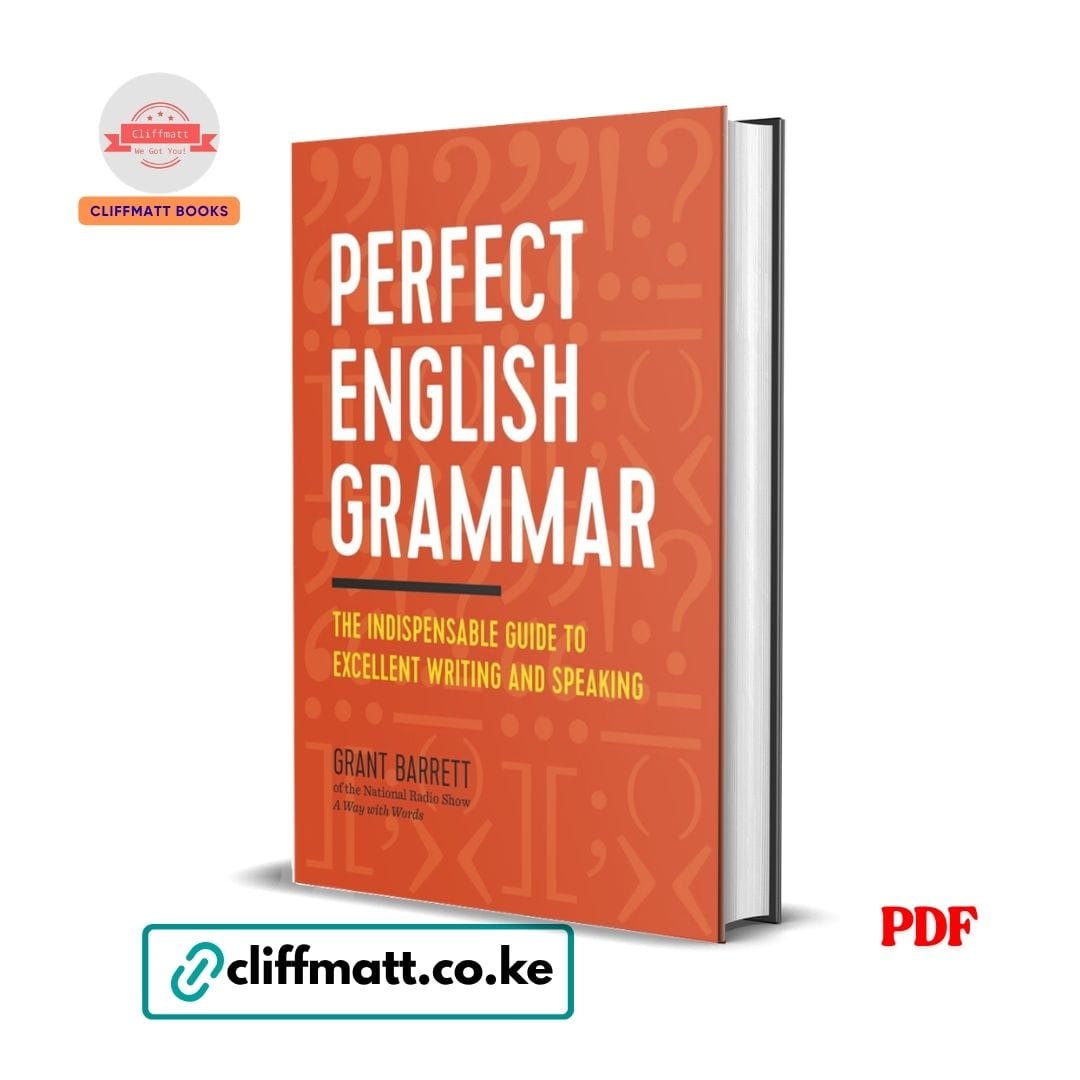
Perfect English Grammar: The Indispensable Guide to Excellent Writing and Speaking by Grant Barrett — host of the national radio show A Way with Words, one of the most respected and most accessible language authorities in the English-speaking world — is that reference. The specific, clear, comprehensively organised, and genuinely readable grammar guide that answers every English grammar question a Kenyan professional, student, or communicator is likely to encounter — written not for academic linguists but for real people who use English every day and who want to use it correctly, confidently, and effectively.
At Ksh 100, the most practically useful English language investment available to every Kenyan communicator.
What This Book Covers:
Why Grammar Still Matters — And Why This Guide Is Different:
- The specific case for grammar in the specific Kenyan professional context — why correct English grammar is not a colonial legacy to be dismissed but the specific professional tool that determines credibility, clarity, and career advancement in Kenya’s specific English-medium professional world; why the specific Kenyan professional whose written English is impeccable consistently commands more respect, more trust, and more opportunity than the specific equally talented professional whose English contains avoidable errors
- Why most grammar books fail — the particular problem with the traditional grammar reference that is either too academic (organised for linguists, not for users) or too basic (covering what most adults already know rather than the specific questions adults actually struggle with); why Perfect English Grammar is specifically designed for the adult who already uses English competently and who wants the specific reference that addresses the specific questions that competent adult users actually ask
- Grant Barrett’s specific approach — the particular combination of linguistic authority and accessible explanation that Barrett has developed across years of the A Way with Words radio programme, where real people ask real English questions and receive real, immediately useful answers; why this specific approach makes Perfect English Grammar the most readable and most immediately applicable grammar reference available
Parts of Speech — The Complete Foundation:
Nouns:
- The specific noun rules that most English users never fully internalise — the particular count and non-count noun distinction (furniture, not furnitures; information, not informations) that is the specific source of one of the most common and most professionally visible errors in Kenyan professional English; the specific collective noun agreement rules; the particular compound noun formation and hyphenation conventions
- The specific proper noun capitalisation rules — when to capitalise and when not to; the particular titles (President, Doctor, Professor) that are capitalised in direct address but not in general reference; the specific institutional name capitalisation that confuses even experienced writers
- The specific plural formation rules — the particular irregular plurals (criteria not criterias, phenomena not phenomenons, data as a plural) that appear frequently in academic and professional Kenyan English and that are consistently misused even by well-educated writers
Pronouns:
- The specific pronoun case rules — the particular who versus whom distinction that confuses even the most educated English users; the specific I versus me, he versus him, she versus her decisions in compound constructions (“between you and me” not “between you and I”) that are among the most common and most noticeable grammar errors in professional English
- The specific pronoun-antecedent agreement — the particular singular they usage and its specific current grammatical status; the specific agreement rules for collective nouns (the committee has decided versus the committee have decided — British versus American convention and which applies in Kenyan professional English)
- The specific reflexive pronoun rules — myself, yourself, himself — the specific contexts where reflexive pronouns are correct and the specific very common misuse of myself as a substitute for I or me (“Please contact myself if you have questions” is wrong; “Please contact me” is correct) that appears with extraordinary frequency in Kenyan professional email writing
Verbs:
- The specific tense system — the complete, clearly explained guide to the English tense system that most Kenyan students were taught incompletely in school; the particular present perfect versus simple past distinction that is one of the most consistently misapplied grammar points in Kenyan professional English; the specific future tense options and when each is most appropriate
- The specific subject-verb agreement rules — the particular cases that consistently cause disagreement errors (neither…nor constructions, either…or constructions, collective nouns, indefinite pronouns); the specific rules for each and the particular examples that make them immediately clear
- The specific active and passive voice — when passive voice is appropriate and when active voice is preferred; the particular professional writing contexts where passive is standard (scientific reports, formal correspondence) and the specific creative and business writing contexts where active voice consistently produces clearer, more forceful communication
Adjectives and Adverbs:
- The specific adjective versus adverb distinction — the particular good versus well, bad versus badly, real versus really confusions that are among the most common spoken English errors and that signal grammatical uncertainty to any educated listener; the specific comparative and superlative forms (more unique is incorrect; unique is absolute); the particular double comparative error (more better, more faster)
- The specific adjective order rules — the particular sequence in which multiple adjectives must appear before a noun (opinion, size, age, shape, colour, origin, material, purpose) that native speakers follow instinctively and that non-native speakers often violate in ways that make otherwise correct English sound immediately non-native
Prepositions:
- The specific preposition usage rules — the particular at, in, on distinctions for time and place that are among the most rule-governed and most confusing aspects of English preposition use; the specific prepositional phrases that are fixed idioms (interested in, not interested about; different from, not different than in British English) and that cannot be derived from rules but must be learned as specific expressions
- The specific ending-a-sentence-with-a-preposition question — the authoritative answer to one of the most frequently asked and most consistently misunderstood English grammar questions; why the “rule” against sentence-final prepositions is a myth, when it matters stylistically, and when it produces the specific awkwardness that reveals overcorrection rather than grammatical authority
Punctuation — The Complete Guide:
Commas:
- The specific comma rules that most English users have never been clearly taught — the particular Oxford comma question and its professional implications; the specific comma with coordinating conjunctions rule; the particular comma after introductory elements; the specific comma in non-restrictive versus restrictive clauses (which versus that and the comma that distinguishes them)
- The specific comma splice — one of the most common and most professionally visible punctuation errors in Kenyan professional writing; the particular rule, the specific examples, and the specific three ways to correct it that every professional writer needs
Semicolons and Colons:
- The specific semicolon rules — perhaps the most consistently misused punctuation mark in Kenyan professional English; the particular two correct uses (joining independent clauses without a conjunction; separating complex list items) and the specific most common misuse (using a semicolon before a list, which requires a colon not a semicolon)
- The specific colon rules — when a colon is correct and when a colon is not; the particular rule that only an independent clause may precede a colon; the specific capitalisation convention after a colon
Apostrophes:
- The specific apostrophe rules — the particular possessive formation for singular nouns (the doctor’s bag), plural nouns ending in s (the doctors’ lounge), and plural nouns not ending in s (the children’s ward); the specific it’s versus its distinction that is the single most common apostrophe error in written English; the specific contraction apostrophe rules
- The specific its versus it’s explanation — delivered with the specific clarity and the specific memorable distinction that finally makes this specific error permanently avoidable; why this single apostrophe rule, once genuinely learned, eliminates one of the most frequently occurring and most professionally noticeable punctuation errors in Kenyan professional writing
Quotation Marks, Hyphens, and Dashes:
- The specific quotation mark rules — the particular British versus American convention for punctuation inside or outside quotation marks and which convention Kenyan professional English uses; the specific quotation marks for titles versus italics; the particular scare quotes usage and its professional implications
- The specific hyphen versus en dash versus em dash distinctions — three marks that most writers conflate or ignore but that serve specific, different grammatical and stylistic purposes in professional writing; the specific rules for each and the specific professional contexts where getting them right signals genuine writing authority
Sentence Structure — Building Correct, Clear Sentences:
- The specific sentence types — simple, compound, complex, compound-complex — and the specific grammatical requirements of each; how to identify and correct the specific sentence fragment and the specific run-on sentence that are the two most fundamental sentence-level errors in written English
- The specific parallel structure rule — the particular requirement that items in a list, paired constructions, and correlative conjunctions (both…and, either…or, not only…but also) must be grammatically parallel; the specific very common parallel structure violations in professional writing and how to identify and correct them
- The specific dangling and misplaced modifier — the particular error where a modifier describes the wrong word or no word at all; the specific examples that make this error immediately recognisable; the specific revision strategy that consistently corrects it
Common Grammar Confusions — The Most Asked Questions:
- The specific affect versus effect distinction — the particular rule, the specific exceptions, and the specific memory device that makes this distinction permanently clear
- The specific fewer versus less distinction — the particular count/non-count rule that governs this choice and that makes “10 items or less” technically incorrect (it should be fewer)
- The specific lay versus lie confusion — one of the most consistently misused verb pairs in English; the particular present, past, and past participle forms of each verb laid out with specific clarity
- The specific comprise versus compose distinction — the particular professional writing error (the team is comprised of five members is incorrect; the team comprises five members is correct) that reveals grammatical uncertainty to any informed reader
- The specific that versus which distinction — the particular restrictive versus non-restrictive clause rule that determines which word is correct in every case
- The specific who versus whom question — resolved once and for all with the specific subject/object test that makes every who/whom decision immediately and permanently clear
Speaking English Correctly — The Spoken Grammar Chapter:
- The specific spoken English grammar rules — the particular grammar conventions that apply to spoken professional English (presentations, meetings, job interviews, client conversations) as well as written; why the specific Kenyan professional communicator who masters both written and spoken grammar commands the specific professional credibility that career advancement consistently requires
- The specific formal versus informal spoken register — when the specific grammar rules of formal written English apply to spoken professional communication and when the specific relaxed conventions of informal spoken English are appropriate; the particular professional contexts (the job interview, the board presentation, the client meeting) where formal spoken grammar is specifically expected
Why Kenyan Professionals Are Buying This Book:
English is not merely Kenya’s official language — it is Kenya’s professional currency. The Kenyan doctor writing clinical notes, the Kenyan lawyer drafting contracts, the Kenyan teacher marking essays, the Kenyan entrepreneur writing a business proposal, the Kenyan student submitting an assignment, the Kenyan professional composing a job application — every one of them is being evaluated, consciously or unconsciously, on the specific quality of their English. And the specific errors that Perfect English Grammar addresses — the misplaced comma, the wrong pronoun case, the dangling modifier, the apostrophe in its, the semicolon used as a colon — are precisely the errors that consistently undermine otherwise excellent work.
At Ksh 100, the most practically useful and most immediately applicable English grammar investment available to every Kenyan professional, student, and communicator.
Who This Book Is For:
- Kenyan professionals — doctors, lawyers, teachers, engineers, bankers, civil servants — who use English daily in their work and who want the specific authoritative reference that answers their specific grammar questions immediately and clearly
- Kenyan university students writing essays, research papers, dissertations, and academic assignments who want the specific grammar foundation that the Academic Writing: A Handbook for International Students (Bailey) builds upon
- Kenyan job seekers and CV writers who want to ensure that their written English is impeccable — knowing that grammar errors in a job application consistently eliminate otherwise strong candidates before the interview stage
- Kenyan teachers of English who want the most clear, most comprehensive, and most accessible single-volume grammar reference available for their own professional use and for recommendation to their students
- Every reader of Academic Writing: A Handbook for International Students (Bailey), English Grammar Workbook for Adults, The Well-Spoken Woman, and Communication and Public Speaking titles who wants the most authoritative and most immediately practical grammar reference to anchor their complete English communication library
📖 Author: Grant Barrett
📄 Format: PDF eBook (instant download via WhatsApp or email)
💰 Price: Ksh 100 only
🚀 Delivery: Instant after M-Pesa payment confirmation
👉 Order now on cliffmatt.co.ke — Pay via M-Pesa, receive your PDF instantly.





Reviews
There are no reviews yet.