
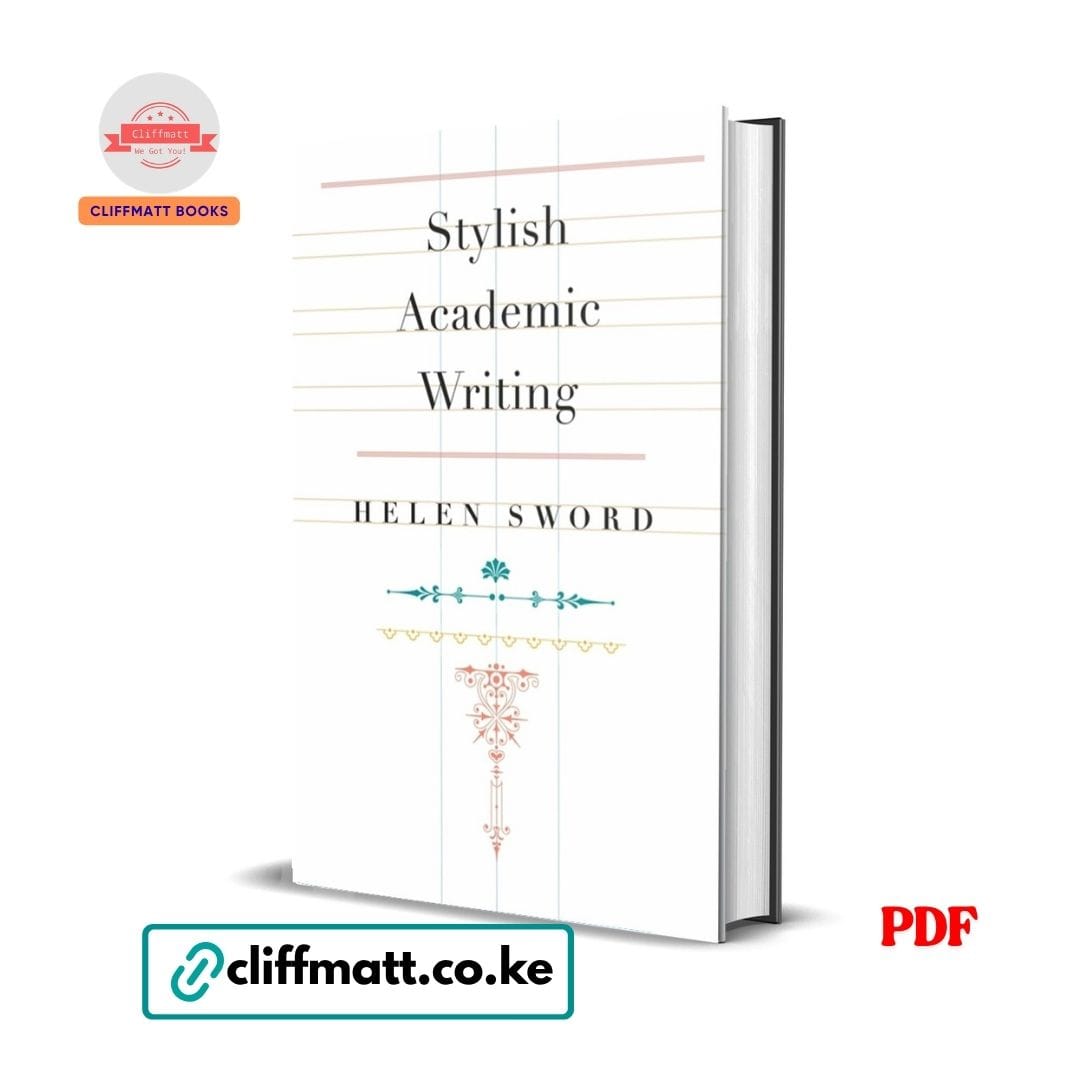


Description
Academic writing has a reputation. It is a reputation built on decades of jargon-dense, passive-voice-laden, nominalisaton-heavy prose that communicates the specific message that the writer is serious, qualified, and thoroughly embedded in their discipline — while simultaneously ensuring that almost no one outside that discipline, and many people within it, can read the work with any genuine pleasure or even genuine comprehension.
Helen Sword — professor, researcher, and one of the most thoughtful and most practically useful voices on academic writing available — spent years studying the specific writing practices of academics across disciplines, across countries, and across the full spectrum from the genuinely unreadable to the genuinely excellent. And what she found was both reassuring and immediately actionable: stylish academic writing is not a gift. It is a set of learnable, practicable, specific choices that any writer with the specific commitment to their readers’ experience can begin making today.
Stylish Academic Writing is the most liberating and most practically structured guide to making those choices — the complete argument that academic writing can be, must be, and without sacrificing a single atom of scholarly rigour genuinely is better when it is also genuinely readable.
What This Book Covers:
The Problem — Why Academic Writing Is So Often Unreadable:
- The specific institutional pressures that produce bad academic writing — the specific reward structures, the specific peer review culture, the specific disciplinary conventions, and the specific academic identity investment in appearing serious that collectively produce the specific stilted, impersonal, jargon-heavy prose that most academic writing becomes
- The specific myths that sustain bad academic writing — the myth that complex ideas require complex sentences; the myth that impersonal prose is more objective than personal prose; the myth that jargon demonstrates expertise; and the specific myth that readable writing is somehow less rigorous than unreadable writing
- Sword’s specific empirical research — the analysis of hundreds of published academic articles across dozens of disciplines that provides the specific evidence for what characterises the most and least readable academic writing; the specific features that correlate most reliably with reading engagement versus reading abandonment
- Why the specific Kenyan academic context — where the specific publication pressure of university research assessment exercises, the specific international journal submission requirements, and the specific disciplinary conventions imported from Western academic traditions — produces the specific writing challenges that this book addresses most directly
The Elements of Stylish Academic Writing:
Titles:
- The specific difference between informative titles (that tell the reader exactly what the paper is about), evocative titles (that intrigue the reader into wanting to find out), and the specific compound title (a colon-separated combination of both) that most effectively serves the specific dual purpose of academic discoverability and reader engagement
- The specific analysis of what makes a title work — and the specific examples of titles that fail; the specific lessons for Kenyan researchers whose titles are the first and often decisive contact between their work and potential readers
The Opening Hook:
- Why the specific first paragraph of any academic piece is the specific most important real estate in the entire document — the specific evidence that readers make their continue-or-abandon decision within the first paragraph of most academic texts; what specifically characterises the openings that keep readers and the specific openings that lose them
- The specific hook strategies — opening with a specific compelling story, a specific provocative question, a specific surprising fact, or the specific vivid scene that draws the reader into the specific intellectual territory the paper will explore; how each strategy serves different disciplinary contexts and different reader expectations
- The specific anti-hook patterns — the specific literature review opening, the specific definitional opening, and the specific announcement-of-structure opening that most reliably produce immediate reader disengagement; why these specific patterns are so common in academic writing despite their specific consistently ineffective impact on reader engagement
The Scholarly Story:
- The specific narrative dimension of academic writing — Sword’s argument that the most compelling academic writing tells a story; not a fictional narrative but the specific intellectual story of a problem encountered, an investigation conducted, evidence marshalled, and a specific conclusion reached; the particular arc that makes academic argument feel like discovery rather than assertion
- The specific signposting practices that guide readers through the specific structure of academic argument without the specific bureaucratic announcement-of-structure that most academic writing over-relies on; the specific craft of structural guidance that feels natural rather than mechanical
- Why the specific academic writing that most successfully reaches its intended audience is the academic writing that most clearly understands the specific reader’s experience — what they know, what they need to know, and the specific journey from one to the other that the specific prose must provide
Textual Detail — The Sentence Level:
Verbs:
- The specific case against nominalisation — the specific academic habit of converting active verbs into abstract nouns (“an examination of” rather than “we examined”; “the facilitation of” rather than “facilitating”) that produces the specific heavy, airless quality that characterises the worst academic prose; why nominalisation is the single most effective target for any writer who wants to make their academic prose more readable
- The specific case for strong, active verbs — the particular words that move sentences, that produce the specific clarity and the specific energy that engaged reading requires; how to audit your own academic prose for verb weakness and the specific revision practices that strengthen it
- The specific passive voice audit — not the blanket condemnation of passive voice (it has legitimate uses in academic writing) but the specific identification of the specific overuse that produces the specific impersonal, agency-free prose that most academic writing defaults to when writers are most anxious about appearing insufficiently objective
Jargon:
- The specific legitimate versus illegitimate uses of technical terminology — the specific distinction between jargon that carries genuine conceptual precision that ordinary language cannot replicate (legitimate, necessary, appropriate) and jargon that performs expertise without adding meaning (illegitimate, excluding, damaging to genuine communication)
- The specific jargon audit practices — how to read your own work from the perspective of the specific reader who is genuinely expert in the field but genuinely unfamiliar with your specific subfield’s specific terminology; the specific question “Could I say this in plainer language without losing essential precision?” as the specific test for every technical term
- The specific Kenyan cross-disciplinary context — how Kenyan academics writing for both national and international audiences navigate the specific tension between the specific technical vocabulary of their international disciplinary community and the specific accessibility requirements of Kenyan policy, practitioner, and general audiences
Personal Voice:
- The specific case for the first person in academic writing — Sword’s evidence-based argument that the specific use of “I” and “we” in academic prose is both more prevalent and more positively received in high-quality academic writing than the specific myth of academic impersonality suggests; the specific disciplines where personal voice is standard practice and the specific disciplines where it remains more contested
- The specific voice and credibility relationship — the specific evidence that academic writing with a genuine personal voice is more, not less, trusted by readers than the specific impersonal prose that performs objectivity while actually concealing the specific person whose specific choices, specific interpretations, and specific judgments are the paper’s actual intellectual substance
- The specific practices for finding and sustaining personal voice in academic writing — the particular attention to one’s own natural writing rhythms, the particular commitment to sounding like oneself rather than like the academic writing one has most recently read, and the specific revision practice of reading one’s own draft aloud to catch the specific moments where voice disappears into performance
Readers:
- The specific discipline of audience awareness in academic writing — the particular questions every academic writer should ask before beginning: Who will read this? What do they already know? What do they need to know? What experience of reading this do I want them to have?
- The specific reader engagement techniques — direct address, rhetorical questions, specific concrete examples, and the particular narrative gestures that consistently maintain reader engagement through the specific argumentative sections of academic writing where engagement most commonly flags
- The specific disciplinary reader conventions — what readers in different academic disciplines specifically expect and specifically resist; how Kenyan academics writing across disciplines navigate the specific convention conflicts that cross-disciplinary work produces
Concrete Details:
- The specific case for concrete, specific, sensory detail in academic writing — the counterintuitive evidence that abstract academic claims are consistently better received, better understood, and better remembered when they are grounded in specific concrete examples, specific case studies, and specific vivid illustrations rather than when they are stated at the level of abstraction that most academic writing defaults to
- The specific example as evidence — how well-chosen specific examples do not merely illustrate abstract claims but constitute the specific primary evidence for those claims in many fields; why the specific concrete detail is not ornamentation but substance
- The specific Kenyan research context — how Kenyan researchers writing about Kenyan data, Kenyan communities, and Kenyan experiences can use the specific richness of their specific local context as the specific source of the specific concrete detail that makes their work both more readable and more genuinely insightful than abstract presentation of the same data would produce
The Writing Habit:
- The specific writing habits of productive academic writers — the particular daily practice, the particular separation of drafting from editing, and the particular specific time protection that the most productive academic writers consistently maintain; why prolific, readable academic writing is almost always the product of consistent small-session discipline rather than occasional marathon efforts
- The specific drafting versus revising distinction — why the specific attempt to write perfectly on the first draft produces the specific writing paralysis that most academic writers experience; why giving yourself specific permission to write badly in the first draft is the specific prerequisite of writing well in the final one
- The specific reading as a writing practice — how deliberate reading of exemplary academic writing (and of genuinely good non-academic prose) develops the specific ear for language that produces better writing; why the best academic writers are almost always also the most deliberate readers
Why Kenyan Academics Are Buying This Book: Kenya’s universities are producing an extraordinary generation of researchers, postgraduate students, and academic professionals who are generating genuinely important knowledge about genuinely important questions. The specific challenge of communicating that knowledge in writing that genuinely reaches its intended audience — in journal articles, in theses, in policy papers, and in the specific scholarly books that have the specific potential to contribute to Kenya’s academic record — is precisely what Stylish Academic Writing addresses.
At Ksh 100, the most practically useful and most liberating guide to writing academic work that is both rigorous and genuinely readable.
Who This Book Is For:
- Kenyan postgraduate students — masters and doctoral — who want the most practically structured guide to developing the specific academic writing skills that their thesis, their coursework, and their eventual publications require
- Kenyan academic researchers who want to improve the specific readability and the specific impact of their published work without sacrificing the specific scholarly rigour that their discipline requires
- Kenyan university lecturers who teach academic writing and who want the most evidence-based and most practically applicable reference for the specific writing development they are supporting
- Every Kenyan professional in policy, civil society, and development work who produces written work intended for academic or semi-academic audiences and who wants the specific guidance to make that work both credible and readable
- Every reader of SPSS Statistics for Dummies (McCormick), Data Analysis in Management with SPSS Software (Verma), and How to Write a Great Research Paper who wants the most complete academic writing skills library available at any Kenyan digital platform
📖 Author: Helen Sword 📄 Format: PDF eBook (instant download via WhatsApp or email) 💰 Price: Ksh 100 only 🚀 Delivery: Instant after M-Pesa payment confirmation
👉 Order now on cliffmatt.co.ke — Pay via M-Pesa, receive your PDF instantly.











Reviews
There are no reviews yet.