


Description
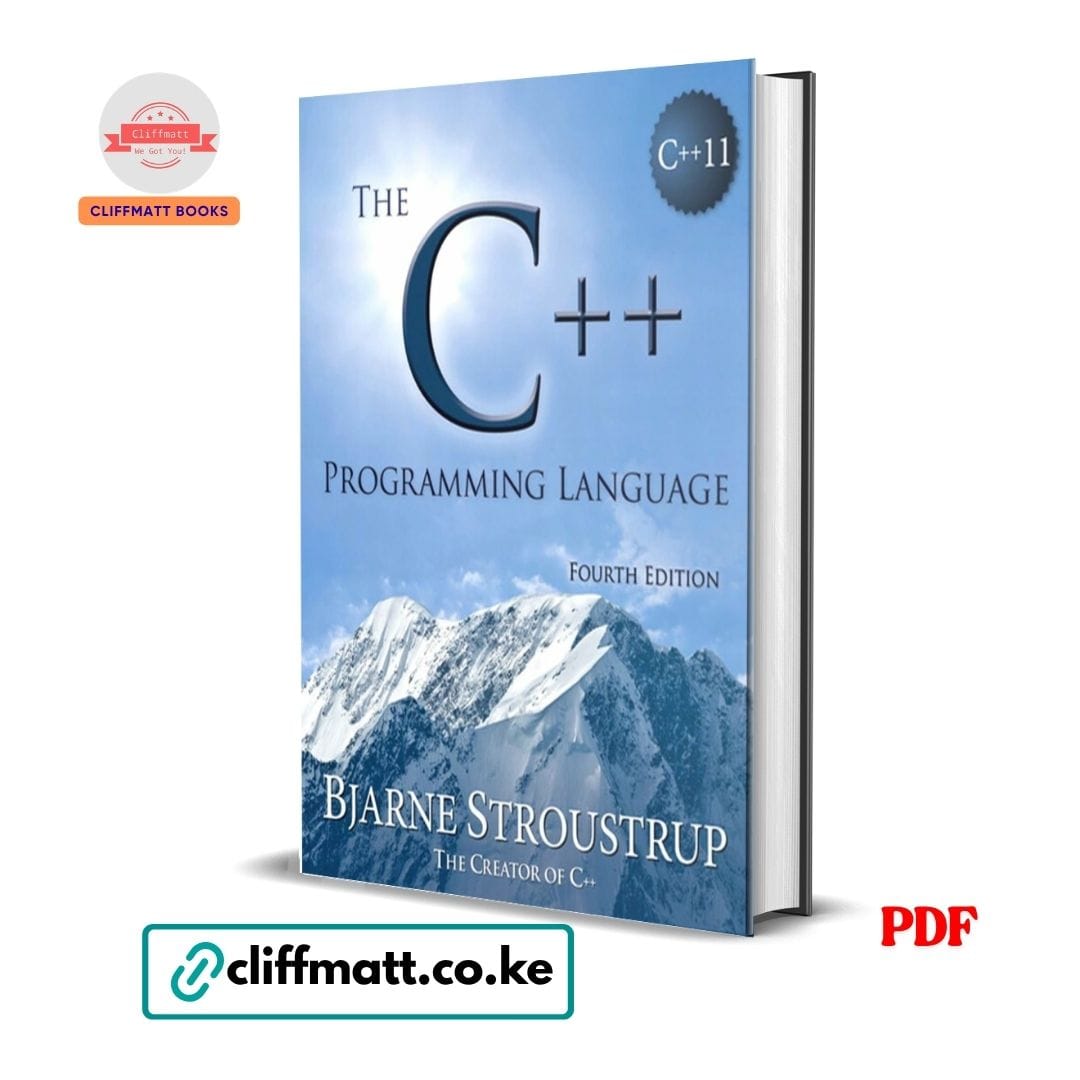
There is only one person in the world who can write the definitive guide to C++: the person who created it. Bjarne Stroustrup invented C++ in the 1980s at Bell Labs. He has been developing it, teaching it, and writing about it ever since. The C++ Programming Language is his complete, authoritative account of the language he built — every feature, every design decision, every nuance of usage, written by the one person who understands it from the ground up.
The Fourth Edition covers C++11 — the most significant update to C++ since its creation; the version that added move semantics, lambda expressions, the auto keyword, range-based for loops, smart pointers, and dozens of other features that made C++ both more powerful and more expressive. Mastering C++11 is the foundation for everything in modern C++ development.
This is not a beginner’s tutorial. This is the language reference that every serious C++ developer keeps within reach at all times — and the book that every computer science student who wants to genuinely understand C++ must eventually read. Available now on Cliffmatt Books for Ksh 200.
What This Book Covers:
Part One — Introduction:
- The philosophy of C++ — why Stroustrup designed it the way he did; the specific design principles (zero-overhead abstraction, type safety, direct hardware access) that make C++ simultaneously one of the most powerful and most demanding languages available
- The basics — types, variables, arithmetic, logic, control structures; the specific C++ syntax and semantics that every programmer must master before everything else
- A tour of C++ — the essential features of the language presented in a high-level overview before the deep dive; the specific C++11 additions that distinguish modern C++ from the language of the previous decade
- For Kenyan IT students: C++ is taught at virtually every Kenyan university computer science and IT programme; this is the foundational reference that makes everything else in the curriculum comprehensible
Part Two — Basic Facilities:
- Types, values, and variables — the complete specification of C++’s type system; the specific rules for type conversion, type inference (auto), and the specific type safety mechanisms that prevent the most common programming errors
- Pointers, arrays, and references — the specific memory management mechanisms that are both C++’s greatest power and its greatest source of difficulty for new programmers; how to use them correctly and safely
- Structures, unions, and enumerations — the specific aggregate types that allow programmers to create complex data structures; the specific best practices for each
- Statements and expressions — the complete specification of C++ control flow and expression evaluation; the specific behaviours that distinguish C++ from other languages
- Select operations — the specific operations (copy, move, assignment) that every C++ programmer must understand deeply to write correct, efficient code
Part Three — Abstraction Mechanisms:
- Classes — the central abstraction mechanism of C++; how to define types that behave like built-in types; the specific member functions (constructors, destructors, copy and move operations) that every class must manage
- Construction, cleanup, copy, and move — the complete lifecycle of C++ objects; the specific mechanisms that make C++ resource management both powerful and demanding
- Overloading — how to give the same name to functions that operate on different types; the specific rules that govern overload resolution
- Templates — the most powerful abstraction mechanism in C++; how to write code that works correctly for any type that satisfies specific requirements; the specific template mechanisms that make the standard library possible
- Generic programming — how to use templates to write maximally flexible, maximally efficient code; the specific design patterns of generic C++ programming
- For Kenyan computer science students: templates and generic programming are the most challenging and most powerful aspects of modern C++; Stroustrup’s exposition is the most authoritative available anywhere
Part Four — The Standard Library:
- The standard library overview — the complete library that comes with every C++ implementation; the specific components (containers, algorithms, iterators, strings, streams, numerics, utilities) and how they fit together
- STL containers — vector, list, deque, map, set, and their variants; the specific performance characteristics and the specific use cases for each
- STL algorithms — the 100+ generic algorithms that operate on containers through iterators; the specific algorithms that cover sorting, searching, transforming, and accumulating
- Strings — the specific string handling capabilities of C++11; the specific operations for creating, manipulating, and converting strings
- I/O streams — the complete input/output framework; the specific mechanisms for reading from and writing to files, strings, and the console
- Numerics — the mathematical library; the specific numeric types, the specific mathematical functions, and the specific random number generation facilities
- Concurrency — C++11’s threading library; the specific mechanisms for writing multi-threaded programs; the specific synchronisation primitives that prevent data races
- For Kenyan developers: the standard library is what makes C++ practically usable for real applications; mastering it is the difference between writing correct C++ and fighting the language
A Note on the Edition:
This Fourth Edition covers C++11 — the 2011 standard. C++ has continued to evolve (C++14, C++17, C++20, C++23 have followed), but C++11 remains the foundation that all subsequent standards build upon. Every C++ developer must master C++11 before understanding what came after. This is still the most important single C++ reference available, and Stroustrup’s authorship gives it an authority that no other edition of any C++ book can match.
Pricing Note: Priced at Ksh 200 — Cliffmatt’s specialist technical reference price, matching medical and other professional technical texts.
Who This Book Is For:
- Kenyan computer science and IT students who need the most authoritative C++ reference for their university coursework
- Kenyan software developers who use C++ professionally and who want the definitive language reference rather than a tutorial
- Competitive programmers for whom C++ is the language of choice and for whom deep language knowledge provides competitive advantage
- Game developers, embedded systems engineers, and system programmers for whom C++ performance characteristics make it the only viable language
- Anyone who wants to genuinely understand C++ rather than just use it
📖 Author: Bjarne Stroustrup (Creator of C++)
📄 Format: PDF eBook (instant download via WhatsApp or email)
💰 Price: Ksh 200
🚀 Delivery: Instant after M-Pesa payment confirmation
👉 Order now on cliffmatt.co.ke — Pay via M-Pesa, receive your PDF instantly.









Reviews
There are no reviews yet.