

Description
Forty to forty-five percent of what you do every day is not a decision. It is a habit. The specific route you take to work. The specific way you make your morning coffee. The specific sequence of your evening routine. The specific way you respond to stress. The specific way you handle your finances. Almost half of every day — the half that most directly shapes the specific outcomes of your life — is being run not by your conscious, deliberate decision-making but by the specific automatic routines that your brain has built through repetition and that it now executes without requiring your full attention.
Understanding how those routines work — and how to change them — is the specific knowledge that Charles Duhigg argues is the most practically powerful insight available to anyone who wants to change their health, their productivity, their relationships, their finances, or their organisation.
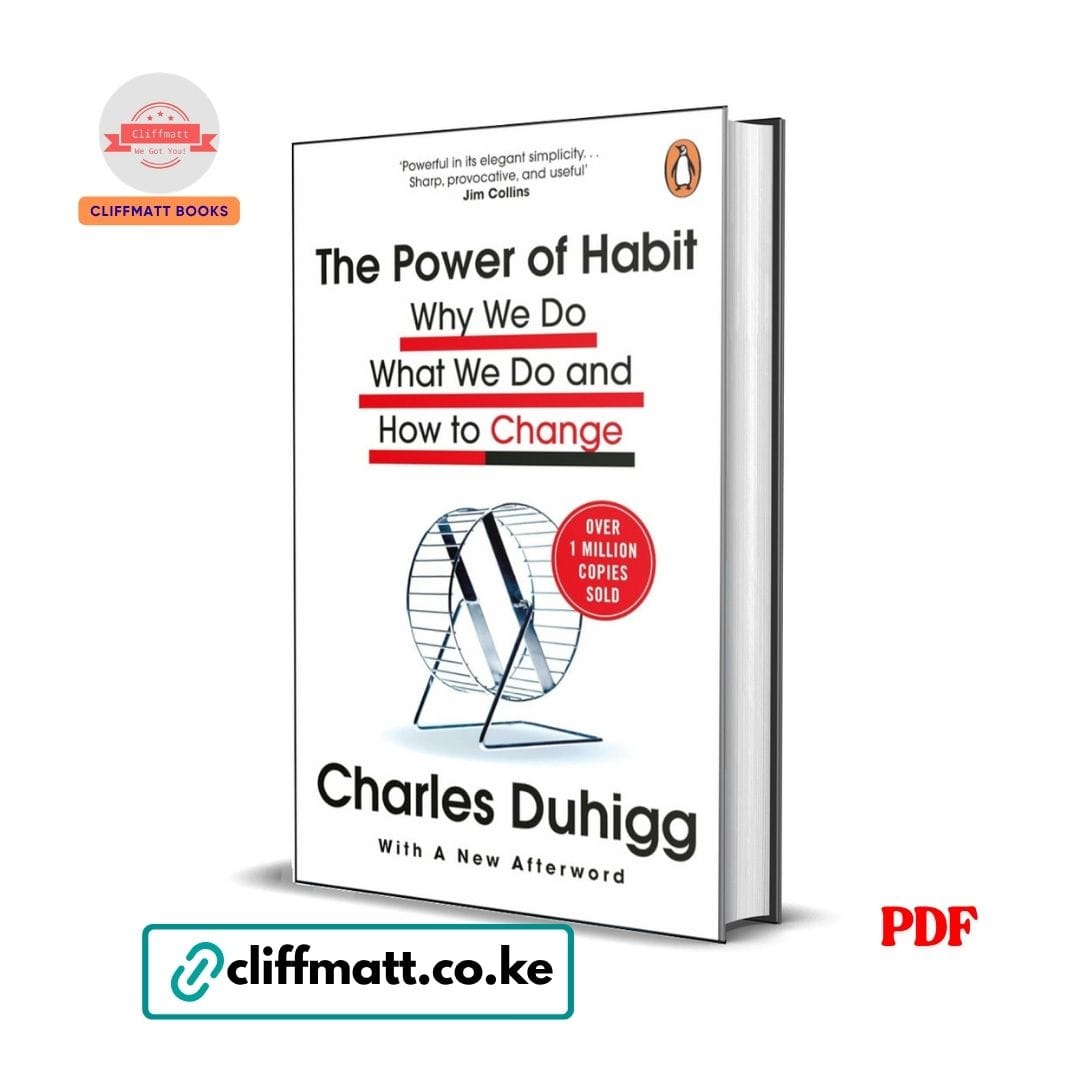
The Power of Habit: Why We Do What We Do and How to Change by Charles Duhigg — Pulitzer Prize-winning journalist, New York Times bestselling author, published by Penguin, over 1 million copies sold, with a new afterword, endorsed by Jim Collins as “powerful in its elegant simplicity… sharp, provocative, and useful” — is the book that brought the science of habits to the world in the most readable, most story-rich, and most immediately applicable form ever assembled.
“Powerful in its elegant simplicity… Sharp, provocative, and useful” — Jim Collins
What This Book Covers:
The Habit Loop — The Architecture of Behaviour:
- The foundational neuroscience of habits — the specific three-part structure (cue → routine → reward) that every habit, good or bad, shares; and the specific way that the brain converts deliberate behaviour into automatic routine through a process called chunking
- Why the brain creates habits — the specific evolutionary logic of habit formation; how the basal ganglia’s role in habit storage frees the prefrontal cortex for the genuinely novel decisions that actually require conscious attention; why habits are a feature of human cognition rather than a flaw
- The habit loop in detail — the specific cue that triggers the routine, the specific routine that the behaviour follows, and the specific reward that reinforces the loop; why understanding all three components of any specific habit is the necessary prerequisite for changing it
- The craving — Duhigg’s crucial addition to the basic habit loop; the specific anticipatory craving that the cue creates for the reward, and that is the actual neurological engine of habitual behaviour; why habits are so much harder to break than people expect, and why the craving explains both the difficulty and the specific solution
- Why you cannot simply eliminate a habit — the specific neuroscience that shows that once a habit loop is established in the basal ganglia it never disappears; and the specific implication of that finding: the only effective strategy for changing a habit is not elimination but replacement — keeping the cue and the reward while changing the routine
The Habit Loop Applied — Individual Habits:
Understanding Your Own Habit Loops:
- How to diagnose the specific habit loops that are producing the specific outcomes you want to change — the specific detective work of identifying the specific cue, the specific routine, and the specific reward driving any problematic habit
- The cue identification challenge — the specific five categories of cues (location, time, emotional state, other people, immediately preceding action) and the specific diagnostic protocol for identifying which category is triggering any specific habit
- The reward identification challenge — why the reward a habit provides is often not what it appears to be; the specific experiments Duhigg describes for identifying the true reward driving any habit through the specific substitution test
- The golden rule of habit change — the single most important principle for changing any habit: keep the cue and the reward exactly the same, change only the routine; and why this specific approach consistently produces lasting change while willpower-based elimination consistently fails
Keystone Habits:
- The most important concept in the book after the habit loop — keystone habits: the specific habits that, when changed, produce cascading positive changes across multiple other habits and behaviours through a process Duhigg calls small wins
- How Paul O’Neill’s transformation of Alcoa through a single keystone habit (worker safety) produced one of the most dramatic organisational turnarounds in American corporate history — and what this tells us about how to identify the keystone habits in our own lives and organisations
- The specific qualities of keystone habits — why they work by creating structures that help other habits flourish; why they produce small wins that generate the specific belief in personal change that makes further change increasingly possible
- The specific keystone habits that research most consistently identifies as the highest-leverage individual habits — exercise, meal planning, sleep, and journalling — and the specific evidence for the cascading positive effects that each produces across other life domains
Willpower — The Habit of Habits:
- The specific neuroscience of willpower — the specific evidence that willpower functions like a muscle: it fatigues with use, it can be trained to become stronger, and the specific conditions (stress, hunger, cognitive load) that deplete it fastest
- The willpower depletion research — why the specific quality of self-regulation consistently decreases over the course of a day; why the specific decision to exercise, to eat well, and to manage impulse is hardest at the end of the day; and the specific implications for designing your environment to require less willpower rather than relying on more of it
- The specific insight that willpower is most effective when it is turned into a habit — the specific practice of pre-deciding how you will respond to specific temptations and difficulties so that the response is automatic rather than requiring willpower in the moment
- The implementation intention — the specific psychological technique (“When X happens, I will do Y”) that converts willpower decisions into habit-like automatic responses; the specific evidence for its effectiveness and the specific way to apply it to your own most challenging habit changes
The Habit Loop in Organisations:
Organisational Habits and Institutional Culture:
- How organisations have habits — the specific routines, the specific procedures, and the specific automatic responses to specific stimuli that characterise every organisation’s day-to-day operation; how these organisational habits were formed, how they are maintained, and why they are both the source of organisational efficiency and the specific source of organisational dysfunction
- The Alcoa case — O’Neill’s use of a single safety habit to transform not just Alcoa’s safety record but its entire culture, its communication systems, its management accountability, and its financial performance; the specific mechanism by which a single keystone habit produced cascading changes across an entire organisation
- Why crises are opportunities for organisational habit change — the specific window of disruption that genuine crises create in which the specific routines that normally resist change become temporarily malleable; the specific leadership practices that use crises to install new routines before the old ones reassert themselves
How Companies Create and Exploit Habits:
- The specific marketing science of habit formation — how companies like Procter & Gamble, Starbucks, and Target have used the specific understanding of habit loops to design products, services, and marketing campaigns that create and exploit habitual customer behaviour
- The Target pregnancy prediction case — the specific story of how Target’s data scientists used purchasing data to identify pregnant customers and change their habitual shopping patterns; what this tells us about the specific power of the habit loop in marketing and the specific ethical questions it raises
- The Febreze case — how P&G transformed a product that consumers resisted into one of their most successful launches by understanding the specific missing component of the Febreze habit loop and adding it; the specific lesson about how a craving must be created for a new habit to form
- The Starbucks case — how Starbucks built a culture of habitual customer service excellence by teaching its employees a specific keystone habit (the LATTE method) that enabled them to handle the specific emotionally challenging customer interactions that most service failures involve
The Habit Loop in Society:
How Social Movements Create Change:
- The specific habit-based analysis of how social movements work — the specific role of strong ties (close relationships) in mobilising initial participation, weak ties (acquaintances) in spreading participation, and the specific creation of new habits and new identities in sustaining participation beyond the initial mobilisation
- The Rosa Parks case — why Rosa Parks’ specific act of resistance became the catalyst for the Montgomery Bus Boycott when earlier similar acts had not; the specific social network analysis that reveals why her particular case activated the specific combination of strong and weak ties that produced a movement
- The Rick Warren case — how Saddleback Church grew to twenty thousand members through the specific creation of small groups that installed the specific habits of prayer, scripture reading, and community service in individual members; what this tells us about how institutions change behaviour at scale through habit rather than through doctrine
- The specific implication for Kenyan community change — how the specific understanding of keystone habits, small wins, and the social habit loop applies to the specific challenges of community development, organisational culture change, and social movement building in Kenya’s specific institutional and cultural context
Appendix — A Reader’s Guide to Using These Ideas:
- The specific framework for diagnosing and changing any habit — the step-by-step application of the habit loop analysis to your own specific habit challenges; the specific questions to ask, the specific experiments to run, and the specific indicators of progress to watch for
- The specific applications across different life domains — health habits, productivity habits, financial habits, relationship habits — with the specific adaptations of the core framework that each domain requires
- How to use the habit loop framework in organisational change — the specific leadership practices for identifying and targeting the keystone habits of underperforming organisations; the specific role of crisis in creating the specific window for organisational habit change
The New Afterword — Fifteen Years Later:
- What the fifteen years since the book’s original publication have added to the science of habits — the specific new research that has refined, confirmed, and extended the core framework; the specific ways that the understanding of habits has deepened across neuroscience, psychology, and organisational behaviour
- Duhigg’s own reflections on how writing this book changed his own habits — the specific personal honesty that makes the afterword a model of the habit change process the book describes
Why Kenyan Achievers Are Buying This Book: The Power of Habit addresses the specific gap between knowing what you should do and actually doing it — between the specific New Year resolution that feels genuine on January 1st and the same resolution that has been abandoned by January 31st. Every Kenyan professional, every Kenyan entrepreneur, every Kenyan student, and every Kenyan parent who has experienced that specific gap will find in Duhigg’s framework the most scientifically rigorous and most practically structured explanation of why it happens — and the most evidence-based guide to making it stop.
At Ksh 100, this is over one million copies’ worth of habit science and practical transformation guidance.
Who This Book Is For:
- Every Kenyan who wants to understand why they keep doing what they know they should stop doing — and the specific, science-based approach to genuinely changing it
- Entrepreneurs and professionals who want to understand and change the specific organisational habits that are limiting their team’s performance
- Parents who want to understand the specific habit formation dynamics of childhood and how to install the specific keystone habits that produce the outcomes they want for their children
- Healthcare professionals who counsel patients on behaviour change and want the most rigorously evidence-based framework for understanding why patients fail to change the behaviours that are harming them
- Every reader of Atomic Habits (Clear), Daily Self-Discipline (Edwards), Grit (Duckworth), and Essentialism (McKeown) who wants the most scientifically comprehensive account of habit neuroscience and organisational habit change to complete their behaviour change library
📖 Author: Charles Duhigg (With a New Afterword) 🏢 Publisher: Penguin 📄 Format: PDF eBook (instant download via WhatsApp or email) 💰 Price: Ksh 100 only 🚀 Delivery: Instant after M-Pesa payment confirmation
👉 Order now on cliffmatt.co.ke — Pay via M-Pesa, receive your PDF instantly.








Reviews
There are no reviews yet.