


Description
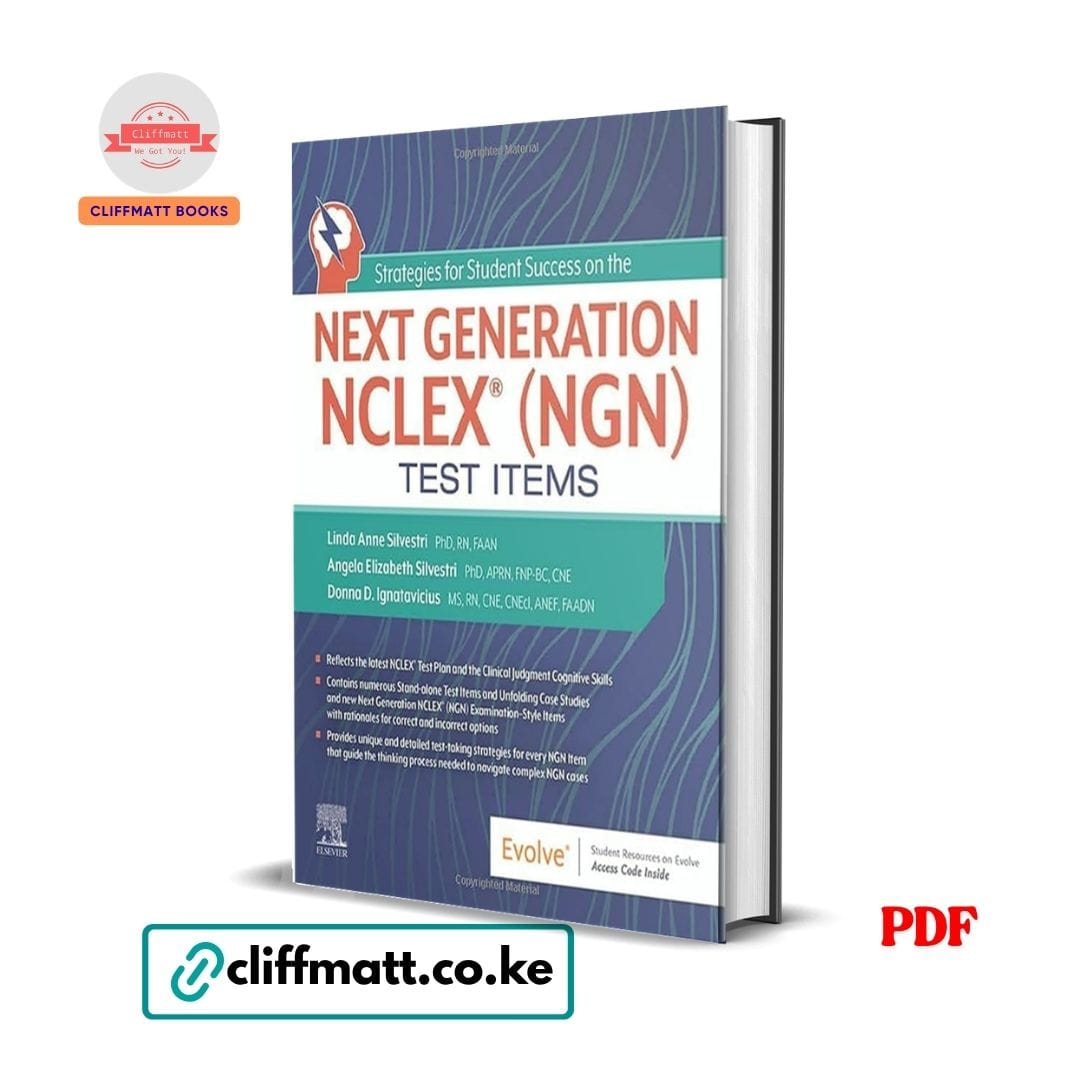
The NCLEX has changed. Fundamentally, structurally, and in ways that make every previous preparation strategy partially obsolete. The Next Generation NCLEX® (NGN) is not simply a harder version of the classic NCLEX. It is a different kind of examination — one designed to assess not just nursing knowledge but the specific Clinical Judgment that separates safe, competent nurses from those who merely recall facts. It tests how you think, not just what you know. And preparing for it requires a guide that was built specifically for what it has become.
Strategies for Student Success on the Next Generation NCLEX® (NGN) Test Items — published by Elsevier, the world’s leading medical and nursing publisher, and authored by Linda Anne Silvestri PhD RN FAAN, Angela Elizabeth Silvestri PhD APRN FNP-BC CNE, and Donna D. Ignatavicius MS RN CNE CNEcl ANEF FAADN — is exactly that guide. These are among the most respected names in NCLEX preparation in the world. Their preparation resources have helped hundreds of thousands of nursing students pass the NCLEX across multiple exam generations. This book represents their most current, most rigorously updated response to the most significant change in NCLEX history.
For every Kenyan nurse pursuing NCLEX licensure for practice in the United States, the United Kingdom, Canada, Australia, or any other country that accepts NCLEX certification — this is the book that the current examination demands.
What This Book Covers:
Understanding the Next Generation NCLEX — What Has Changed and Why:
- The specific reasons the NCLEX was redesigned — what research on nursing error, patient safety, and the gap between nursing school performance and clinical competence revealed about what the classic examination was failing to measure
- The Clinical Judgment Measurement Model (CJMM) — the theoretical framework that underlies the NGN; the specific cognitive processes (recognising cues, analysing cues, prioritising hypotheses, generating solutions, taking action, evaluating outcomes) that every NGN item is designed to assess
- How the NGN differs from the classic NCLEX in format, in scoring, in item type, and in the cognitive demands it places on the candidate — and why that difference requires a fundamentally different preparation approach
- The latest NCLEX Test Plan — the specific content areas, the specific client need categories, and the specific distribution of questions across those categories that determine what the examination tests and in what proportion
- The Computerised Adaptive Testing (CAT) mechanism and how it interacts with NGN item types — what candidates need to understand about how the examination adapts to their performance and what that means for preparation strategy
The New Item Types — Complete Mastery:
The NGN introduces item types that did not exist in the classic examination. Every Kenyan nurse preparing for NCLEX must understand and practise each one specifically:
- Extended Multiple Response — selecting all correct answers from a list of options; how this differs from classic multiple-choice and the specific reasoning approach that produces correct responses
- Extended Drag-and-Drop — organising information or sequencing nursing actions; the clinical judgment skills assessed by this item type and how to approach them systematically
- Cloze (Drop-Down) — completing sentences or tables by selecting from drop-down menus; how this item type tests the integration of assessment findings with nursing decisions
- Enhanced Hot Spot — identifying areas on an image or highlighting specific text; the clinical assessment skills these items test and how to develop the visual and analytical reasoning they require
- Matrix/Grid — making multiple decisions simultaneously across rows and columns; how to approach the complex, multi-variable clinical scenarios these items present without becoming overwhelmed
- Bow-Tie Items — the most complex NGN item type, requiring the candidate to simultaneously identify client conditions, identify actions to take, and identify parameters to monitor; the specific three-part clinical judgment this item type assesses and the systematic approach that consistently produces correct responses
Unfolding Case Studies — The Signature NGN Format:
- What unfolding case studies are — the extended clinical scenarios that develop across six items, each presenting new clinical information and requiring clinical judgment decisions at different stages of a patient’s care
- How unfolding case studies differ from classic NCLEX scenarios — the specific challenge of integrating new information with previous findings, of updating clinical judgments as the clinical picture changes, and of maintaining analytical rigour across six connected questions
- The specific approach to unfolding case studies that the authors teach — how to read each item, how to use the evolving clinical information, how to avoid the specific cognitive errors that these scenarios are designed to catch, and how to allocate your thinking time across the six items
- The clinical content areas most commonly featured in NGN unfolding case studies — the specific patient populations, clinical conditions, and nursing care settings that candidates should ensure they have thoroughly reviewed before examination day
- Stand-alone NGN items — how these differ from the unfolding case study format and what preparation approach each requires
The Clinical Judgment Cognitive Skills — Deep Development:
The six cognitive skills of the Clinical Judgment Measurement Model are the engine of every NGN item. This book develops each one specifically:
- Recognise Cues — how to identify the relevant clinical data in a complex patient presentation; the specific practice of distinguishing significant from insignificant findings, expected from unexpected, and urgent from non-urgent in the specific context of each clinical scenario
- Analyse Cues — how to interpret the clinical significance of recognised cues; the specific pathophysiological reasoning, the specific pattern recognition, and the specific clinical knowledge that transforms raw data into meaningful clinical understanding
- Prioritise Hypotheses — how to rank potential nursing diagnoses and medical conditions in order of urgency and likelihood; the specific clinical judgment that must be applied quickly in examination conditions when multiple hypotheses are simultaneously plausible
- Generate Solutions — how to identify the specific nursing interventions, assessments, and collaborative actions that are most appropriate given the prioritised hypothesis; the specific clinical knowledge of nursing interventions, their mechanisms, their expected outcomes, and their potential complications
- Take Action — how to sequence nursing actions correctly; the specific reasoning about what to do first, what can wait, and what requires immediate escalation that determines safe clinical performance
- Evaluate Outcomes — how to assess whether nursing and medical interventions are producing the expected results, and how to recognise and respond to outcomes that indicate deterioration, complication, or inadequate response
Test-Taking Strategies — The Authors’ Signature Contribution:
- The specific test-taking strategies that Silvestri has developed across decades of NCLEX preparation — strategies that are not tricks but specific logical approaches to each item type that consistently guide the thinking process toward correct answers
- How to approach items when you are uncertain — the specific elimination strategies, the specific reasoning from first principles, and the specific clinical safety logic that produces better outcomes than guessing
- Time management on the NGN — how to allocate your examination time across different item types, how to handle the specific time demands of unfolding case studies, and how to maintain analytical quality across a potentially lengthy examination
- Managing examination anxiety — the specific cognitive and behavioural strategies that maintain clear thinking under examination pressure; why anxiety management is not a soft skill but an examination performance skill with direct impact on results
- The specific errors that NGN candidates most commonly make — item misreading, premature answer selection, failure to use all available clinical information, and the specific cognitive shortcuts that produce incorrect responses; how to avoid each
Clinical Content Review — Knowledge Foundation:
- The specific clinical knowledge areas that NGN items most heavily draw upon — medical-surgical nursing, pharmacology, mental health nursing, maternity and paediatric nursing, and community health — reviewed with the specific depth and the specific clinical judgment application that the NGN requires
- Pharmacology for the NGN — the specific drug classes, their mechanisms, their expected outcomes, their adverse effects, and the specific nursing assessment and intervention knowledge that NGN pharmacology items consistently test
- Priority setting and delegation — the specific NCLEX framework for determining which patient to assess first, which interventions to perform before calling the physician, and which tasks can be delegated to unlicensed assistive personnel; the specific clinical safety logic that underlies every priority-setting item
- Safety and infection control — the specific NGN emphasis on patient safety, error prevention, and the clinical judgment that identifies and responds to safety risks before they produce patient harm
Rationales — Learning from Every Question:
- Every practice item in this book is accompanied by detailed rationales for both correct and incorrect answers — the specific feature that transforms practice questions from performance tests into learning opportunities
- How to use rationales effectively — not simply to confirm correct answers but to understand the specific reasoning behind every option, including the specific clinical reasons why each incorrect option is wrong
- The specific learning approach that produces maximum improvement from practice question review — how to analyse your patterns of error, how to identify the specific knowledge gaps or reasoning errors they reveal, and how to target your content review to address exactly those gaps
Why Kenyan Nurses Are Buying This Book: Kenya’s most ambitious nurses are pursuing NCLEX licensure in increasing numbers — drawn by the professional opportunities, the compensation, and the global clinical experience available in the United States, the UK, Canada, and other NCLEX-accepting countries. The NGN is the examination that stands between them and those opportunities. And the NGN is significantly more demanding than the classic NCLEX that previous preparation resources were built for.
Strategies for Student Success on the Next Generation NCLEX® Test Items is the most current, most specifically NGN-targeted, and most rigorously authored preparation resource available anywhere in the world — now accessible to every Kenyan nurse at Ksh 100.
A Note on the Evolve Access Code: The physical book includes an Evolve access code for online student resources. As a PDF eBook, the Evolve online content is not included. The PDF provides the complete print content — all test items, all unfolding case studies, all test-taking strategies, and all rationales — which constitutes the primary and most comprehensive preparation resource in the book.
Who This Book Is For:
- Kenyan nurses preparing for the NCLEX-RN or NCLEX-PN under the Next Generation format — the most important and most time-sensitive audience for this title
- Nursing students in their final year who want to begin NGN preparation before graduation
- Kenyan nurses who have previously attempted the NCLEX under the classic format and are preparing for an NGN attempt
- Nursing educators and lecturers at Kenyan nursing schools who want the most current resource for teaching clinical judgment and NCLEX preparation to their students
- Every reader of CMDT 2026, Robbins & Kumar Basic Pathology, and Math for Nurses in your medical catalogue who wants the specific NCLEX preparation resource to complete their professional nursing library
📖 Authors: Linda Anne Silvestri PhD RN FAAN, Angela Elizabeth Silvestri PhD APRN FNP-BC CNE, Donna D. Ignatavicius MS RN CNE CNEcl ANEF FAADN 🏢 Publisher: Elsevier 📄 Format: PDF eBook (instant download via WhatsApp or email) 💰 Price: Ksh 100 only 🚀 Delivery: Instant after M-Pesa payment confirmation
👉 Order now on cliffmatt.co.ke — Pay via M-Pesa, receive your PDF instantly.










Reviews
There are no reviews yet.