

Description
English is Kenya’s official language of education, government, law, business, and professional advancement. It is the language in which Kenyan students sit their KCSE examinations, write their university assignments, apply for their jobs, present in their boardrooms, and build their careers. It is the language that separates a Kenyan professional who is taken seriously from one who is not — and the difference between those two outcomes is frequently not intelligence, not knowledge, and not work ethic. It is grammar.
Specifically: it is the specific, precise, consistently applied understanding of English grammar that allows a person to write clearly, speak confidently, and present themselves with the authority that proper English commands in every formal Kenyan context.
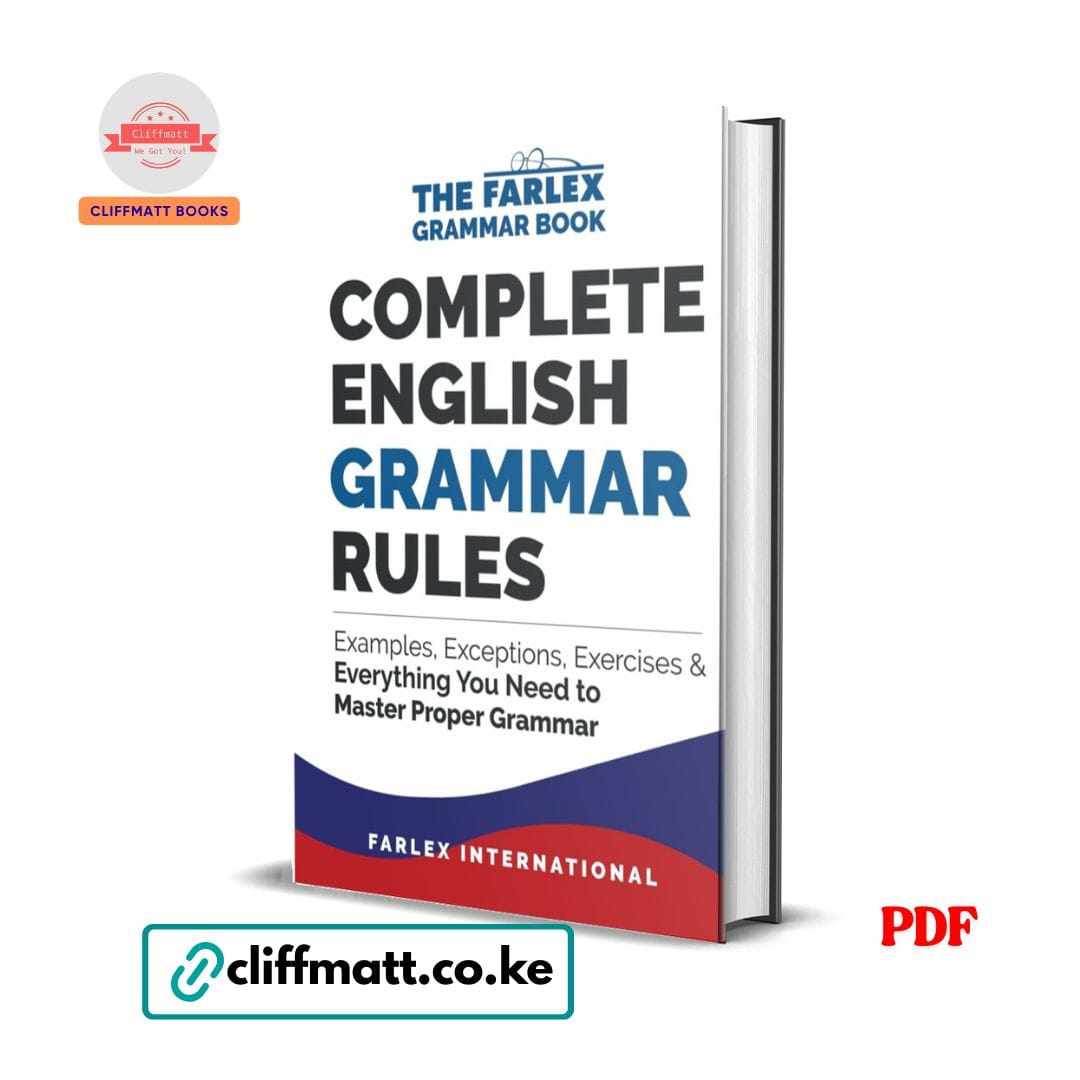
The Farlex Grammar Book: Complete English Grammar Rules — from Farlex International, publishers of TheFreeDictionary.com, one of the world’s most visited online language references — is the most comprehensive, most clearly structured, and most immediately usable complete English grammar reference ever assembled in a single volume. Drawing on the same authoritative, meticulously researched grammar content that has made Farlex’s online resources trusted by millions of English users worldwide, this book brings every rule, every exception, every example, and every exercise together in the most complete printed grammar reference available at any price — let alone Ksh 100.
The cover tells you exactly what you are getting — bold, no-nonsense typography on a clean white background with a navy and red banner: Complete English Grammar Rules. Examples, Exceptions, Exercises and Everything You Need to Master Proper Grammar. Everything. Not a selection. Not an introduction. Not a simplified overview. Everything.
What This Book Covers:
Parts of Speech — The Building Blocks of Every Sentence:
- Nouns — common and proper, concrete and abstract, countable and uncountable, collective nouns, compound nouns, possessive forms; every noun category with the specific rules and exceptions that confuse Kenyan writers most consistently
- Pronouns — personal, possessive, reflexive, relative, interrogative, demonstrative, and indefinite pronouns; pronoun-antecedent agreement; the specific pronoun errors that appear most frequently in Kenyan academic and professional writing
- Verbs — action verbs, linking verbs, auxiliary verbs, modal verbs; regular and irregular conjugations; transitive and intransitive verbs; phrasal verbs; the specific verb constructions that cause the most consistent confusion for Kenyan English users
- Adjectives — descriptive, quantitative, demonstrative, possessive, interrogative, and proper adjectives; comparative and superlative forms; adjective order rules; the specific adjective errors that mark writing as non-native
- Adverbs — manner, place, time, frequency, degree, and sentence adverbs; comparative and superlative adverbs; adverb placement rules and the specific placement errors most common in Kenyan writing
- Prepositions — prepositions of place, time, movement, and manner; prepositional phrases; the specific preposition collocations that cannot be derived from rules but must be learned — and that this book provides comprehensively
- Conjunctions — coordinating, subordinating, and correlative conjunctions; the specific rules for comma use with each conjunction type; the most common conjunction errors in formal Kenyan writing
- Interjections — their grammatical function and appropriate use in formal versus informal writing contexts
- Articles — definite, indefinite, and zero article; the specific article usage rules that are among the most consistently difficult for Kenyan English users to master, with extensive examples and exercises
Sentence Structure — Building Correct and Effective Sentences:
- Subjects and predicates — how to identify, construct, and vary sentence subjects and predicates for both grammatical correctness and rhetorical effectiveness
- Phrases — noun phrases, verb phrases, adjective phrases, adverb phrases, and prepositional phrases; how each functions within a sentence and how to use them to add precision and variety to writing
- Clauses — independent and dependent clauses; relative clauses; noun clauses; adverbial clauses; the specific clause construction errors that most consistently undermine the quality of Kenyan academic and professional writing
- Sentence types — simple, compound, complex, and compound-complex sentences; when each is most appropriate; how to vary sentence structure for clarity, emphasis, and rhetorical power
- Subject-verb agreement — the complete set of agreement rules including the most commonly violated exceptions; collective nouns, indefinite pronouns, compound subjects, inverted sentences, and the specific agreement errors that appear most frequently in Kenyan writing
- Sentence fragments and run-on sentences — how to identify each, why they undermine written communication, and the specific corrections that transform them into grammatically complete, professionally acceptable sentences
Punctuation — The Signals That Make Writing Clear:
- The full stop, the comma, the semicolon, the colon, the apostrophe, the quotation marks, the hyphen, the dash, the ellipsis, the parentheses, the brackets, and the slash — every punctuation mark with every rule governing its use
- Comma rules in full detail — the specific fourteen-plus contexts in which a comma is required or optional, with examples of each; the most common Kenyan comma errors, including comma splices and missing serial commas
- The apostrophe — possessive and contraction uses; the specific apostrophe errors (it’s versus its, your versus you’re) that are the most visible markers of grammatical uncertainty in any written document
- Quotation marks in formal academic and professional writing — the specific rules for integrating quotations, the punctuation that goes inside and outside quotation marks, and the consistent errors that undermine the credibility of Kenyan academic writing
- Capitalisation rules — the comprehensive set of capitalisation conventions covering proper nouns, titles, first words, and the specific Kenyan capitalisation errors that appear most frequently in formal documents
Verb Tenses — Expressing Time with Precision:
- All twelve English tenses — simple, continuous, perfect, and perfect continuous in present, past, and future — explained with the specific rules, the specific time expressions associated with each, and the specific errors that result from tense confusion
- The present simple versus present continuous — the most consistently confused tense pair in Kenyan English, with the specific rules that distinguish stative from dynamic verbs and the exercises that cement that distinction
- The past simple versus the present perfect — the second most commonly confused pair, with the specific Kenyan English errors that result from treating them as interchangeable, and the clear rules that resolve the confusion permanently
- Future forms — will, going to, present simple, and present continuous as future markers; when each is appropriate and the specific errors that result from treating them as synonymous
- Conditional sentences — zero, first, second, third, and mixed conditionals; the specific structure of each, the specific time references each expresses, and the specific construction errors most common in Kenyan academic and professional writing
- Passive voice — formation, appropriate use, and the specific contexts where passive construction is required, preferred, or to be avoided; a particular focus on passive voice in academic and scientific writing where Kenyan students most need clarity
Style, Usage, and Commonly Confused Words:
- Commonly confused word pairs — affect/effect, then/than, there/their/they’re, its/it’s, who/whom, lay/lie, and dozens of others; the complete rules for each pair with memorable examples
- Commonly misused expressions — the specific idiomatic errors that mark writing as uncertain, including dangling modifiers, misplaced modifiers, double negatives, and redundant expressions
- Formal versus informal English — the specific register differences that every Kenyan professional writer needs to understand for academic submissions, business correspondence, job applications, and official documents
- Concise writing — how to eliminate wordiness, redundancy, and the inflated constructions that pad length without adding meaning; the specific editing approaches that produce cleaner, more professional writing
- Parallel structure — the grammatical principle that produces balanced, professional sentences and whose violation produces the awkward, list-breaking constructions that weaken otherwise competent writing
Exercises and Practice:
- Each grammatical topic is accompanied by specific exercises that test understanding, identify persistent errors, and build the muscle memory of correct grammar through deliberate practice
- Answer keys that allow self-study learners to assess their own understanding accurately and target their practice at the specific areas of weakness their answers reveal
- Cumulative exercises that integrate multiple grammatical concepts in realistic writing contexts — the bridge between knowing rules and applying them automatically in actual writing
Why Kenyan Students and Professionals Are Buying This Book:
English grammar mastery in Kenya is not an academic nicety. It is a professional necessity. The Kenyan job application that contains grammatical errors does not get to interview. The Kenyan student’s university essay that demonstrates grammatical uncertainty loses marks before the examiner evaluates its ideas. The Kenyan professional’s email, report, or proposal that contains punctuation errors or subject-verb agreement mistakes signals a lack of attention to detail that follows that professional into every future professional interaction.
The Farlex Grammar Book provides the most complete, most clearly explained, and most extensively practised English grammar reference available to any Kenyan student, professional, or writer — at Ksh 100. It is the reference that every Kenyan who uses English professionally should have at hand, should have read completely at least once, and should return to every time a grammatical question arises.
Who This Book Is For:
- Kenyan secondary school and university students who want the complete grammar reference that transforms essay writing, report writing, and academic communication from a source of uncertainty into a source of confidence
- KCSE candidates preparing for English language examinations who need the comprehensive rule coverage that most classroom instruction provides in fragments rather than in complete, systematic form
- Kenyan professionals — in law, medicine, banking, education, government, and every field where formal written English is required — who want to eliminate the specific grammatical uncertainties that undermine the authority of their written communication
- English teachers at Kenyan secondary schools and primary schools who want the most complete, most authoritative grammar reference to inform their own teaching and to recommend to their students
- Job applicants and CV writers who understand that grammatical errors in application documents are among the most common and most consequential reasons for rejection
- Writers, bloggers, content creators, and journalists who want to write with full grammatical confidence and eliminate the specific errors that undermine the credibility of their published work
- Every reader of English Grammar Workbook for Adults already in your catalogue who wants the complete Farlex Grammar Book as the comprehensive reference complement to that practice-oriented workbook
📖 Publisher: Farlex International 📄 Format: PDF eBook (instant download via WhatsApp or email) 💰 Price: Ksh 100 only 🚀 Delivery: Instant after M-Pesa payment confirmation 👉 Order now on cliffmatt.co.ke — Pay via M-Pesa, receive your PDF instantly.




Reviews
There are no reviews yet.