

Description
Most organisational improvement initiatives fail. They are announced with enthusiasm, resourced with energy, and abandoned within eighteen months when the specific results fall short of the specific expectations. The reason is almost always the same: the specific improvement effort was imposed from the top down, designed in a conference room far from where the work actually happens, and treated as a project with a beginning and an end rather than a culture with no end at all.
Kaizen — the Japanese word for continuous improvement — is the specific alternative to that pattern. Not a project. Not an initiative. Not a management programme. A culture: the specific daily, incremental, people-driven practice of making the work better, the process cleaner, the waste smaller, and the quality higher — not through dramatic overhauls but through the specific accumulation of small, consistent improvements made by the specific people who do the work, in the specific place where the work is done.
That place is the gemba — Japanese for “the real place”, the specific location where value is actually created. The factory floor. The hospital ward. The customer service counter. The farm. The classroom. The specific place where the organisation’s actual work happens and where the specific improvement opportunity is always greatest and always most immediately visible.
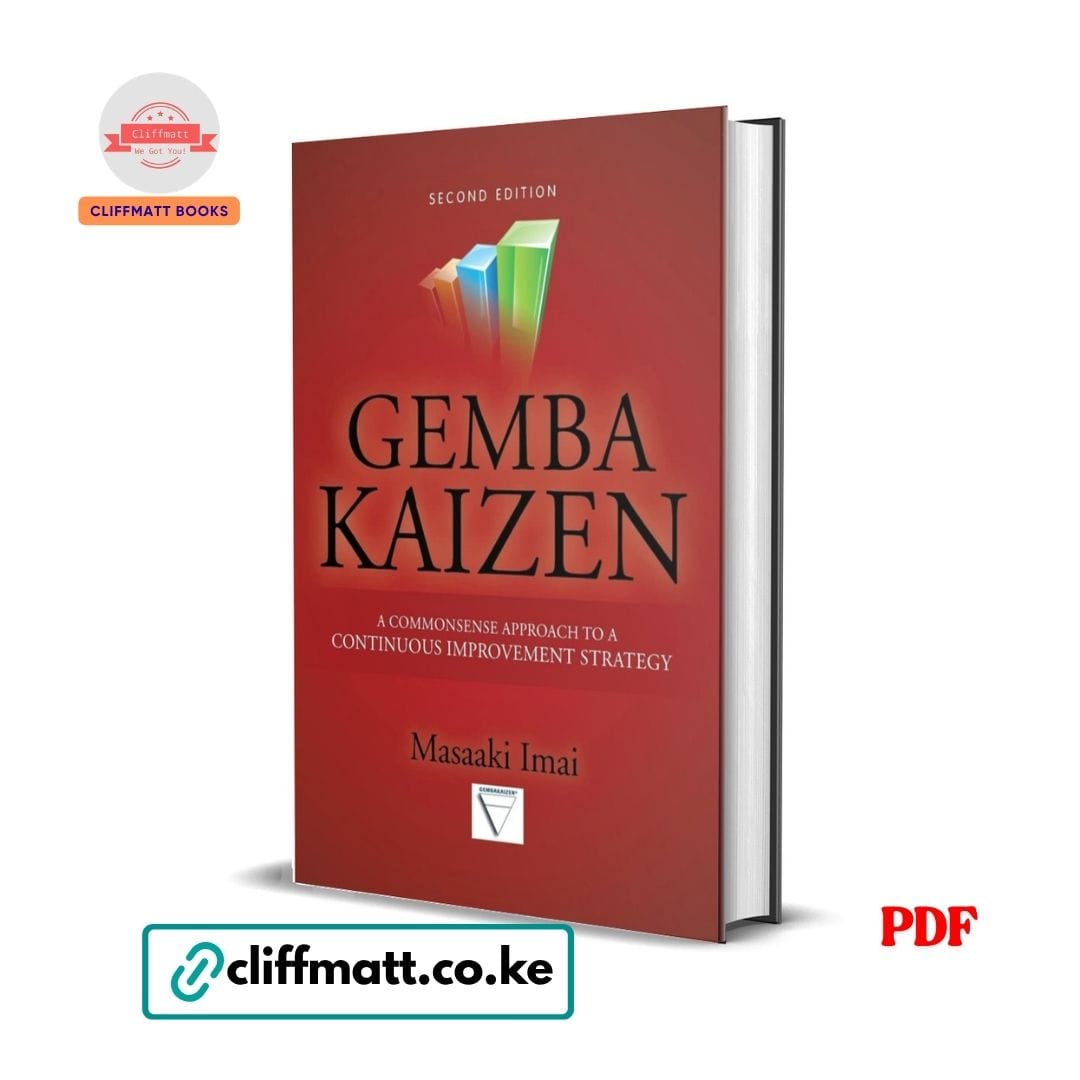
Gemba Kaizen: A Commonsense Approach to a Continuous Improvement Strategy (Second Edition) by Masaaki Imai — the man who introduced the concept of Kaizen to the Western world — is the most authoritative, most practically structured, and most comprehensively evidenced guide to Kaizen as a complete organisational philosophy and a specific, daily, operational discipline. With the second edition’s updated case studies, updated frameworks, and updated applications across manufacturing, service, healthcare, and public sector contexts, this is the definitive Kaizen reference for every Kenyan leader, manager, and professional who wants to build an organisation that improves every day.
What This Book Covers:
The Philosophy — What Kaizen Actually Means:
- The specific definition of Kaizen — the Japanese compound of kai (change) and zen (good); why the specific translation as “continuous improvement” captures the direction but not the depth of what Kaizen actually represents as an organisational philosophy
- The specific Kaizen mindset versus the Western innovation mindset — the specific cultural difference between organisations that make large, infrequent, capital-intensive improvements and those that make small, daily, people-powered ones; the specific evidence for which approach produces better long-term quality, lower long-term cost, and greater long-term competitive advantage
- The three pillars of Gemba Kaizen — housekeeping (5S), waste elimination (muda), and standardisation; how these three practices together create the specific operational foundation from which genuine continuous improvement grows and from which quality, efficiency, and cost performance consistently improve
- Why Kaizen is everybody’s job — the specific Kaizen principle that improvement is not the exclusive responsibility of management, engineering, or a dedicated improvement team, but the specific daily responsibility of every person who does any work anywhere in the organisation; the specific management systems that make this principle operational rather than aspirational
The Gemba — Where Improvement Happens:
- The specific gemba philosophy — the Kaizen principle that problems are solved and improvements are made at the place where the work happens, not in the management office or the conference room; the specific management practice of going to the gemba when a problem occurs rather than receiving reports about it
- The specific gemba management practices — the daily walk-through, the direct observation, the specific questions (What is the standard? Is the standard being followed? What is the problem? How are we improving?) that the Kaizen-oriented manager asks at every gemba visit; why this specific management presence produces both better performance and better engagement
- The specific gemba observation methodology — how to observe work processes with the specific attention to waste, to variation, and to the specific improvement opportunities that trained Kaizen eyes consistently identify and untrained eyes consistently overlook
- The gemba problem-solving approach — the specific immediate response to problems at the place where they occur: contain the problem, find the root cause, implement a countermeasure, verify the result, standardise the solution; the specific contrast with the report-and-decide approach that delays problem resolution while the problem continues producing its specific damage
5S — The Foundation of Gemba Kaizen:
- Seiri (Sort) — the specific practice of separating necessary from unnecessary items at the gemba; how the specific red-tagging methodology identifies the specific items that belong in the work area, the specific items that should be stored elsewhere, and the specific items that should be discarded; why the cluttered gemba is the specific sign of an organisation that has not begun its Kaizen journey
- Seiton (Set in Order) — the specific practice of organising necessary items so that they are immediately findable and immediately accessible; the specific principle that everything has a place and everything is in its place; how this specific practice eliminates the specific search waste that most work environments generate continuously without anyone measuring its specific cost
- Seiso (Shine) — the specific practice of cleaning the gemba not as a one-time event but as a daily discipline; the specific Kaizen understanding that cleanliness is not aesthetic but operational — that the clean machine reveals the specific problems (oil leaks, component wear, abnormal vibration) that the dirty machine conceals
- Seiketsu (Standardise) — the specific practice of making the first three S’s not occasional events but daily standards; the specific visual management tools (colour coding, shadow boards, floor markings) that make the standard condition instantly visible and deviations from it instantly detectable
- Shitsuke (Sustain) — the specific, most difficult of the five S’s; the specific management discipline, the specific employee habit, and the specific organisational culture that sustains the standard condition rather than allowing the natural entropy that degrades every unmanaged system over time
- The specific 5S audit methodology — how to measure 5S progress; the specific scoring systems and the specific visual management tools that make the current state of any gemba immediately visible to any observer
Muda — Waste Elimination:
- The specific seven types of muda (waste) that Imai identifies as the most common and most costly forms of non-value-adding activity in any work process: overproduction, inventory, defects, motion, processing, waiting, and transport; the specific manifestation of each waste type in manufacturing, service, healthcare, and administrative processes
- The specific waste identification methodology — how to observe any work process with the specific question: Does this activity add value for the customer?; the specific discipline of distinguishing value-adding activity from the specific waste that surrounds it in most work processes
- The specific waste elimination approach — not the dramatic redesign but the specific, incremental, gemba-level improvement that removes one waste at a time from the specific process being improved; how the accumulation of small waste eliminations produces significant process improvement over months and years of consistent Kaizen practice
- The specific value stream mapping — the specific tool for visualising the entire flow of value from raw material through finished product, identifying the specific wastes at each step, and planning the specific Kaizen improvements that will reduce those wastes
- The specific waste costs in the Kenyan context — the specific forms of waste (waiting, motion, unnecessary processing) that most Kenyan workplaces generate daily without measuring or managing; the specific financial and operational cost of that waste and what its elimination would produce
Standardisation — The Engine of Sustained Improvement:
- The specific Kaizen understanding of standardisation — not bureaucratic rigidity but the specific discipline of capturing each improvement in a new standard that becomes the new baseline from which the next improvement is made; why the organisation without standards cannot improve because it has no stable baseline to improve from
- Standard Operating Procedures (SOPs) — the specific Kaizen approach to documenting work standards; the specific design principles (visual, simple, specific, written by the people who do the work) that make SOPs genuinely useful rather than the specific compliance documents that nobody reads
- The PDCA cycle (Plan-Do-Check-Act) — the specific improvement methodology that underlies every Kaizen activity; the specific discipline of planning the improvement hypothesis, doing the experiment, checking the result against the prediction, and acting to standardise the improvement or to adjust the approach if the result was not achieved
- The SDCA cycle (Standardise-Do-Check-Act) — the specific maintenance discipline that operates between Kaizen improvements; how to sustain the standard while preparing for the next improvement cycle; why the organisation that improves without sustaining consistently rediscovers the same problems rather than building on each improvement toward the next
Kaizen Events and Tools:
- Kaizen blitz / Kaizen events — the specific concentrated, cross-functional, gemba-focused improvement workshops that produce rapid, visible improvements in targeted work areas; the specific preparation, execution, and follow-up that make Kaizen events produce sustained results rather than temporary excitement
- Quality circles — the specific Kaizen structure of small, self-organised teams of gemba workers who meet regularly to identify, analyse, and solve the specific problems in their own work area; why quality circles produce both operational improvement and employee engagement simultaneously
- Suggestion systems — the specific Kaizen practice of capturing every employee’s improvement ideas in a formal system that ensures each suggestion receives a timely response; the specific evidence for suggestion systems as among the highest-ROI management investments available
- Total Productive Maintenance (TPM) — the specific Kaizen application to equipment; how TPM involves operators in the specific maintenance of their own equipment, eliminates the specific losses (breakdowns, setup time, minor stoppages, reduced speed, defects, startup losses) that equipment underperformance produces, and produces the specific operator ownership of equipment that prevents the specific neglect that produces premature failure
Case Studies — Kaizen Across Industries:
- The specific manufacturing case studies — the specific Kaizen transformations in Japanese and global manufacturing facilities; how specific companies applied specific Kaizen tools to produce specific, measurable improvements in quality, cost, delivery, safety, and morale
- The specific service sector case studies — the specific application of Kaizen principles to banking, hospitality, retail, and the specific service processes where waste elimination and standardisation are equally applicable and equally powerful
- The specific healthcare case studies — the specific application of Kaizen to hospital processes, clinic operations, and the specific healthcare quality and safety challenges that Kaizen is being used to address globally; the specific applications most relevant to Kenya’s healthcare sector
- The specific Kenyan applications — how the specific Kaizen tools and principles apply to Kenya’s specific industrial, agricultural, service, healthcare, and public sector contexts; why the specific challenges of Kenya’s developing economy make the low-cost, people-powered, incremental improvement approach of Kaizen particularly relevant and particularly powerful
Why Kenyan Managers and Leaders Are Buying This Book: Kenya’s most important productive sectors — manufacturing, agriculture, healthcare, education, and public service — are consistently producing below their potential because the specific waste, the specific variation, and the specific quality problems that Kaizen is designed to address are present and unmanaged in virtually every Kenyan work environment. Gemba Kaizen gives every Kenyan leader, every Kenyan manager, and every Kenyan professional who is responsible for any work process the most authoritative and most practically structured guide available to building the specific culture of continuous improvement that consistently and permanently closes the gap between current performance and potential performance.
At Ksh 100, this is the most important operational improvement book ever written — now available to every Kenyan.
Who This Book Is For:
- Kenyan manufacturing managers, production supervisors, and quality professionals who want the most authoritative guide to implementing Kaizen in their specific operations
- Kenyan healthcare managers, hospital administrators, and clinical leaders who want the specific quality improvement methodology that is transforming healthcare delivery globally through its application to the specific processes of patient care
- Kenyan public sector managers and government officials who want the specific operational improvement framework for making government services more efficient, more consistent, and more genuinely useful to the citizens they serve
- Kenyan agribusiness managers and agricultural processing operations who want the specific waste elimination and standardisation tools that improve the specific quality and the specific efficiency of agricultural value chain operations
- Every reader of Actionable Strategies (Bonham), Built to Last (Collins), The Lean Startup (Ries), 100+ Management Models (Fischler), and Leaders Eat Last (Sinek) who wants the most operationally specific and most gemba-focused continuous improvement framework to complete their management library
📖 Author: Masaaki Imai 📄 Format: PDF eBook (instant download via WhatsApp or email) 💰 Price: Ksh 100 only 🚀 Delivery: Instant after M-Pesa payment confirmation
👉 Order now on cliffmatt.co.ke — Pay via M-Pesa, receive your PDF instantly.










Reviews
There are no reviews yet.