


Description
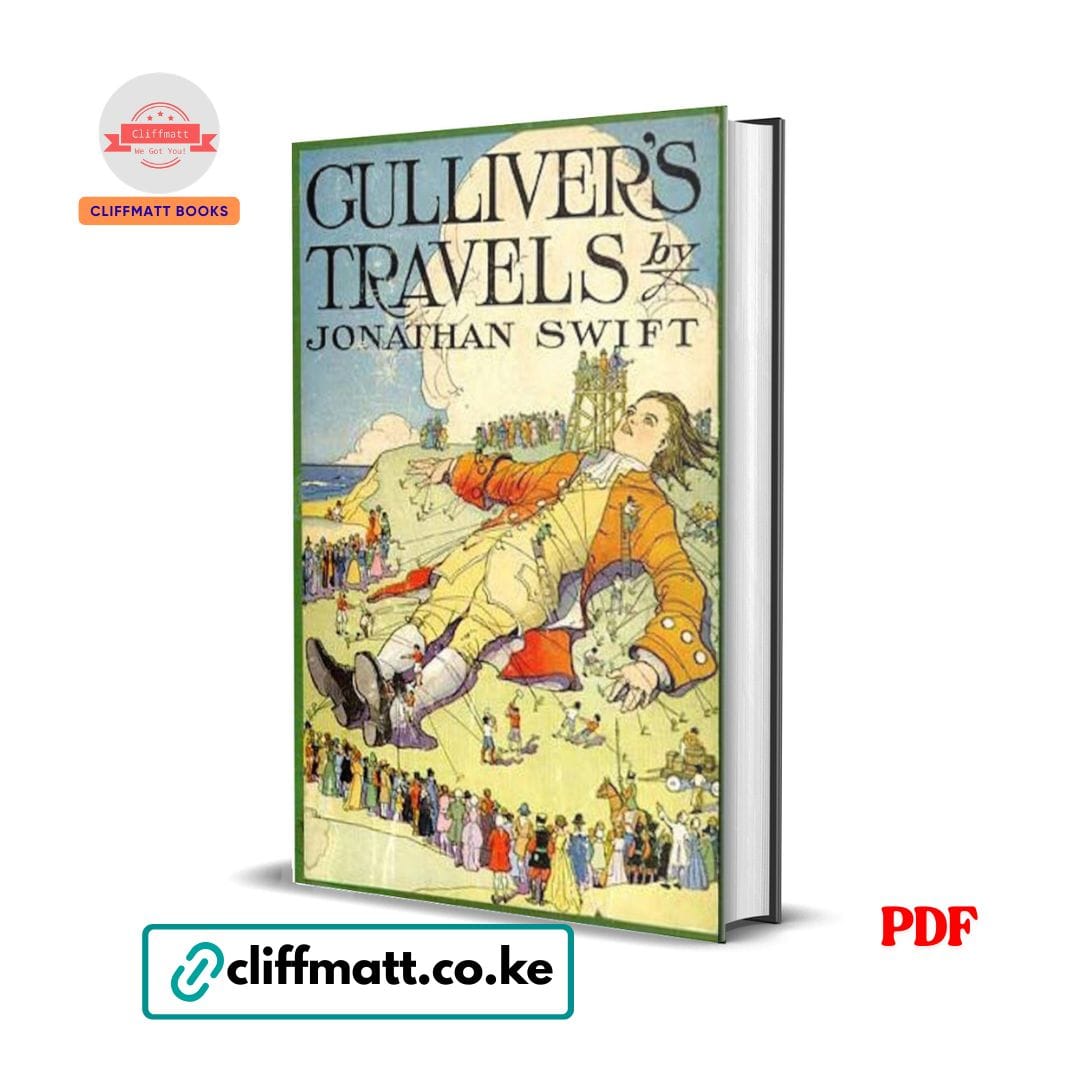
On the surface, Gulliver’s Travels is an adventure story. Lemuel Gulliver — ship’s surgeon, practical man, reliable narrator — travels to extraordinary places and encounters extraordinary peoples. He is shipwrecked among the Lilliputians, tiny people no more than six inches tall who bind him with ropes and drag him to their capital. He is abandoned among the Brobdingnagians, giants so enormous that he is a curiosity, a toy, a pet. He visits the flying island of Laputa, populated by impractical philosophers and absent-minded scientists. And he travels, finally, to the country of the Houyhnhnms — rational, peaceful horses who are served by the savage, irrational, filthy Yahoo creatures who are unmistakably, disturbingly human.
Beneath the surface, Gulliver’s Travels is something far more subversive. Jonathan Swift — Irish clergyman, political pamphleteer, and one of the sharpest satirical minds in the history of English literature — was not writing a children’s adventure story. He was writing one of the most savage, most precise, and most enduringly relevant attacks on human pride, political corruption, intellectual vanity, and the gap between what human beings claim to be and what they demonstrably are. The adventure is the vehicle. The satire is the cargo.
Three hundred years after its first publication in 1726, Gulliver’s Travels remains as funny, as uncomfortable, and as devastatingly accurate as the day Swift wrote it. Which is perhaps the most damning thing that can be said about human nature — and the most impressive thing that can be said about Swift.
The Four Voyages:
Part I — A Voyage to Lilliput:
- Gulliver is shipwrecked and wakes to find himself bound by the ropes of the Lilliputians — a people miniature in every physical dimension but entirely recognisable in every political and social one
- The court of the Lilliputian Emperor — its intrigues, its factions, its high political offices awarded for the ability to dance on a tight-rope rather than for any quality of wisdom or governance — is Swift’s portrait of the British court and political establishment rendered in miniature and therefore unmissable in its absurdity
- The great controversy that divides Lilliput into bitter factions — which end of a boiled egg should be broken first — is Swift’s portrait of religious and political sectarianism; the ferocity with which the Lilliputians pursue this dispute, to the point of war and exile, is recognisable to every generation that has watched human beings destroy each other over distinctions of comparable importance
- Gulliver’s growing entanglement with Lilliputian politics — his service to the Emperor, his fall from favour, the charges brought against him, his escape — is one of the most perfectly constructed satirical plots in English literature
Part II — A Voyage to Brobdingnag:
- The perspective reverses completely: Gulliver is now the tiny creature in a land of giants, carried in a box, displayed as a curiosity, nursed by a girl named Glumdalclitch who treats him with a kindness that is itself humiliating
- The Brobdingnagian King’s response to Gulliver’s proud account of European civilisation — his laws, his government, his military achievements, his political institutions — is the satirical centrepiece of the entire book; the King, examining European history as Gulliver has described it, concludes that the majority of Europeans appear to be the most pernicious race of little odious vermin that nature ever suffered to crawl upon the surface of the earth
- How Swift uses the reversal of physical scale to reverse the reversal of perspective — Gulliver in Lilliput saw his own pride reflected in tiny creatures and was amused; in Brobdingnag, his own pride is examined from outside and found revolting
- The specific humiliations of Gulliver’s physical smallness in Brobdingnag — and how those humiliations mirror the intellectual and moral smallness that European civilisation’s most distinguished representative has just demonstrated to the King’s satisfaction
Part III — A Voyage to Laputa and Other Places:
- The flying island of Laputa — suspended above the land it rules, occupied entirely by philosophers and musicians so lost in abstract thought that they require servants called flappers to strike them on the mouth and ears when they need to speak or listen
- The Academy of Lagado — Swift’s satire on the Royal Society and the scientific establishment of his time; its projectors are engaged in extracting sunbeams from cucumbers, softening marble for pillows, building houses from the roof downward, and breeding naked sheep; the projects are absurd; their resemblance to actual Royal Society projects of Swift’s era makes them more rather than less absurd
- Glubbdubdrib — the island of sorcerers, where Gulliver can summon the dead; his conversations with historical figures reveal the specific gap between the heroic accounts of history and the sordid realities that the official record suppresses
- The Struldbruggs — the immortals of Luggnagg; Gulliver’s initial enthusiasm at the prospect of immortality meets the reality of the Struldbruggs: not the vigorous, eternally wise elders he imagined but decrepit, bitter, senile creatures from whom death’s mercy has been withheld; Swift’s meditation on the specific nature of the human desire for immortality
Part IV — A Voyage to the Houyhnhnms:
- The most radical and most disturbing voyage — in which Gulliver encounters a society of rational, honest, peaceful horses (the Houyhnhnms) who are served by savage, filthy, dishonest, irrational creatures called Yahoos who are biologically identical to human beings
- The Houyhnhnms have no word for lying — because they have no conception of saying the thing which is not; Gulliver’s attempts to explain European institutions, wars, legal systems, and political arrangements to his Houyhnhnm master produce some of the most devastating satirical passages in English literature
- The specific horror of the Yahoos — who represent humanity stripped of its pretensions, viewed from outside its own self-flattering perspective; how Swift uses them to ask what remains of human pride when the specific qualities that justify it are removed
- Gulliver’s complete transformation — his growing identification with the Houyhnhnms and his growing revulsion at his own species; his eventual return to England and his inability to bear human company, preferring the stable and his horses
- The debate about whether Gulliver’s final state is madness or enlightenment — the specific ambiguity that makes Part IV the most discussed and most contested section in the entire book
What Makes This Novel a Masterpiece:
Swift’s Satirical Method:
- The specific genius of Swift’s satire — its deadpan delivery, its refusal to signal its own meaning, its use of Gulliver’s literal-minded reliability as the instrument through which the most devastating observations are made with complete apparent innocence
- How Swift uses perspective — the reversal of scale, the outsider observer, the rational non-human — as the specific tool for making the familiar strange and the accepted intolerable
- The accumulation of satirical targets across four voyages — political corruption, religious sectarianism, scientific pretension, imperial ambition, legal injustice, and finally human nature itself — that makes the whole more devastating than any of its parts
The Novel’s Enduring Relevance:
- Why Gulliver’s Travels reads with such uncomfortable contemporaneity — because the specific human failings Swift identified in 1726 are the same human failings that produce the same political, social, and intellectual disasters in every subsequent generation
- The Lilliputian debate about egg-ends in the context of Kenya’s own political and communal disputes — the specific satirical gift of Swift’s writing is that every reader sees their own society in the miniature
- The Brobdingnagian King’s verdict on European civilisation in the context of every generation’s pride in its own achievement — the specific humility that genuine intellectual honesty about human history requires
- The Yahoos in the context of every contemporary encounter with humanity at its worst — the specific question Swift asks about whether the distance between the Houyhnhnm and the Yahoo is as great as we prefer to believe
Why Kenyan Readers Are Buying This Book: Gulliver’s Travels is a fixture on literature syllabi at Kenyan secondary schools and universities — one of the most widely studied English literary classics in the East African curriculum. But it is also, and perhaps more importantly, a book that repays reading for the pleasure of Swift’s prose, the ingenuity of his invention, and the specific uncomfortable recognition that his satirical targets are never safely historical but always embarrassingly present.
As a public domain classic, Gulliver’s Travels is available free in various forms — but Cliffmatt’s PDF offers the complete, clean, professionally formatted text at Ksh 100, with the convenience of instant WhatsApp or email delivery that makes it immediately accessible for students with deadlines, teachers preparing lessons, and readers who want the book on their device without the unreliability of free internet sources.
Who This Book Is For:
- Kenyan secondary school and university students studying Gulliver’s Travels as a set text who need a clean, complete, immediately accessible digital copy
- Literature teachers and lecturers who want a reliable digital text for lesson preparation and classroom use
- Every Kenyan reader who wants the most enduringly relevant English literary classic in their digital library
- Readers who know Gulliver’s Travels only from its children’s adaptation — the story of the giant tied down by tiny people — and who want to encounter the savage, sophisticated, politically brilliant original
- Every reader of The Concubine (Amadi), Purple Hibiscus (Adichie), The River Between (Ngũgĩ), and Matilda (Dahl) who wants a Western literary classic of comparable depth and enduring relevance to complete their fiction library
📖 Author: Jonathan Swift 📄 Format: PDF eBook (instant download via WhatsApp or email) 💰 Price: Ksh 100 only 🚀 Delivery: Instant after M-Pesa payment confirmation
👉 Order now on cliffmatt.co.ke — Pay via M-Pesa, receive your PDF instantly.











Reviews
There are no reviews yet.