


Description
Java is one of the most widely used programming languages on earth. It powers Android applications. It runs enterprise systems in banks, hospitals, insurance companies, and government agencies across Kenya and the world. It is the specific language that most Kenyan university computer science programmes teach first — and that most Kenyan software employers expect their candidates to know. And it is the specific language that, once genuinely mastered, opens more professional doors in Kenya’s technology sector than almost any other single technical skill.
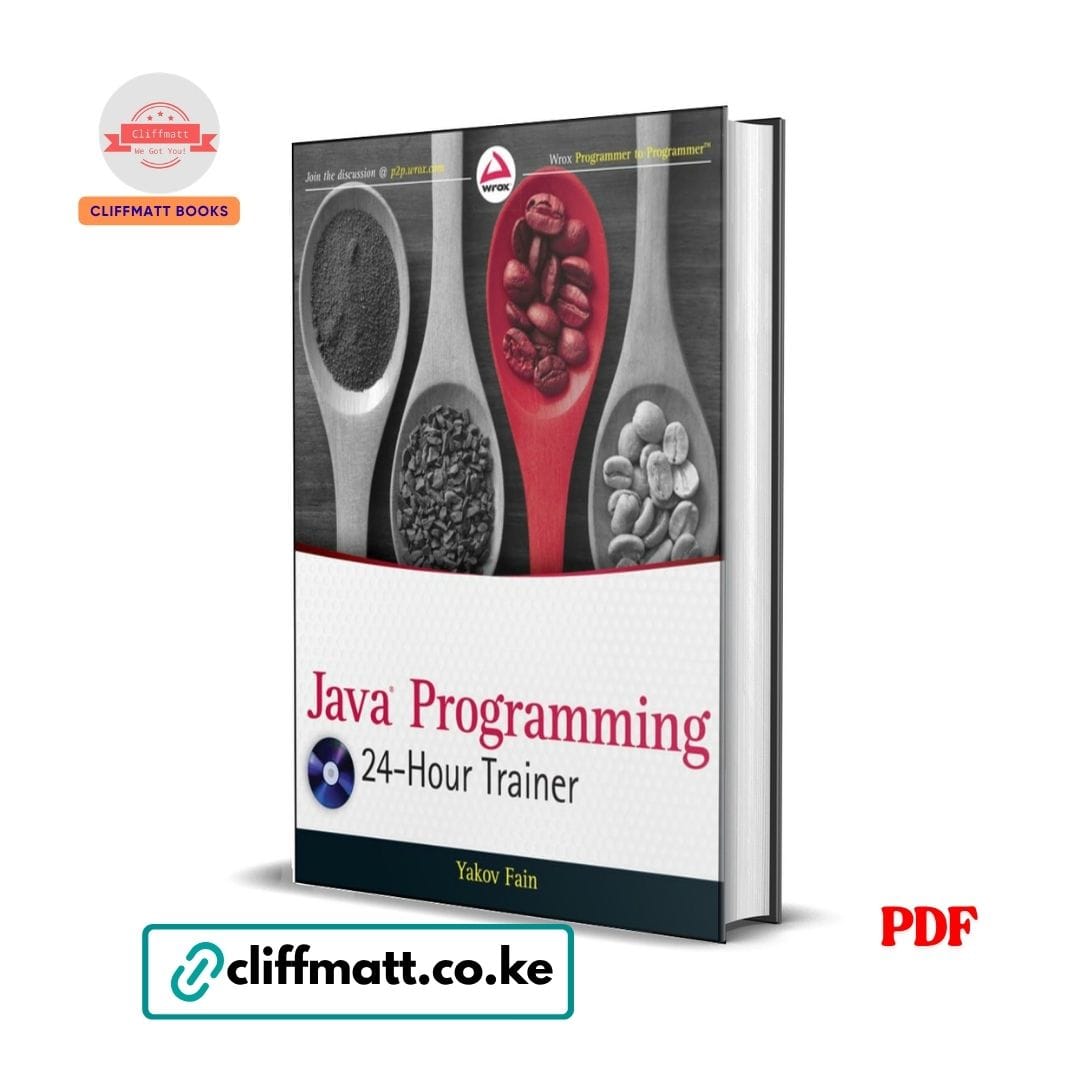
Java Programming 24-Hour Trainer by Yakov Fain — published by Wrox, the Programmer to Programmer series from one of the most respected technical programming publishers in the world — is the most structured, most clearly paced, and most immediately practical Java learning guide available. Built on the specific 24-hour trainer format that delivers each major concept in a focused, manageable lesson, it takes every learner from the very first principles of Java programming through the specific core competencies that professional Java development requires.
What This Book Covers:
Getting Started — Java Foundations:
- Setting up your Java development environment — installing the JDK (Java Development Kit), configuring the PATH environment variable, and the specific IDE (Integrated Development Environment) setup that makes Java development productive; the specific step-by-step environment configuration that eliminates the specific setup frustration that most beginners encounter before writing a single line of code
- Your first Java programme — the specific anatomy of the classic Hello World programme; what each element (class declaration, main method, System.out.println) is and why it is there; the specific compile-and-run workflow (javac and java commands) that takes source code through the specific Java compilation to the specific JVM execution
- The specific Java platform architecture — the JVM (Java Virtual Machine), the JRE (Java Runtime Environment), and the JDK; the specific “write once, run anywhere” principle that makes Java uniquely portable; why Java programmes run on Windows, Mac, Linux, and Android through the same compiled bytecode
- Java syntax fundamentals — statements, expressions, blocks, comments, and the specific structural conventions that make Java code both readable and compilable; why Java is case-sensitive and what that specifically means for the specific beginner who will discover this the hard way on their first programme
Core Java — The Essential Language:
Variables and Data Types:
- The specific eight primitive data types in Java — byte, short, int, long, float, double, boolean, and char — their specific storage sizes, their specific value ranges, and the specific use cases for each; why choosing the right data type matters for both memory efficiency and computational accuracy
- Variable declaration and initialisation — the specific syntax for declaring and assigning variables; the specific rules for variable naming (legal identifiers, conventions); the specific concept of variable scope and why a variable declared inside a method cannot be accessed outside it
- Type casting — the specific difference between widening conversion (int to double, automatically safe) and narrowing conversion (double to int, requiring explicit cast and potentially losing information); why Java requires explicit casts for narrowing conversions as a specific safety mechanism
Operators and Expressions:
- The specific arithmetic operators (+, -, *, /, %) and their specific behaviour with integer versus floating-point operands; why integer division truncates (7/2 = 3 in Java, not 3.5) and how to prevent this specific common beginner error
- Comparison and logical operators — the specific comparison operators (==, !=, <, >, <=, >=) and logical operators (&&, ||, !) and their specific boolean return values; the specific short-circuit evaluation behaviour of && and || that every Java programmer needs to understand
- Assignment operators — the specific compound assignment operators (+=, -=, *=, /=, %=) and their specific equivalence to the expanded form; the specific prefix and postfix increment/decrement operators (++, –) and the specific difference between i++ and ++i in expressions
Control Flow:
- if-else statements — from simple boolean conditions through else-if chains to the specific nested if structures that complex conditional logic requires; the specific best practices for if-else structure that make conditional code readable
- switch statements — the specific syntax, the specific fall-through behaviour, and the specific break statement that prevents it; when switch is preferable to if-else chains and when it is not
- for loops — the specific three-part for loop structure (initialisation; condition; update); the specific for-each loop for iterating over arrays and collections; when to use which
- while and do-while loops — the specific difference (do-while always executes at least once); the specific use cases for each; the specific infinite loop risk and how break prevents it
Arrays:
- One-dimensional arrays — declaration, creation, and initialisation; the specific zero-based indexing; the specific ArrayIndexOutOfBoundsException and why it is one of the most common Java runtime errors; how to avoid it
- Multi-dimensional arrays — the specific Java implementation as arrays of arrays; how to declare, create, and traverse two-dimensional arrays; the specific applications in the specific data structures that Java programmes commonly require
- Arrays class utilities — sorting, searching, copying, and the specific static methods of the java.util.Arrays class that make array manipulation more efficient than manual loops
Object-Oriented Programming — The Heart of Java:
Classes and Objects:
- The specific OOP fundamentals — classes as blueprints, objects as instances; why object-oriented programming is the specific programming paradigm that Java was designed for and that most professional software development uses
- Class structure — fields (instance variables), constructors, and methods; the specific access modifiers (public, private, protected, package-private) and the specific encapsulation principle they implement; why making fields private and providing getter/setter methods is the specific best practice that every Java professional follows
- Constructors — the specific constructor syntax, the specific no-argument constructor, constructor overloading, and the specific this() call for constructor chaining; why constructors are not methods and what specifically distinguishes them
- The this keyword — the specific reference to the current object; its specific use in constructors to distinguish instance variables from parameters; its specific use to call other constructors
Inheritance:
- The specific extends keyword and what it specifically means — the specific IS-A relationship; how subclasses inherit all non-private fields and methods of their superclass; the specific method overriding mechanism that allows subclasses to provide their own implementation of inherited methods
- The super keyword — calling the superclass constructor; calling the superclass version of an overridden method; the specific rules about when super() must be the first statement in a subclass constructor
- The Object class — Java’s universal superclass; the specific methods every Java class inherits (toString, equals, hashCode, getClass) and why overriding toString and equals is the specific best practice for any custom class
Polymorphism and Interfaces:
- The specific polymorphism mechanism — how a reference variable of a supertype can hold an object of any subtype; the specific dynamic dispatch that calls the appropriate overridden method based on the runtime type of the object rather than the compile-time type of the reference
- Abstract classes — the specific abstract keyword; abstract methods that declare but don’t implement; why you cannot instantiate an abstract class; when abstract classes are preferable to interfaces
- Interfaces — the specific interface syntax; implementing interfaces; implementing multiple interfaces (Java’s specific answer to multiple inheritance); the specific contract that an interface represents; the specific default method feature introduced in Java 8
Exception Handling:
- The specific exception hierarchy — Throwable, Error, Exception, RuntimeException; checked versus unchecked exceptions; why the distinction matters for the specific try-catch-finally structure
- try-catch-finally — the specific syntax; how exceptions propagate up the call stack; the specific finally block and why it always executes; the specific try-with-resources statement for automatic resource management
- Throwing exceptions — the specific throw statement; the specific throws clause in method signatures; creating custom exception classes; when to use checked versus unchecked exceptions in the specific design of a Java API
Collections and Java APIs — Professional Programming:
The Collections Framework:
- The specific List interface and its implementations — ArrayList (fast random access, slow insertion/deletion) and LinkedList (slow random access, fast insertion/deletion); when to use which based on the specific performance characteristics of each
- The specific Map interface and HashMap — storing key-value pairs; the specific get, put, remove, and containsKey methods; iterating over maps using entrySet; why HashMap is the specific most commonly used Map implementation
- The specific Set interface and HashSet — storing unique values; the specific add, contains, and remove methods; when to use a Set rather than a List
File I/O:
- Reading from and writing to files using the specific Java I/O classes (FileReader, FileWriter, BufferedReader, BufferedWriter, PrintWriter); the specific try-with-resources pattern for the specific safe file handling that prevents resource leaks
- The specific Scanner class for file reading and for reading user input from the console; the specific delimiter handling that Scanner provides for parsing structured text files
Java Generics:
- The specific generic syntax — the specific type parameter notation; how generics provide compile-time type safety without runtime overhead; why the specific raw type (non-generic) List should be avoided in modern Java code
- Creating the specific generic classes and methods; the specific bounded type parameters; the specific wildcard that allows generic methods to accept arguments of multiple types
Introduction to JavaFX:
- The specific basics of Java’s modern GUI framework — Stage, Scene, and the specific scene graph architecture; the specific event handling model; how to build the specific basic interactive user interfaces that demonstrate Java’s capabilities beyond command-line programming
Why Kenyan Programmers Are Buying This Book: Java is Kenya’s most important programming language for the specific employment market. The specific banking systems that most Kenyans use, the specific mobile applications that most Kenyan developers build, and the specific enterprise systems that most Kenyan corporations operate are all built on Java. Java Programming 24-Hour Trainer gives every Kenyan student and every Kenyan professional who wants to enter software development the most structured, most clearly paced, and most practically progressive Java learning path available anywhere in Kenya.
At Ksh 100, this is the Wrox Programmer to Programmer guide to the most professionally valuable programming language in Kenya’s technology sector.
Who This Book Is For:
- Kenyan university students in computer science, information technology, and software engineering programmes who want the most structured and most clearly explained Java guide to support their coursework
- Kenyan professionals in non-technical roles who want to learn Java programming as a career transition toward software development
- Self-taught Kenyan developers who have been learning from online tutorials and who want the specific structured, comprehensive reference that fills in the specific gaps that tutorial-based learning consistently leaves
- Every Kenyan who wants to build Android applications, enterprise software, or web services and who needs the specific Java foundation that all of these require
- Every reader of The Hacker’s Guide to Scaling Python (Danjou) and Microsoft Access 2013 Step by Step (Cox/Lambert) who wants the most structured Java programming guide to complete their technical skills library
📖 Author: Yakov Fain 🏢 Publisher: Wrox (Programmer to Programmer) 📄 Format: PDF eBook (instant download via WhatsApp or email) 💰 Price: Ksh 100 only 🚀 Delivery: Instant after M-Pesa payment confirmation
👉 Order now on cliffmatt.co.ke — Pay via M-Pesa, receive your PDF instantly.










Reviews
There are no reviews yet.