
Description
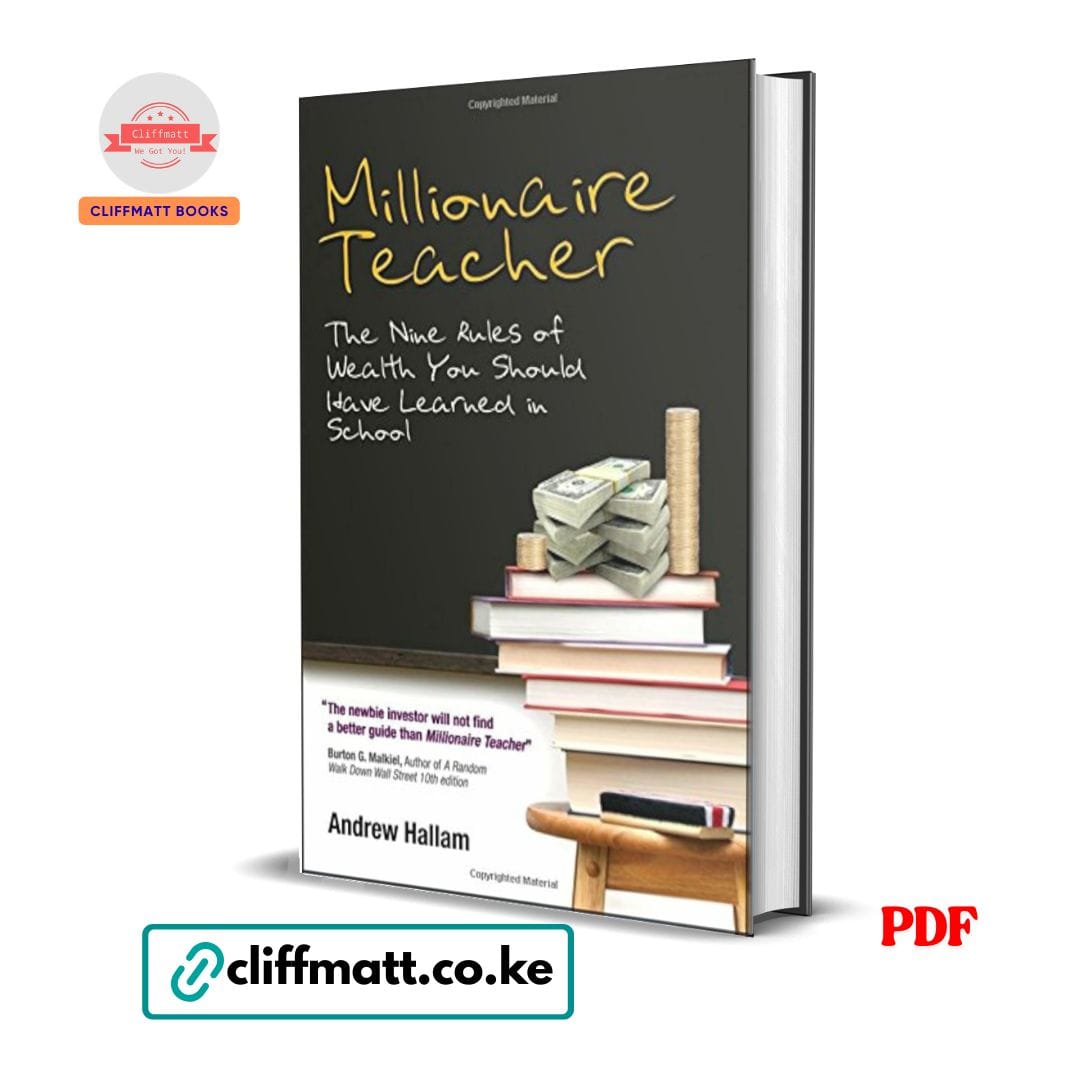
What if the reason most people never build real wealth has nothing to do with their income — and everything to do with what they were never taught? Andrew Hallam was a high school English teacher. Not a banker. Not a hedge fund manager. Not an inheritance recipient. A teacher — on a teacher’s salary — who became a self-made millionaire through disciplined, simple, proven investing principles that anyone can apply. Millionaire Teacher is the book he wrote to share every lesson he learned.
This is not a book about getting rich quickly. It is not a book full of complex financial instruments or Wall Street jargon. It is the most honest, most practically accessible, and most immediately actionable personal finance book available — written by someone who proved the principles work on an ordinary income before he wrote a single word of advice.
Available now on Cliffmatt Books for only Ksh 100.
The Nine Rules of Wealth:
Rule 1 — Spend Like You Want to Grow Rich:
- Why the foundation of wealth is not income level but spending behaviour — the specific spending philosophy that separates people who accumulate wealth from people who earn well and stay broke
- The psychology of lifestyle inflation — why every income increase that is fully consumed by increased spending produces zero progress toward financial freedom
- How to build the gap between income and expenditure that makes investing possible — even on a modest Kenyan salary
- Why the Kenyan habit of visible consumption — the car, the house, the school fees visible to the community — is the single greatest wealth-destroying force in middle-class Kenyan life
Rule 2 — Use the Greatest Investment Ally You Have:
- Compound interest — the mathematical force that Albert Einstein reportedly called the eighth wonder of the world — explained with the clarity and concrete examples that make it immediately motivating rather than abstractly theoretical
- Why starting early is worth more than earning more — the specific numbers that show a 25-year-old Kenyan investing modestly will out-accumulate a 35-year-old investing aggressively
- The specific time horizons that make compound interest transformative — and why the Kenyan habit of waiting until you “have enough to invest” is the most expensive financial mistake available
- How to put compound interest to work on any income level — the practical starting point that requires no minimum investment amount, no financial adviser, and no specialist knowledge
Rule 3 — Small Fees Destroy Fortunes — Avoid Them:
- Why investment fees — seemingly small percentages that most investors ignore — are the single most powerful wealth-destroyer in the investment industry
- The specific mathematics of fees over time: how a 2% annual management fee, sustained over 30 years, consumes a staggering proportion of the wealth that compound interest would otherwise have built
- Why the Kenyan investment industry — like every investment industry — is structured to profit from your money rather than to maximise your returns
- The low-cost investment alternatives that professional financial advisers rarely recommend — because recommending them does not generate commission
Rule 4 — Conquer the Enemy in the Mirror:
- Behavioural investing — why the human brain is the most dangerous investment enemy you will ever face
- The specific cognitive biases — loss aversion, recency bias, herd behaviour, overconfidence — that cause ordinary investors to buy high, sell low, and chronically underperform the market they are invested in
- Why watching financial news, following investment tips, and reacting to market movements systematically destroys the returns that a patient, disciplined investor would otherwise receive
- The specific psychological disciplines — rules-based investing, automated contributions, deliberate non-reaction — that protect your investment returns from your own instincts
Rule 5 — Build Mountains of Money with a Responsible Portfolio:
- Index fund investing — the strategy that the world’s most successful investors, including Warren Buffett, recommend for the vast majority of ordinary investors — explained in plain language accessible to every Kenyan reader
- Why a simple portfolio of low-cost index funds consistently outperforms the vast majority of actively managed funds over any meaningful time horizon — and the specific research that proves it
- How to build a responsible, diversified portfolio appropriate for a Kenyan investor — the specific asset allocation principles that balance growth and stability across different life stages
- Why simplicity is not a compromise in investing — it is the strategy most consistently associated with the best long-term outcomes
Rule 6 — Sample a Buffett-Style Investing Tasting Menu:
- When and how stock-picking can be appropriate — the specific conditions, knowledge requirements, and temperamental prerequisites that make individual stock selection viable for a small portion of a portfolio
- What Warren Buffett’s actual investing philosophy reveals about the difference between speculation and genuine value investing — and why most people who believe they are investing like Buffett are actually speculating
- The specific financial literacy required to evaluate individual stocks — and the honest assessment of whether most Kenyan investors currently possess that literacy
- Why Hallam recommends index funds for most investors while acknowledging the legitimate place of value investing for those with the knowledge, temperament, and time to do it properly
Rule 7 — Peek Inside a Pilferer’s Playbook:
- The specific ways the financial services industry extracts wealth from ordinary investors — the hidden fees, the commission structures, the product designs that benefit advisers far more than clients
- How to identify a financial adviser who is genuinely working in your interest versus one who is working in their own — the specific questions to ask and the specific answers that reveal alignment or conflict of interest
- Why financial literacy — the ability to understand what you are being sold — is the most valuable financial skill available, and why the industry has no incentive to teach it to you
- The Kenya-specific financial products and practices to approach with particular caution
Rule 8 — Avoid Seduction:
- Why investment fads — cryptocurrency cycles, hot sector funds, “can’t miss” opportunities — systematically destroy the wealth of the investors who chase them
- The specific psychological mechanisms that make investment fads so compelling and so dangerous — and the rules-based investment discipline that makes you immune to them
- Why the most boring investment strategy available is almost always the most profitable one over a full investment lifetime
- How to evaluate any investment opportunity against the principles in this book — the specific questions that separate genuine investments from sophisticated wealth transfers
Rule 9 — The 10% Solution:
- The specific, actionable starting point for any Kenyan who wants to begin building wealth today — regardless of current income, current savings, or current financial knowledge
- How to automate the investment habit so that it requires no ongoing willpower, no monthly decision-making, and no emotional engagement with market movements
- The specific investment vehicles available to Kenyan investors — and how to access them practically, affordably, and without needing a financial adviser
- The long-term projection: what consistent, disciplined application of Hallam’s nine rules produces for a Kenyan investor over 20, 30, and 40 years
Why This Book Is Essential for Kenyan Readers:
Kenya’s growing middle class is earning more than any previous generation — and saving and investing less effectively than the wealth those earnings should be producing. The gap is not income. It is financial literacy. Millionaire Teacher closes that gap with the most practically accessible, most honestly presented personal finance education available in a single book.
For Kenyan nurses, teachers, civil servants, corporate professionals, and small business owners — people who earn consistently but have never been taught to invest systematically — this book is the financial education that school never provided and that most financial advisers have no incentive to give you.
Who This Book Is For:
- Every Kenyan professional who earns a salary but has no systematic investment plan — this book is your starting point
- Young Kenyans in their 20s and early 30s who are at the exact life stage where the principles in this book produce the most dramatic long-term results
- Teachers, nurses, civil servants, and other public sector professionals who assume their income is too modest to invest meaningfully — this book was written by one of them to prove that assumption wrong
- Anyone who has tried to understand investing and been confused, intimidated, or misled by the financial industry
- Readers of Rich Dad Poor Dad (Kiyosaki), Psychology of Money (Housel), Rules of Wealth (Templar), and Think Like a Billionaire who want the specific, practical, low-cost investment strategy that makes every financial mindset book actionable
📖 Author: Andrew Hallam 📄 Format: PDF eBook (instant download via WhatsApp or email) 💰 Price: Ksh 100 only 🚀 Delivery: Instant after M-Pesa payment confirmation 👉 Order now on cliffmatt.co.ke — Pay via M-Pesa, receive your PDF instantly.









Reviews
There are no reviews yet.