


Description
One third to one half of all people are introverts. In a world that was built by and for extroverts — a world that celebrates the quick talker, rewards the confident networker, and structures schools, offices, churches, and meetings around the assumption that the loudest voice carries the most wisdom — this is an enormous proportion of the human population who are spending enormous amounts of energy pretending to be something they are not.
Susan Cain — Harvard Law graduate, former Wall Street lawyer, and one of the most rigorously researched popular science writers of her generation — spent years investigating the specific science, the specific history, and the specific personal experience of introversion. What she found was not what conventional wisdom suggests: that introversion is a limitation to be overcome, a shyness to be managed, a quietness to be forced into participation. What she found was that introversion is a genuinely different, genuinely powerful, and genuinely indispensable way of engaging with the world — and that the specific abilities it produces (deep thinking, careful listening, sustained concentration, and the particular creative and intellectual achievements that solitude makes possible) are exactly the abilities that the world most urgently needs and most consistently undervalues.
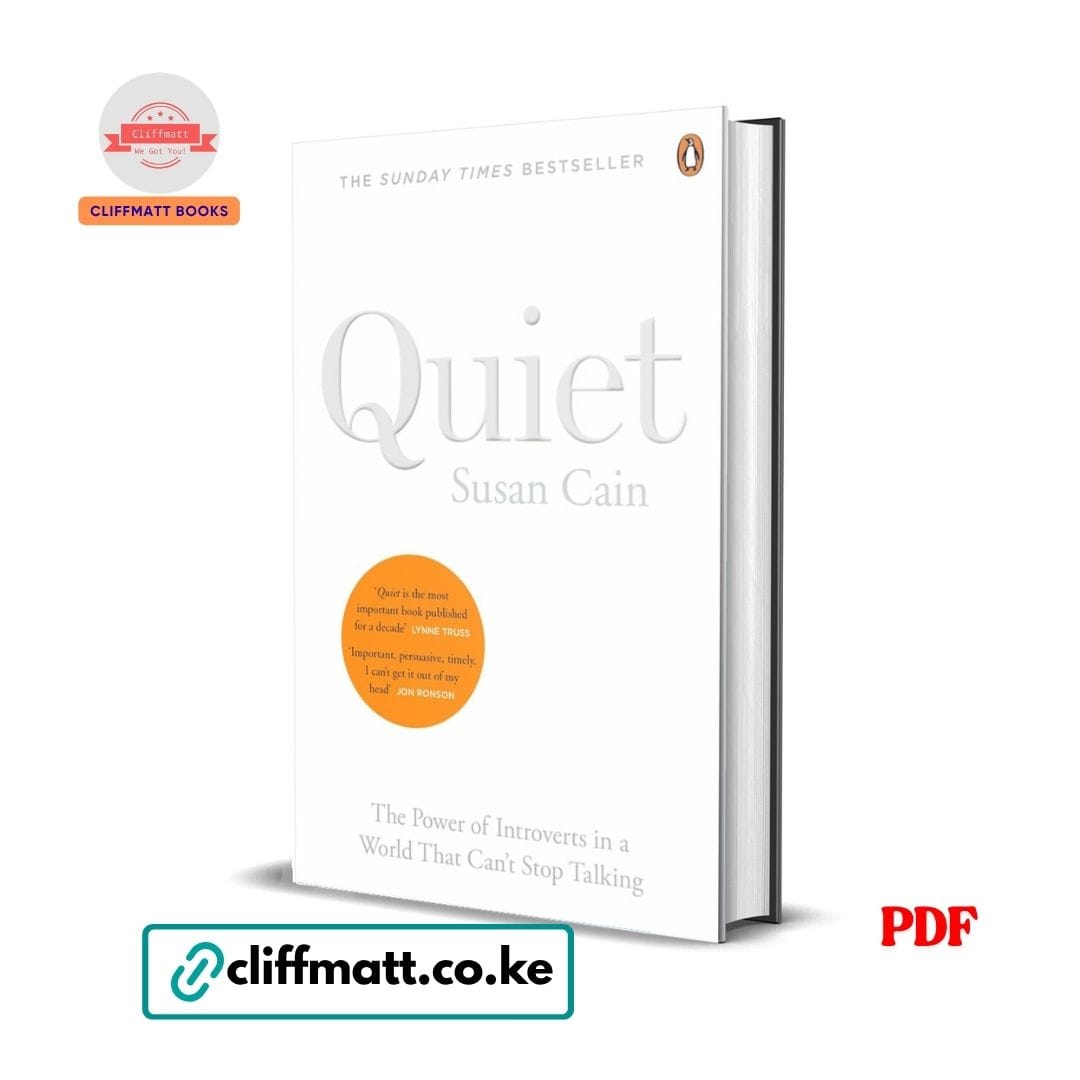
Quiet: The Power of Introverts in a World That Can’t Stop Talking — Sunday Times Bestseller, published by Penguin — is the book that has changed how millions of people understand themselves, their relationships, their workplaces, and their children. It may be the most personally liberating book available to the estimated one third to one half of Kenyans who have spent their lives wondering why the world keeps asking them to be louder, bolder, and more outgoing than they genuinely are.
What This Book Covers:
The Extrovert Ideal — How It Came to Dominate:
- The specific history of the Extrovert Ideal — Susan Cain’s compelling account of how Western culture, particularly American culture (which has deeply influenced global professional culture including Kenya’s), shifted in the early twentieth century from a Culture of Character (which valued inner virtues like integrity, honour, and depth of thought) to a Culture of Personality (which valued outer presentation, charm, enthusiasm, and the specific performance of confidence and sociability that we now call the Extrovert Ideal)
- The specific institutions that embody the Extrovert Ideal — the open-plan office (designed for collaboration but producing the specific constant distraction that destroys the deep work that introverts and many extroverts most need to do their best thinking), the group brainstorming session (which research consistently shows produces fewer and worse ideas than the same number of people working alone), and the school classroom redesigned for group work (which consistently disadvantages the specific learning style of the children who most need quiet to process deeply)
- The specific social and professional cost of the Extrovert Ideal for introverts — the specific exhaustion of sustained extroversion performance; the specific undervaluation of genuinely deep thinking relative to fast talking; and the specific experience of feeling fundamentally out of place in a world that consistently rewards the specific qualities you do not naturally possess
- Why the specific Kenyan social context — with its specific cultural emphasis on community, on communal participation, on the specific social visibility that family and community membership requires — creates the specific additional layer of introvert challenge that many Kenyan introverts experience as a specifically cultural double burden
The Science of Introversion — Why Introverts Are Different:
- The specific neuroscience of introversion — the specific brain differences that distinguish introverts from extroverts; the particular sensitivity of the introvert nervous system to stimulation; the particular dopamine and acetylcholine processing differences that make introverts find social overstimulation draining and solitude restorative while extroverts find the opposite
- The specific arousal theory — Hans Eysenck’s foundational research demonstrating that introverts have a higher baseline level of cortical arousal than extroverts; that this difference explains both the introvert’s preference for quieter, lower-stimulation environments and the extrovert’s preference for higher-stimulation ones; the specific implications for optimal working environments, optimal social engagement levels, and optimal personal renewal practices
- The specific high sensitivity dimension — Elaine Aron’s research on the Highly Sensitive Person (HSP) and its specific overlap with introversion; the particular depth of processing, the particular emotional responsiveness, and the specific sensitivity to subtlety that characterise many introverts and that produce both the specific challenges and the specific profound gifts of the highly sensitive temperament
- The specific Asian introversion paradox — why Asian cultures, which have historically produced higher rates of introversion and higher cultural valuation of quiet, thoughtful, non-assertive behaviour, consistently outperform Western cultures on educational and economic measures despite the specific disadvantage that the global Extrovert Ideal should in theory impose
The Power of Introverts — What They Bring:
- The specific introvert advantages — deep thinking, sustained concentration, careful listening, the particular creativity that solitude produces, the specific leadership style that produces better results in many contexts than the charismatic extrovert leader, and the specific moral courage that the thoughtful, conviction-driven person who is not performing for social approval consistently demonstrates
- The specific introvert leadership research — the counterintuitive finding that introverted leaders consistently produce better results than extroverted leaders in specific, important contexts; the particular quality of listening, the particular genuineness of empowerment, and the specific absence of the need to be the loudest person in the room that makes introverted leaders particularly effective with proactive, self-motivated teams
- The specific creative achievement of introverts — the particular historical evidence that a disproportionate share of the world’s most significant intellectual, artistic, scientific, and philosophical achievements were produced by people who worked alone, thought deeply, and valued the specific solitude that their best work required; what this reveals about the specific relationship between the introvert’s natural working style and the specific quality of sustained, original thought that significant creative achievement requires
- The specific innovation paradox — why the specific open, collaborative, constant-communication culture that contemporary organisations celebrate as the specific prerequisite of innovation is, according to the specific research, the specific environment most likely to suppress it; why genuine innovation most reliably comes from individuals given the specific solitude, the specific autonomy, and the specific freedom from constant performance that genuine creative thinking requires
Working and Living as an Introvert — The Practical Chapters:
Introverts in the Workplace:
- How to navigate extrovert-biased workplaces as an introvert — the specific strategies for performing effectively in the specific open-plan office, the specific group meeting, and the specific networking event without either exhausting yourself or abandoning your genuine working style
- The specific introvert leadership strategies — how introverted managers, executives, and team leaders can lead effectively without performing the specific extrovert leadership style that their organisations expect but that their genuine style does not produce
- The specific restorative niches — Susan Cain’s specific concept of the deliberate temporary adoption of extrovert behaviour for professional purposes, followed by the specific solitude and recovery time that restores the introvert’s specific depleted energy; how to build restorative niches into a professional life that requires regular extroversion
Introverts in Relationships:
- The specific introvert-extrovert relationship dynamics — how the specific combination of introvert and extrovert partners (one of the most common relationship configurations, since the qualities of each are genuinely attractive to the other) navigates the specific needs, the specific social preferences, and the specific energy management requirements that make introvert-extrovert partnerships both specifically enriching and specifically challenging
- The specific communication practices for introvert-extrovert partnerships — how to negotiate the specific social calendar, the specific party-going versus staying-home decisions, and the specific after-work conversation needs that the introvert and the extrovert typically experience very differently
- The specific parenting an introvert child guidance — how to support an introvert child’s genuine nature rather than trying to fix it; the specific school navigation, the specific social development support, and the specific genuine celebration of the introvert child’s specific gifts that every introvert child deserves and that this book gives every parent the specific understanding to provide
Introverts and Solitude:
- The specific creative solitude practices — how introverts can deliberately protect the specific time and the specific space for the deep, sustained, solitary thinking that produces their best work; the specific practices of environment design, time management, and social boundary-setting that make genuine solitude consistently available even in the busiest professional life
- The specific online introversion — how the specific digital environment, with its specific combination of connection without physical presence, has created new professional and social possibilities for introverts who find the specific digital medium more naturally comfortable than the specific face-to-face social performance
Cain’s Conclusion — A Call to Introvert Power:
- The specific invitation to every introvert reading this book — to stop apologising for the specific way they are wired, to stop performing the specific Extrovert Ideal at the specific cost of their genuine nature, and to start bringing the specific full power of their specific introvert gifts to the specific world that genuinely needs them
- The specific societal invitation — to redesign schools, offices, organisations, and communities to value the specific contributions of the quietest people rather than simply rewarding the loudest; to create the specific environments where genuine depth of thought, genuine careful listening, and genuine sustained concentration are recognised as the specific highest-value contributions rather than the specific performances of social confidence
- Why the specific world of 2025 — of information overload, of attention fragmentation, and of the specific premium on deep thinking that the specific complexity of contemporary problems requires — most needs the specific introvert gifts that the Extrovert Ideal has spent a century suppressing
Why Kenyan Readers Are Buying This Book: Kenya’s educational system, professional culture, and church communities are deeply shaped by the specific extrovert ideal — the specific valuation of confidence, assertiveness, vocal participation, and social engagement that consistently disadvantages the specific third to half of Kenyan people who are genuinely introverted. Quiet gives every introvert Kenyan the specific scientific understanding, the specific historical context, and the specific personal validation that their specific way of engaging with the world is not a deficit to be corrected but a genuine, specific, powerful gift to be developed and deployed.
And it gives every extrovert Kenyan parent, spouse, teacher, employer, and church leader the specific understanding of the introvert people in their lives that produces the specific environments where those people can genuinely thrive.
At Ksh 100, the most personally liberating book published in the last decade — now available to every Kenyan.
Who This Book Is For:
- Every Kenyan introvert who has spent years wondering why the world keeps asking them to be louder, more confident, and more socially assertive than they genuinely are — and who wants the most thoroughly researched validation and the most practically useful guidance available
- Kenyan parents of quiet children who want to understand and support their child’s genuine nature rather than trying to change it into something it is not
- Kenyan managers and leaders who want to understand the introvert employees in their teams — the specific motivation, the specific working style, and the specific contributions that introverts are consistently bringing that extrovert-biased management consistently fails to recognise and reward
- Kenyan educators who want to understand why their quietest students are often their most deeply thoughtful ones — and how to build the specific classroom conditions that allow those students to thrive
- Every reader of Outliers (Gladwell), Essentialism (McKeown), The Things You Can See Only When You Slow Down (Sunim), Kid Confidence (Kennedy-Moore), and Out of Control (Tsabary) who wants the most comprehensively researched and most personally validating account of the specific power of the quiet mind to complete their understanding of human difference and human potential
📖 Author: Susan Cain 🏢 Publisher: Penguin 📄 Format: PDF eBook (instant download via WhatsApp or email) 💰 Price: Ksh 100 only 🚀 Delivery: Instant after M-Pesa payment confirmation
👉 Order now on cliffmatt.co.ke — Pay via M-Pesa, receive your PDF instantly.










Reviews
There are no reviews yet.