


Description
Python is the world’s most widely used programming language. It powers startups and global enterprises, data science pipelines and web applications, automation scripts and distributed systems. Kenya’s Silicon Savannah runs on Python — at iHub, at Andela, at every startup building the next generation of African technology. And the single most common challenge that Python developers face as their applications mature, their user base grows, and their data volumes increase is the same challenge everywhere: how do you make Python scale?
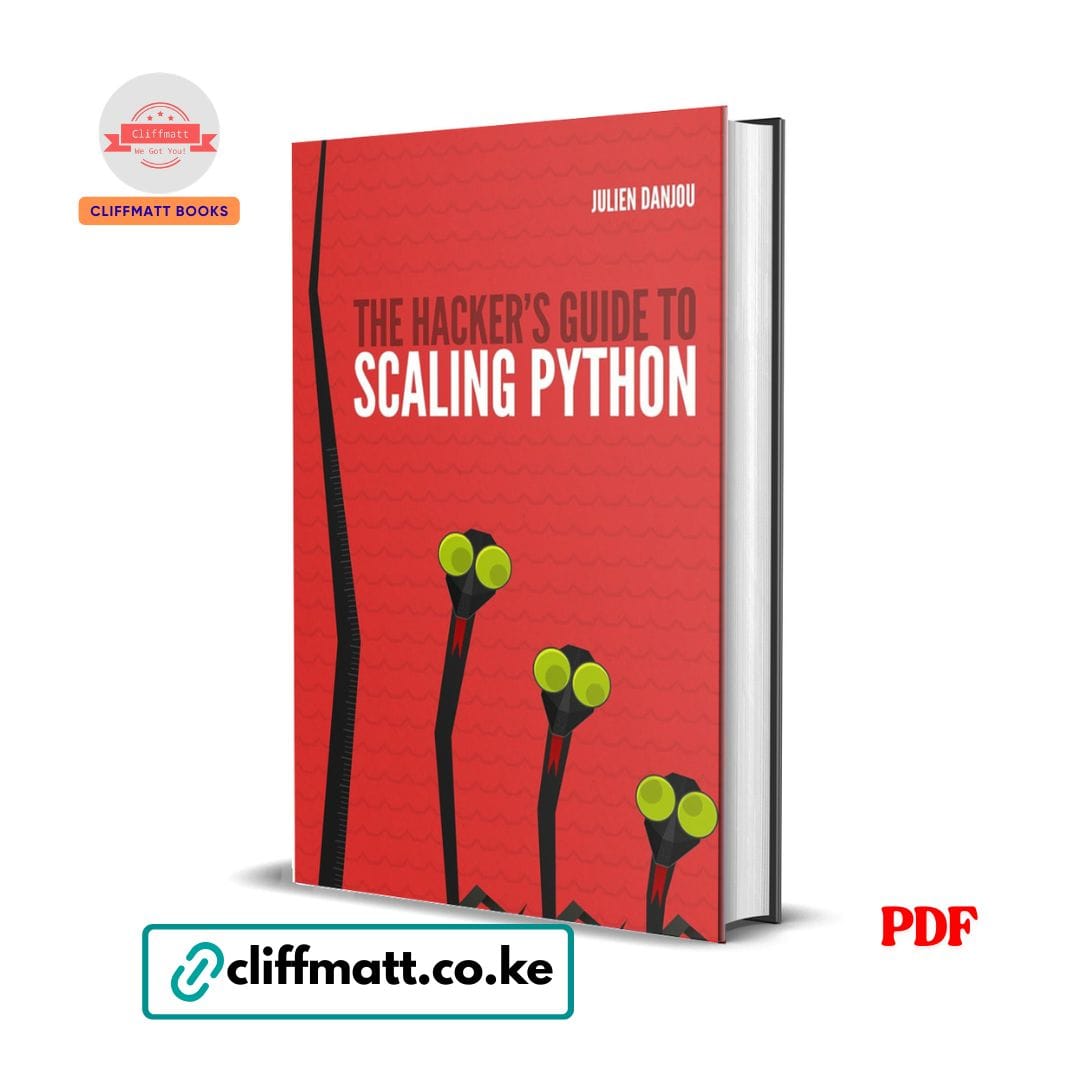
The Hacker’s Guide to Scaling Python by Julien Danjou — veteran Python developer, core contributor to the OpenStack project (one of the largest Python codebases in existence), and one of the most respected voices on Python performance and architecture in the global developer community — is the most practically focused, most immediately actionable guide to that challenge available. It is the book that takes you beyond beginner and intermediate Python into the specific architectural thinking, the specific concurrency models, and the specific distributed systems patterns that the real world of production Python development demands.
This is not a Python tutorial. It is the book for developers who already know Python and need to know how to make it do more, handle more, and fail less.
What This Book Covers:
Understanding Python’s Performance Landscape:
- The specific performance characteristics of Python that every developer must understand before making architectural decisions — the Global Interpreter Lock (GIL), its specific implications for CPU-bound concurrency, and the specific constraints it places on threading as a parallelism strategy
- Why Python’s performance reputation is both deserved and misunderstood — the specific contexts in which Python’s performance is entirely adequate and the specific contexts in which it requires the specific techniques this book covers
- The specific trade-off between development speed and execution speed that Python represents — and how the specific scaling techniques in this book allow you to have both; how to write Pythonic, readable, maintainable code that also performs at production scale
- Profiling — the specific tools (cProfile, line_profiler, memory_profiler) and the specific methodology for identifying exactly where your Python application is spending its time and memory before optimising anything; why optimising without profiling is the most consistent source of wasted engineering effort in Python development
Threading — Concurrency for I/O-Bound Work:
- The Python threading model — how threads work in Python, what the GIL actually prevents and what it does not, and the specific types of work for which threading produces genuine performance improvement despite the GIL
- The specific I/O-bound use cases where threading is the correct concurrency tool — network requests, database queries, file operations, and any work where the primary bottleneck is waiting rather than computing
- The
threadingmodule in depth — Thread objects, daemon threads, the specific lifecycle management that production threading requires, and the specific patterns for thread-safe code that prevent the race conditions and deadlocks that destroy concurrent applications - Synchronisation primitives — Locks, RLocks, Semaphores, Events, Conditions, and Barriers; when to use each, how to use each correctly, and the specific patterns that prevent the specific concurrency bugs that are hardest to reproduce and most costly to debug
- Thread pools — the
ThreadPoolExecutorfromconcurrent.futuresand how to use it for the specific high-volume I/O workloads that individual thread management cannot efficiently handle; the specific configuration decisions (pool size, timeout, error handling) that determine whether thread pool usage is a performance win or a resource disaster
Multiprocessing — True Parallelism for CPU-Bound Work:
- Why multiprocessing bypasses the GIL and when that bypass is worth the specific overhead it introduces — the specific CPU-bound workloads (numerical computation, image processing, cryptography, data transformation) where true parallelism produces dramatic performance improvement
- The
multiprocessingmodule — Process objects, the specific inter-process communication mechanisms (Queues, Pipes, shared memory, Manager objects), and the specific architectural patterns for distributing CPU-bound work across multiple processes - Process pools —
ProcessPoolExecutorandmultiprocessing.Pool; the specific use cases for each, the specific performance characteristics of each, and the specific configuration that produces optimal throughput for different workload types - The fork vs spawn distinction — how Python processes are created on different platforms, the specific implications for resource inheritance and safety, and the specific patterns that work correctly across operating systems
- Shared state management in multiprocessing — why shared mutable state between processes is dangerous, the specific safe alternatives, and how to design multiprocessing architectures that avoid the specific race conditions that shared state produces
Asyncio — Event-Loop Concurrency for High-Volume I/O:
- The event loop model and why it produces dramatically better performance than threading for high-concurrency I/O workloads — the specific explanation of how a single thread can handle thousands of simultaneous connections through cooperative multitasking
asyncandawait— the specific syntax, the specific mental model, and the specific patterns for writing correct asyncio code; the common mistakes that developers make when transitioning from synchronous to asynchronous Python and how to avoid each- Coroutines, tasks, and futures — the specific asyncio primitives and their specific relationships; how to create, schedule, cancel, and gather coroutines efficiently
- Asyncio with I/O —
aiohttpfor HTTP clients and servers,asyncpgfor PostgreSQL,aioredisfor Redis, and the specific ecosystem of async libraries that enable high-performance I/O across every common external dependency - The specific architectural patterns for asyncio applications — how to structure async code for readability, testability, and maintainability while preserving the performance characteristics that justify its complexity
- When NOT to use asyncio — the specific workloads and team contexts where asyncio’s complexity costs more than its performance gains are worth; the honest assessment of the asyncio trade-off that most asyncio advocates do not provide
Distributed Systems — Scaling Beyond One Machine:
- Why single-machine scaling eventually hits limits — the specific physical and architectural ceilings that make distributed systems the necessary evolution for applications that genuinely need to scale beyond what one process, one server, or one data centre can provide
- Message queues and task queues — Celery with Redis or RabbitMQ as the most widely used Python task queue system; the specific patterns for offloading work from synchronous request handlers to asynchronous background workers; how to design task queues that are reliable, observable, and scalable
- Redis as a shared state and communication layer — the specific Redis data structures (strings, hashes, lists, sets, sorted sets, streams) and the specific Python use cases for each; Redis as a cache, as a session store, as a pub/sub message broker, and as a distributed lock
- Service-oriented architecture — how to decompose a monolithic Python application into independently scalable services; the specific communication patterns (REST, gRPC, message passing) between services and when to use each
- Containerisation and deployment — how Docker and container orchestration change the scaling model for Python applications; the specific patterns for packaging Python applications as containers that scale horizontally
Caching — The Performance Multiplier:
- The specific caching strategies — cache-aside, write-through, write-behind, read-through — and when to apply each to Python applications
- In-process caching —
functools.lru_cache,cachetools, and the specific patterns for memoising expensive function calls; the specific cache invalidation strategies that prevent stale data from producing incorrect results - Distributed caching with Redis and Memcached — the specific implementation patterns, the specific serialisation considerations, and the specific cache key design that produces efficient, collision-free distributed caches
- HTTP caching — how to use cache headers correctly for Python web applications; the specific performance impact of properly configured HTTP caching for high-traffic API and web applications
Databases — The Scaling Bottleneck:
- Why the database is almost always the first scaling bottleneck in Python web applications — and the specific strategies for addressing database performance before reaching for more expensive architectural solutions
- Connection pooling — how database connection management affects Python application performance;
SQLAlchemy‘s connection pool configuration and the specific settings that produce optimal performance under high concurrency - Query optimisation for Python developers — how to use
EXPLAINand database profiling tools to identify slow queries; the specific query patterns that produce N+1 problems in ORM code and how to resolve them with eager loading and query restructuring - Read replicas and database sharding — when horizontal scaling of the database layer becomes necessary and the specific Python patterns for routing queries to the appropriate database instance
Profiling and Observability — You Can’t Scale What You Can’t See:
- The specific profiling workflow — from identifying a performance problem through to implementing and validating the fix; the specific toolchain that Danjou recommends for different types of performance investigation
- Application performance monitoring — how to instrument Python applications with metrics (Prometheus, StatsD), distributed tracing (Jaeger, Zipkin), and structured logging that makes production performance problems identifiable and debuggable
- Memory profiling — how to identify and resolve memory leaks in Python applications; the specific tools and techniques for understanding Python memory usage and reducing it
Why Kenyan Developers Are Buying This Book: Kenya’s technology sector is growing rapidly — and the Python developers building that sector’s applications are increasingly encountering the specific scaling challenges that come with production success. The application that worked perfectly at 100 users starts struggling at 10,000. The API that responded in milliseconds under light load starts timing out under production traffic. The data pipeline that processed files in minutes starts failing under production volumes.
The Hacker’s Guide to Scaling Python is the specific book for that specific moment — the moment when a Kenyan developer needs to move from writing code that works to writing code that scales.
At Ksh 100, this is world-class Python performance engineering knowledge accessible to every developer in Kenya’s Silicon Savannah.
Who This Book Is For:
- Kenyan Python developers at intermediate to senior level who are building applications that need to handle production scale
- Backend developers working on web applications, APIs, and data pipelines who are encountering performance and concurrency challenges
- Data engineers and data scientists whose Python pipelines are hitting performance limits that data science education never addressed
- Software engineering students and bootcamp graduates who know Python syntax and want to understand the production architecture that real-world applications require
- DevOps and platform engineers managing Python applications in production who want to understand the code-level decisions that most affect the performance of the systems they operate
- Every Kenyan developer in the iHub and Silicon Savannah community who has outgrown beginner Python and wants the specific senior-level knowledge that distinguishes the engineer who can scale systems from the one who can only build them
📖 Author: Julien Danjou 📄 Format: PDF eBook (instant download via WhatsApp or email) 💰 Price: Ksh 100 only 🚀 Delivery: Instant after M-Pesa payment confirmation
👉 Order now on cliffmatt.co.ke — Pay via M-Pesa, receive your PDF instantly.













Reviews
There are no reviews yet.