
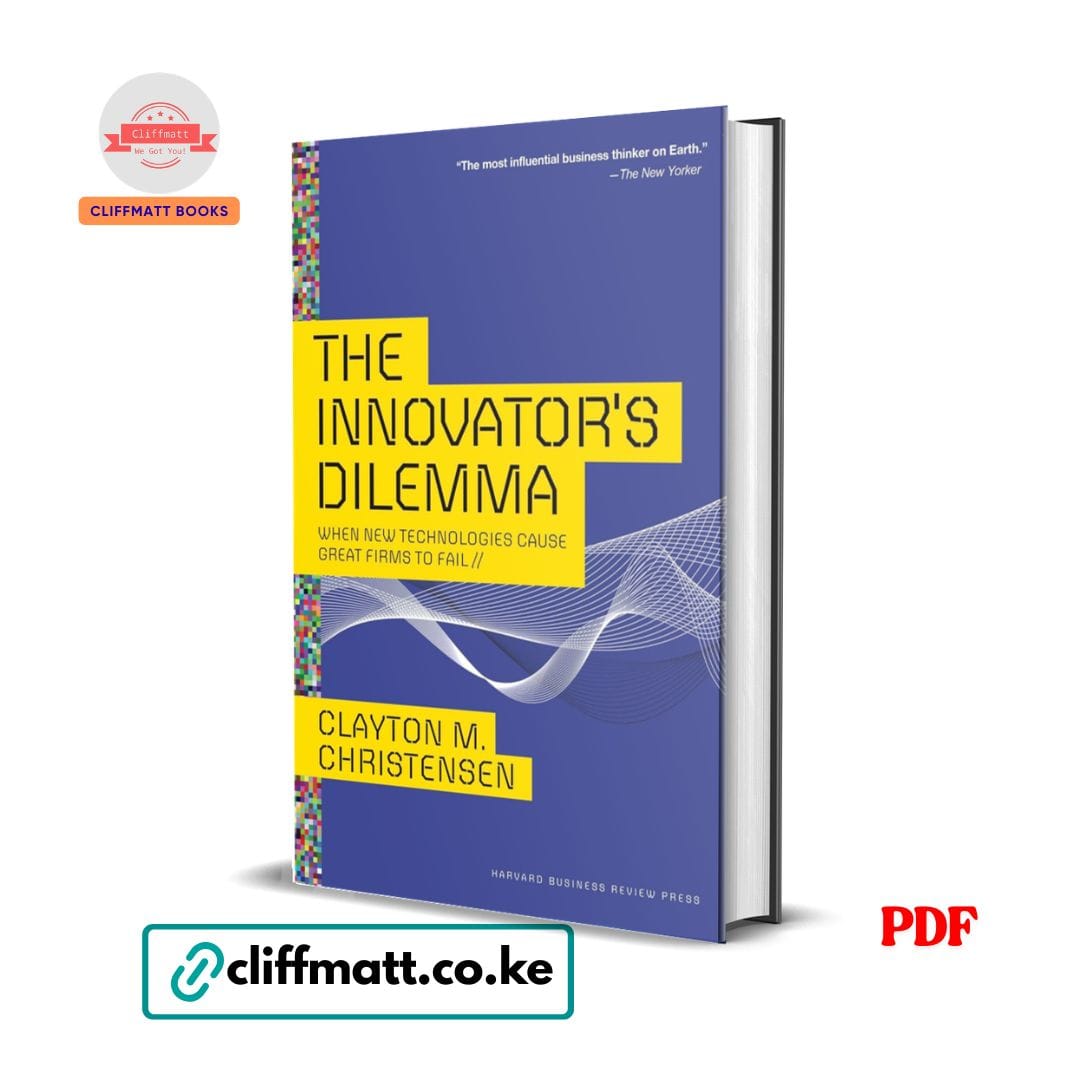

The Innovator’s Dilemma: When New Technologies Cause Great Firms to Fail- Clayton M. Christensen

KSh100

PLEASE CHECK YOUR EMAIL FOR THE DOWNLOAD
The Innovator's Dilemma by Clayton Christensen PDF eBook – When New Technologies Cause Great Firms to Fail – Buy for Ksh 100 on Cliffmatt Books Kenya
This item: The Innovator's Dilemma: When New Technologies Cause Great Firms to Fail- Clayton M. Christensen
KSh100
KSh100
The Book on Rental Property Investing by Brandon Turner PDF eBook – Buy for Ksh 100 on Cliffmatt Books Kenya
KSh100
Business Secrets From The Bible - Rabbi Daniel Lapin
KSh100
Most organisations have good strategies. Most organisations have talented people. Most organisations have adequate resources. And most organisations still fail to produce the results their strategies promise — not because the strategy was wrong, not because the people were incompetent, but because of a single, systemic failure that almost nobody talks about honestly. That failure is execution. And Execution: The Discipline of Getting Things Done by Larry Bossidy and Ram Charan — endorsed by Jack Welch as the definitive book on how to get things done — is the book that finally treats execution not as an afterthought to strategy but as the most important leadership discipline of all.Now in a New and Updated Edition, this landmark business book has transformed how the world's most effective leaders think about the relationship between planning, people, and results.The Central Revelation: Most leaders think their job is to set the direction — to create the strategy, articulate the vision, and inspire the team. What Bossidy and Charan demonstrate, with devastating clarity, is that direction without execution is fiction. The real job of a leader is not to have great ideas. It is to build the systems, the processes, and the culture that consistently translate ideas into outcomes. Execution is not a tactical afterthought. It is the core discipline that separates organisations that achieve from organisations that merely aspire.What This Book Covers:The Execution Gap: Why most strategic plans fail — not because the strategy was wrong but because the organisation lacked the execution discipline to implement it The specific ways that leaders unknowingly create execution gaps — through vague goal-setting, poor people decisions, and failure to follow through Why execution has been systematically undervalued in business education and leadership development — and what that costs organisations The cultural and behavioural foundations of an execution-oriented organisation — what they look, feel, and sound like in practice The Three Core Processes of Execution:The People Process: Why the people process is the most important of the three — because everything else depends on having the right people in the right roles doing the right things How to assess people honestly — not just on past performance but on their ability to execute in future conditions The specific conversations that identify whether someone has the execution capabilities your organisation needs How to build a leadership pipeline that consistently produces execution-capable leaders rather than just strategically brilliant ones The difficult people decisions — moving people out of roles they cannot execute in — that most leaders avoid and that most organisations suffer from The Strategy Process: Why most strategies fail the execution test before implementation even begins — because they were built without the execution reality in mind The specific questions every strategy must be able to answer before it deserves resources — the execution stress test that separates viable plans from beautiful documents How to build a strategy that is concrete enough to execute, flexible enough to adapt, and specific enough to hold people accountable Why the people who will execute a strategy must be involved in building it — and how that involvement transforms both the strategy and the commitment The Operations Process: How to link strategy to operations — the specific systems and rhythms that translate annual plans into quarterly and monthly actions The operating plan — what it must contain, how it must be built, and how it must be managed to produce results rather than just reports How to set priorities that actually get executed rather than priorities that simply exist on a slide deck The rhythm of business reviews — how to run them, what to discuss, and how to use them to identify and address execution gaps in real time How to build accountability into your operating system — so that follow-through is not optional but structural The Behaviours of Execution-Oriented Leaders: Know your people and your business — why leaders who are disconnected from operational reality cannot execute Insist on realism — why honest assessment of where you actually are is the foundation of getting where you want to go Set clear goals and priorities — the specific discipline of focusing organisational energy rather than dispersing it Follow through — the single most underrated execution behaviour, and why most leaders fail at it Reward the doers — how incentive systems either support or undermine execution culture Expand people's capabilities — why execution-oriented leaders are also the best developers of execution-capable talent Know yourself — how self-awareness about your own execution strengths and gaps makes you a better execution leader Jack Welch's Endorsement: When the man widely considered the greatest business leader of the twentieth century — who transformed General Electric from a $14 billion company to a $410 billion company — calls this book "a compelling business story of how to get things done," that is not a casual endorsement. It is a practitioner's recognition that this book captures something he spent decades learning and practising. Every Kenyan business leader should take that seriously.Who This Book Is For: CEOs, MDs, and senior executives responsible for organisational performance who want the most complete framework for building execution discipline Middle managers and department heads who sense that their team has good intentions but consistently underdelivers on commitments Entrepreneurs and business owners who have a clear vision but struggle to translate it into consistent operational results MBA students and business school graduates who want the real-world complement to the strategy frameworks their programmes teach HR and organisational development professionals who want to build execution capability systematically rather than hoping it emerges Every Kenyan organisation — corporate, NGO, government, or startup — that has experienced the frustration of a good plan that did not produce the promised results Every reader of Built to Last (Collins) and 100+ Management Models (Trompenaars) who wants the operational complement to those strategic frameworks Why Kenyan Business Leaders Need This Book: Kenya's corporate and entrepreneurial landscape is full of excellent strategies, impressive presentations, and well-resourced plans that consistently underperform. The execution gap is not uniquely Kenyan — but it is acutely felt in organisations that are growing faster than their execution systems can sustain. Execution gives every Kenyan business leader the specific, practical framework to close that gap — building the people processes, the strategy processes, and the operating processes that turn good intentions into consistent results.At Ksh 100, this is the most practically valuable business book in your entire leadership and management catalogue.Book Details: 📖 Authors: Larry Bossidy & Ram Charan with Charles Burck 📄 Format: PDF eBook (instant download via WhatsApp or email) 📚 Edition: New and Updated Edition 💰 Price: Ksh 100 only 🚀 Delivery: Instant after M-Pesa payment confirmation 👉 Order now on cliffmatt.co.ke — Pay via M-Pesa, receive your PDF instantly.

KSh100
The Startup Playbook by David S. Kidder PDF eBook – Secrets of Fastest-Growing Startups Founding Entrepreneurs – Buy for Ksh 100 on Cliffmatt Books Kenya
KSh100
Who Moved My Cheese by Dr Spencer Johnson PDF eBook – Buy for Ksh 100 on Cliffmatt Books Kenya
KSh100

Description

Why do great companies fail? Not companies that were poorly managed, poorly funded, or poorly led — but genuinely great companies; industry leaders with strong brands, talented people, rigorous processes, and the specific track record of success that should protect them from disruption. Clayton Christensen spent a decade studying exactly that question. The answer he found changed how the business world thinks about innovation, strategy, and the specific vulnerability that success creates.

The Innovator’s Dilemma is the most cited, most influential business book published in the last three decades. It introduced the concept of disruptive innovation — perhaps the most important and most widely used framework in contemporary business strategy — and explained for the first time why the very practices that make a company excellent at serving its current customers make it systematically incapable of responding to the technologies that will ultimately replace it.

Harvard Business Review Press. “The most influential business thinker on Earth.” — The New Yorker. Available now on Cliffmatt Books for only Ksh 100.

What This Book Teaches:

Sustaining vs Disruptive Innovation — The Central Distinction:

  • Sustaining innovation — the specific type of innovation that makes existing products better, faster, cheaper, or more capable for existing customers; the innovation that great companies are extraordinarily good at; the innovation that ultimately does not save them from disruption
  • Disruptive innovation — the specific type of innovation that starts by serving markets that established companies ignore or dismiss (because they are too small, too unprofitable, or too low-quality for their current standards) and then improves rapidly until it overtakes the established product entirely
  • Why disruptive innovations almost always start by appearing inferior — the specific dynamic by which a disruptive product underperforms on the metrics that established customers care about while overperforming on dimensions that a different, underserved market values
  • The trajectory trap — how disruptive innovations improve along a performance trajectory that inevitably intersects with the performance needs of mainstream customers; the specific moment when the disruptive product becomes “good enough” for the market the established company serves
  • For Kenyan entrepreneurs: the specific application of the disruptive innovation framework to Kenya’s market — the specific underserved populations, the specific performance dimensions that Kenyan consumers value differently, and the specific opportunities to build disruptive businesses that serve them

Why Good Management Causes Failure:

  • The innovator’s dilemma itself — the specific, cruel paradox that the better a company is managed according to conventional principles, the more systematically it will fail to respond to disruptive innovation
  • Listening to customers — why the most important management principle of the late 20th century (listen carefully to your best customers and give them what they ask for) actively prevents companies from seeing and responding to disruptive threats
  • Resource allocation — how established companies’ resource allocation processes systematically favour sustaining innovations over disruptive ones; the specific mechanism by which good proposals for disruptive businesses die inside large organisations
  • Performance metrics — how the specific metrics that established companies use to evaluate investments (market size, gross margins, return on assets) make disruptive opportunities look unattractive until it is too late to respond
  • For Kenyan business leaders: understanding the specific organisational dynamics that prevent established Kenyan companies — banks, telecoms, retailers — from responding to disruptive innovations; and why the disruption almost always comes from outside the industry

The Disk Drive Industry — The Evidence:

  • Why Christensen used the disk drive industry as his primary case study — its extraordinary rate of technological change, its clear generational transitions, and the specific data that allows the disruptive innovation pattern to be observed with unusual clarity
  • The pattern repeated — how every new disk drive architecture (from 14-inch to 8-inch to 5.25-inch to 3.5-inch) was initially dismissed by established manufacturers as inferior and unprofitable; and how each one ultimately destroyed the companies that dismissed it
  • The generalisability — how the same pattern that Christensen observed in disk drives appears in steel (mini-mills), excavators, motorcycles, accounting software, and virtually every other industry that has experienced disruptive innovation
  • For Kenyan readers: the disk drive case study as a model for understanding what is happening in Kenyan banking (M-Pesa disrupted formal banking), telecommunications (mobile disrupted fixed line), and retail (digital platforms disrupting physical retail)

Managing Disruptive Innovation — What Works:

  • Why disruptive innovations must be managed differently from sustaining ones — the specific organisational structures, the specific performance metrics, and the specific management approaches that give disruptive projects a chance to develop
  • The independent organisation — why the most successful responses to disruptive innovation involve creating separate business units with their own cost structures, their own markets, and their own definitions of success
  • Matching markets to innovations — the specific process of finding the right initial market for a disruptive innovation; why the right first market is almost never the established company’s current market
  • The resource, process, values framework — Christensen’s analytical tool for diagnosing why an organisation can or cannot respond to a particular innovation challenge; how to use it to assess any organisation’s capacity for disruptive innovation
  • For Kenyan business leaders: applying the disruptive innovation management principles to building new digital and technology businesses within or alongside established Kenyan institutions

The Kenyan Innovation Opportunity:

  • Why Kenya is one of the most fertile environments for disruptive innovation on earth — the specific conditions (large underserved populations, mobile-first infrastructure, entrepreneurial energy, and established companies that are vulnerable to disruption) that make Kenya’s innovation ecosystem so promising
  • M-Pesa as the canonical example of disruptive innovation in Africa — how Safaricom’s mobile money service followed exactly the disruptive innovation pattern Christensen described; starting with the unbanked (whom established banks dismissed), building a simple solution for a real need, and ultimately becoming more financially useful to more Kenyans than any bank
  • The next disruptions — applying Christensen’s framework to identify where the next major disruptions in the Kenyan economy are most likely to come from; which established industries are most vulnerable and which underserved populations represent the biggest opportunities

Why The Innovator’s Dilemma Is Essential for Kenyan Business Leaders:

Kenya’s economy is being disrupted at an extraordinary rate — by mobile money, by digital platforms, by off-grid energy, and by the specific creativity of Kenyan entrepreneurs who are building new solutions for underserved markets that established companies ignored. Understanding the framework that explains why disruption happens the way it does — and how to be on the right side of it — is among the most valuable intellectual investments any Kenyan business leader can make.

Who This Book Is For:

  • Kenyan entrepreneurs who want the analytical framework that explains why disruption happens and how to position their businesses as the disruptors rather than the disrupted
  • Corporate leaders and managers in established Kenyan organisations who want to understand why their organisations struggle to respond to new entrants and what organisational changes would give them a chance
  • Technology and innovation professionals who want the foundational intellectual framework behind every conversation about disruption, digital transformation, and strategic innovation
  • MBA students and business school graduates who want the most important business book of the last three decades in their library
  • Readers of The Startup Playbook (Kidder), Million Dollar Weekend (Kagan), Built to Last, and 100+ Management Models who want the most important strategic framework in contemporary business theory to complete their business education

📖 Author: Clayton M. Christensen 📄 Format: PDF eBook (instant download via WhatsApp or email) 💰 Price: Ksh 100 only 🚀 Delivery: Instant after M-Pesa payment confirmation 👉 Order now on cliffmatt.co.ke — Pay via M-Pesa, receive your PDF instantly.


Reviews

There are no reviews yet.

Be the first to review “The Innovator’s Dilemma: When New Technologies Cause Great Firms to Fail- Clayton M. Christensen”

Your email address will not be published. Required fields are marked *

Frequently bought together

The Innovator's Dilemma by Clayton Christensen PDF eBook – When New Technologies Cause Great Firms to Fail – Buy for Ksh 100 on Cliffmatt Books Kenya
The Innovator's Dilemma: When New Technologies Cause Great Firms to Fail- Clayton M. Christensen
KSh100
+
Hustle Harder Hustle Smarter by 50 Cent Curtis Jackson PDF eBook – Buy for Ksh 100 on Cliffmatt Books Kenya
Hustle Harder, Hustle Smarter by 50 Cent (Curtis Jackson)
KSh100
+
How to Win Government and Private Sector Bids Tenders and Contracts The Kenyan Guide PDF ebook by Titus Miriere – available on Cliffmatt Books Kenya
How To Win Government And Private Sector Bids, Tender And Contracts - Titus Mirireri
KSh100