

Description
The graveyard is the richest place on earth.
It is filled with symphonies never composed, businesses never started, books never written, conversations never had, and contributions never made. It holds the accumulated potential of millions of people who carried their best work inside them their entire lives — and never gave it. Not because they lacked the ability. Because they ran out of time. Or lost their courage. Or convinced themselves that tomorrow was soon enough.
Todd Henry — founder of Accidental Creative, one of the world’s most respected voices on creative productivity and meaningful work — spent years studying the specific patterns that separate the people who do their best work from the people who spend their lives intending to. What he discovered was not a mystery. It was a series of specific, identifiable, correctable patterns — the specific comfort-seeking, the specific permission-waiting, the specific undefined-living — that keep the specific potential inside most people permanently locked and permanently undelivered.
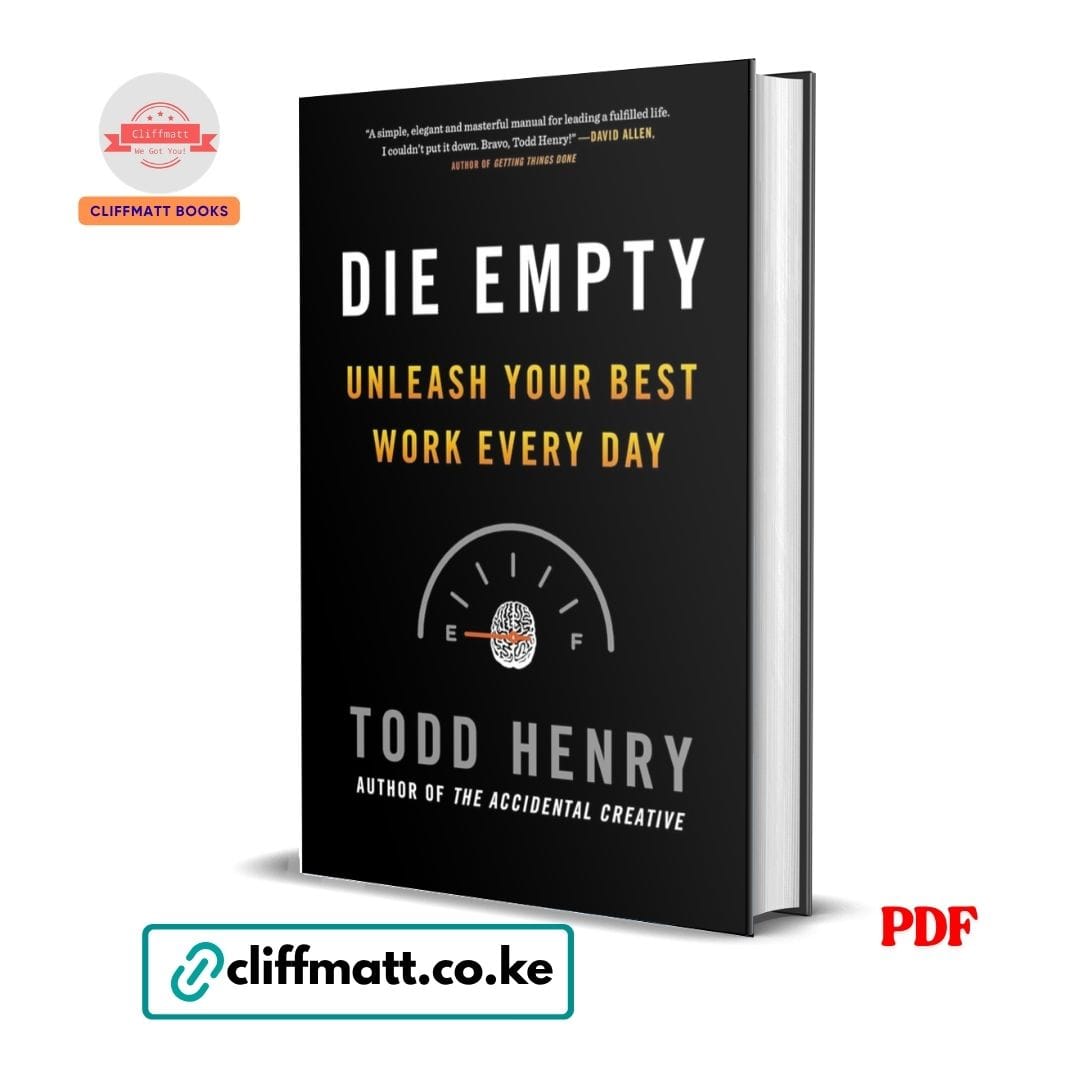
Die Empty: Unleash Your Best Work Every Day — endorsed by David Allen, author of Getting Things Done, as “a simple, elegant and masterful manual for leading a fulfilled life” — is the book that confronts that pattern directly. Not with motivational abstraction. With the specific daily practices, the specific mindset shifts, and the specific structural tools that make doing your best work today — not someday, not when conditions are right, not when you feel ready — the specific non-negotiable daily commitment of a genuinely well-lived life.
At Ksh 100, the most important professional and personal challenge of your life is waiting for your answer.
What This Book Covers:
The Central Premise — The Unlived Life:
- The specific “die empty” challenge — Todd Henry’s foundational provocation: that the goal of a well-lived life is not comfort, not security, and not the accumulation of pleasant experiences, but the specific complete expenditure of every gift, every idea, every capability, and every contribution that you were placed on earth to give; that dying empty — having given everything — is the specific mark of a life fully lived
- The specific enemy of your best work — not lack of talent, not lack of opportunity, and not lack of intelligence, but the specific patterns of comfort-seeking, undefined living, and perpetual deferral that keep the specific best work of most capable people permanently in tomorrow and never in today
- The specific cost of unlived potential — not just to you but to the specific people whose lives your specific unreleased contribution was designed to change; the specific moral weight of carrying gifts you were designed to give and choosing not to give them
- Why the specific Kenyan professional context — with its specific combination of extraordinary talent, significant ambition, genuine potential, and the specific competing pressures of family expectation, economic uncertainty, and cultural obligation — makes the specific “die empty” challenge simultaneously more urgent and more personally resonant than almost anywhere else
The Seven Deadly Sins of Mediocrity — What’s Holding You Back:
Aimlessness:
- The specific danger of living without a clear, defined, personally owned sense of what your work is for and what your life is building toward; why the specific absence of a clear aim is the specific most reliable predictor of the specific wasted potential that the graveyard holds most of
- The specific difference between busyness and direction — how most people fill their days with the specific urgent at the expense of the specific important; why the specific always-busy professional who never has time for their best work is not an overachiever but a specifically misdirected one
- How to define your specific aim — the particular questions (What do I want to be known for? What is the work only I can do? What would I regret not doing?) that produce the specific clarity that replaces aimlessness with genuine direction
Boredom:
- The specific pattern of the disengaged professional — the person who has stopped being curious, stopped learning, and stopped bringing genuine creative engagement to their work; why boredom is not a feature of the work but a specific choice about how you bring yourself to it
- The specific curiosity practices — the particular habits of reading widely, asking better questions, and the specific deliberate exposure to ideas outside your immediate domain that Todd Henry consistently identifies as the most reliable antidote to the specific creative stagnation that boredom produces
Comfort:
- The specific comfort trap — the particular gravitational pull toward the work you already know how to do, the relationships you already have, and the specific territory where you have already proved yourself; why the specific accumulation of comfort is simultaneously the most natural human impulse and the most reliable career-limiting behaviour available to the specific talented professional
- The specific discomfort practices — how to deliberately, consistently introduce the specific productive discomfort that genuine growth requires; the specific discipline of choosing the challenging assignment over the comfortable one, the specific new relationship over the familiar one, and the specific unknown territory over the specific proved ground
Conventionality:
- The specific conformity pressure — the particular professional and social forces that push toward the specific average, the specific expected, and the specific safe; why the specific most original contributions consistently come from the people who have learned to resist the specific pull toward doing what everyone else in their field is doing
- The specific originality practices — how to develop the specific distinctive voice, the specific personal perspective, and the specific genuine point of view that makes your work unmistakably yours rather than a competent version of what already exists
Procrastination:
- The specific two types of procrastination — the simple delay of the specific task you don’t want to do (which is common and manageable) and the specific existential procrastination of the calling, the project, the relationship, or the contribution that you have been telling yourself you will begin when conditions are better (which is the specific pattern that fills the specific richest place on earth)
- The specific anti-procrastination practices — the particular planning structures, the particular accountability systems, and the specific daily commitment protocols that Todd Henry uses to help his readers move their best work from perpetual tomorrow to actual today
Ego:
- The specific ego trap in creative and professional work — how the specific need to protect your reputation, the specific fear of being seen to fail, and the specific attachment to already-proven competence consistently prevents the specific risk-taking that the specific best work requires
- The specific ego-management practices — how to separate the specific health of your self-worth from the specific outcome of any particular project, assignment, or creative risk; the specific psychological groundedness that allows genuine creative risk-taking
Fear:
- The specific fear patterns that most reliably prevent best work — fear of failure, fear of judgment, fear of success, and the specific fear of discovering that your best is not good enough; why fear is not the opposite of productivity but its specific most common companion, and why the specific productive response to fear is not its elimination but its management
- The specific courage practices — the particular habits of small daily courage (the difficult conversation, the risky creative choice, the specific idea shared before it felt ready) that build the specific capacity for the larger courage that significant work consistently requires
The EMPTY Framework — Practical Tools for Daily Best Work:
E — Ethics:
- The specific personal ethics of work — the particular standards, the particular commitments, and the specific values that govern how you bring yourself to your work regardless of whether anyone is watching; why the specific private standards of the professional who is building toward their best work are consistently higher than those required by any external accountability
- The specific identity-based work ethic — how knowing clearly who you are and what you are for produces the specific daily work behaviour that no external motivational system can replicate
M — Mission:
- The specific personal mission — the particular statement of what your work is for and what you are building toward that gives every specific daily task its specific connection to a larger purpose; how to write your specific personal mission statement in the particular format that makes it genuinely useful as a daily decision-making tool rather than merely an inspirational wall decoration
- The specific mission-task alignment — how to evaluate every task, every project, and every commitment in your professional life against your specific mission to ensure that your daily energy is consistently going to the specific work that your specific mission requires
P — People:
- The specific relational dimension of best work — how the specific quality of your relationships (with colleagues, with mentors, with the people whose lives your work serves) is not peripheral to your best work but the specific environment within which it most reliably develops
- The specific community of practice — the particular group of serious, growth-oriented, mutually challenging peers that Todd Henry identifies as the most important career investment any professional can make; why the specific people you choose to work alongside and think alongside shape your specific work more than any other external factor
T — Tasks:
- The specific daily work structure — how to organise your specific daily tasks to ensure that the specific most important work (the specific project that matters most, the specific creative contribution that is hardest to make) receives the specific first and best of your daily energy rather than the specific leftover attention that most people give to their most important work
- The specific sprint and recovery rhythm — the particular pattern of focused creative work and deliberate recovery that produces sustainable high performance over the specific career-long trajectory that producing your best work requires
Y — You:
- The specific investment in yourself — the particular practices (reading, reflection, physical health, spiritual engagement, genuine rest) that maintain the specific creative, intellectual, and emotional resources that your best work requires; why the specific professional who neglects their own development is drawing down on a bank account they are not replenishing
- The specific personal development practices as professional productivity — how the specific daily investment in your own growth, your own clarity, and your own wellbeing is not selfishness but the specific most reliable professional practice available for consistently doing your best work
Making It Daily — The Practices:
- The specific daily checkpoint — the particular end-of-day question (“Did I do my best work today, or did I defer it?”) that creates the specific daily accountability that builds the specific habit of best-work delivery
- The specific morning planning practice — how to begin each day with the specific clarity about what the most important work of that day is, before the specific urgency of others’ demands fills the space that your most important work most needs
- The specific weekly review — the particular weekly reflection practice that maintains the specific connection between daily tasks and long-term mission that prevents the specific gradual drift from meaningful work to mere busyness that most professionals experience over time
- The specific project mapping practice — how to map every active project against your specific capacity, your specific energy, and your specific mission to identify the specific work that most deserves your attention and the specific commitments that most need to be released
Why Kenyan Professionals Are Buying This Book:
Kenya produces some of the world’s most talented, most ambitious, and most capable professionals. The specific combination of educational investment, cultural emphasis on achievement, and genuine personal drive that characterises so many Kenyan professionals means that the specific gap between what most of them are currently delivering and what they are genuinely capable of delivering is not a gap of ability but a gap of discipline, clarity, and daily commitment to their specific best work.
Die Empty closes that gap — not with inspiration that fades by Monday morning, but with the specific daily practices, the specific structural tools, and the specific mindset framework that make giving your best work every day the specific non-negotiable standard of your professional life.
At Ksh 100, the most important professional investment you will make this year.
Who This Book Is For:
- Every Kenyan professional who knows they are capable of more than their current daily output and wants the specific framework that makes doing their best work every day a reliable daily practice rather than an occasional good day
- Kenyan entrepreneurs and business owners who want the specific mindset and the specific daily work disciplines that separate the businesses that fulfil their potential from those that remain permanently below it
- Kenyan creatives — writers, designers, musicians, filmmakers, architects — who want the specific framework for maintaining creative output and creative ambition across the specific long career rather than burning bright and fading
- Kenyan managers and leaders who want to model and build a culture of genuine best-work delivery in their teams and organisations
- Every reader of Atomic Habits (Clear), Grit (Duckworth), Ego Is the Enemy (Holiday), Essentialism (McKeown), and Daily Self-Discipline (Meadows) who wants the most urgently personal and most practically structured guide to doing their specific best work before it’s too late to complete their productivity and purpose library
📖 Author: Todd Henry
📄 Format: PDF eBook (instant download via WhatsApp or email)
💰 Price: Ksh 100 only
🚀 Delivery: Instant after M-Pesa payment confirmation
👉 Order now on cliffmatt.co.ke — Pay via M-Pesa, receive your PDF instantly.





Reviews
There are no reviews yet.