

Description
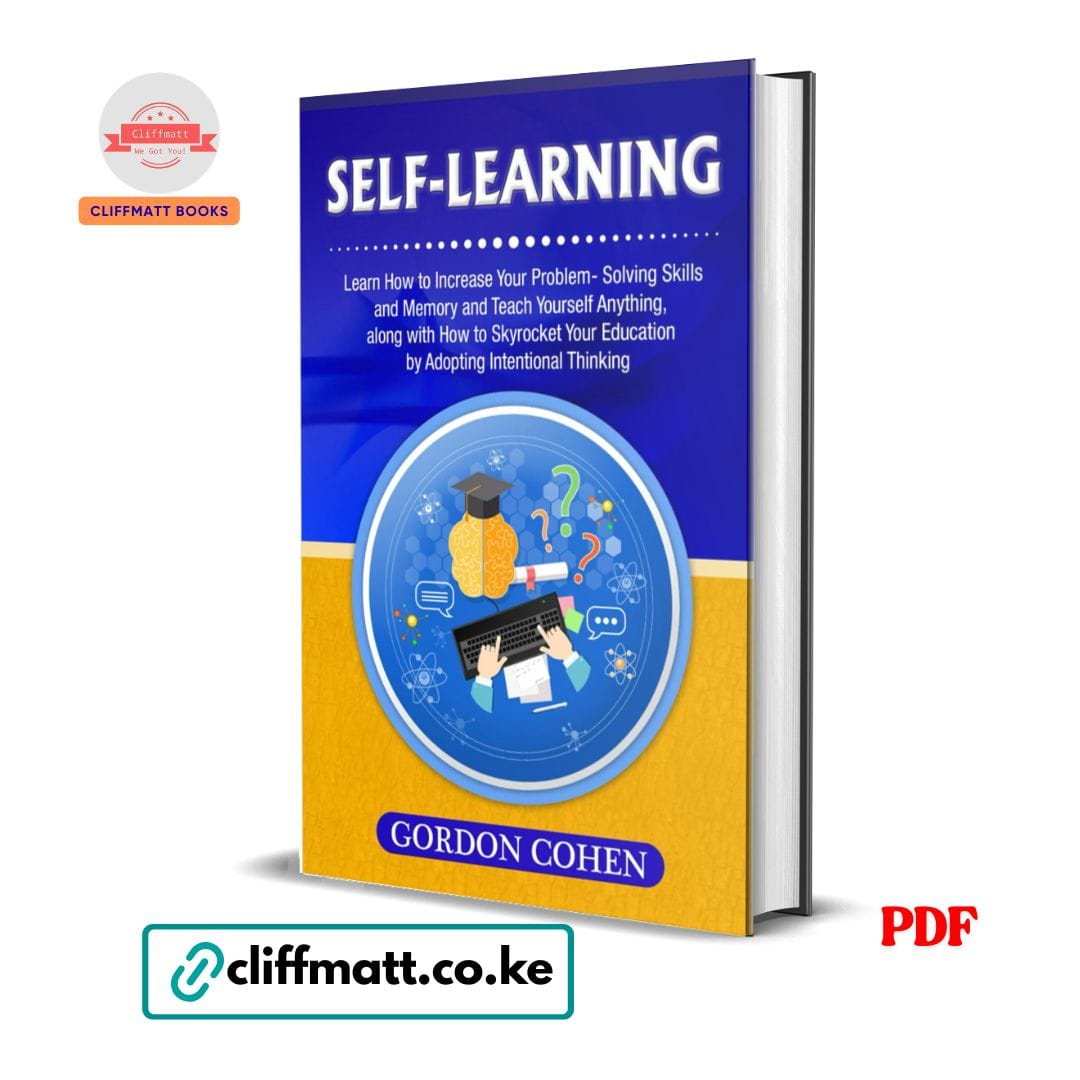
In a world that is changing faster than any formal education system can keep up with, the single most valuable skill available to any Kenyan professional, student, or entrepreneur is not what you currently know — it is how quickly and effectively you can learn what you need to know next. Self-Learning by Gordon Cohen is the practical, immediately applicable guide to developing exactly that skill.
Whether you are a Kenyan university student trying to master complex coursework, a professional needing to upskill in a rapidly changing field, a nursing student preparing for the NCK licensure exam, or an entrepreneur teaching yourself everything from digital marketing to financial management — this book gives you the complete framework to learn faster, retain more, and apply what you learn with genuine competence.
Available now on Cliffmatt Books for only Ksh 100.
What This Book Teaches:
The Foundation of Self-Learning:
- Why the passive learning model — sitting in a classroom, reading without engaging, absorbing information without processing it — produces the illusion of learning while building almost no lasting knowledge or usable skill
- The specific difference between surface learning (recognising information when you see it) and deep learning (being able to recall, apply, and build on information independently) — and why most Kenyan students never cross that line
- Why self-directed learning — taking personal ownership of what, how, and when you learn — consistently produces faster skill acquisition, deeper retention, and more practical competence than institution-directed learning alone
- The intentional thinking framework — the specific mental orientation that transforms every learning experience from passive consumption into active construction of knowledge
- For Kenyan readers: why self-learning is not a luxury supplement to formal education but the essential skill that determines what your formal education is actually worth
Mastering Your Memory:
- How human memory actually works — the specific neurological processes of encoding, storage, and retrieval that determine whether information learned today will be accessible next week or forgotten by tomorrow
- Why repetition alone is one of the least effective learning strategies available — and the specific techniques that produce dramatically superior retention with dramatically less time investment
- Spaced repetition — the scientifically validated learning technique that schedules review at precisely the intervals that maximise long-term retention; why it is used by the world’s fastest language learners, medical students, and professional certification candidates
- Active recall — why testing yourself is more effective than re-reading by a factor that research consistently finds remarkable; the specific self-testing practices that build the kind of memory that holds under exam pressure and professional application
- The memory palace technique — the ancient method of spatial memory encoding that allows the human brain to store and retrieve extraordinary quantities of information with reliable accuracy
- Chunking — how to organise complex information into meaningful clusters that the brain processes as single units rather than overwhelming collections of separate facts
- Why sleep, hydration, and physical activity are not peripheral wellness concerns but direct determinants of memory consolidation — the specific lifestyle factors that amplify every other learning technique
- For Kenyan students: applying these memory techniques directly to high-stakes Kenyan examinations — KCSE, university finals, professional licensure exams, and certification programmes
Developing Problem-Solving Skills:
- Why problem-solving is a learnable skill rather than an innate talent — the specific thinking processes that exceptional problem-solvers use and that any Kenyan can develop through deliberate practice
- First principles thinking — the technique of breaking any problem down to its most fundamental components and reasoning upward from there; the specific approach used by Kenya’s most innovative entrepreneurs and engineers
- Lateral thinking — how to deliberately move outside conventional solution pathways to find creative approaches that linear thinking systematically misses
- The problem decomposition framework — how to take any complex challenge and break it into specific, manageable components that can be addressed systematically
- Why most people solve the wrong problem — the specific diagnostic practices that ensure you have correctly identified what the actual problem is before investing effort in solving it
- Analogical reasoning — how to transfer solutions from familiar domains to unfamiliar ones; the specific technique that allows a breadth of learning to produce an outsized problem-solving advantage
- For Kenyan professionals: applying problem-solving frameworks directly to the specific challenges of Kenyan business, healthcare, education, and community leadership
Teaching Yourself Anything — The Self-Learning System:
- The Feynman Technique — Nobel Prize-winning physicist Richard Feynman’s four-step method for mastering any subject: study it, explain it in simple language, identify gaps, and return to the source; the most reliable self-learning method available for any subject at any level
- The 80/20 principle applied to learning — how to identify the 20% of any subject that produces 80% of the practical value, and how to prioritise your learning investment accordingly; particularly powerful for Kenyan professionals learning new skills under time pressure
- Building a personal curriculum — how to design your own structured learning path for any skill or subject; the specific steps from defining your learning goal to selecting resources to measuring progress
- Deliberate practice for skill acquisition — why the quality of your practice matters more than the quantity; the specific structure of practice sessions that build genuine competence rather than comfortable familiarity
- Learning from multiple sources — why triangulating across books, videos, mentors, and practical application produces faster and deeper learning than any single source; how to synthesise diverse inputs into coherent understanding
- The implementation gap — why most people learn information they never apply; the specific practices that ensure new knowledge becomes new behaviour
Intentional Thinking — The Meta-Skill:
- What intentional thinking actually means — the deliberate, metacognitive orientation toward your own thinking processes that allows you to direct them rather than be driven by them
- Metacognition — thinking about your thinking; the specific self-monitoring practices that allow you to identify when you understand something deeply versus when you merely think you do
- Growth mindset in practice — not as a motivational concept but as a specific set of cognitive habits that determine how you respond to difficulty, confusion, and failure in the learning process
- Why intellectual humility — the genuine acknowledgment of what you do not yet know — is the most important prerequisite for accelerated learning
- Curiosity as a discipline — how to cultivate the active, questioning orientation toward new information that transforms every experience into a learning opportunity
- For Kenyan readers: building the intentional thinking habits that produce lifelong competitive advantage in Kenya’s increasingly knowledge-based economy
Skyrocketing Your Education:
- How to get more from formal education — the specific strategies that transform lectures, textbooks, and coursework from passive experiences into active learning opportunities
- Online learning maximisation — how to learn effectively from the extraordinary range of free and affordable online resources available to any Kenyan with a smartphone; Coursera, YouTube, Khan Academy, and the specific approach to self-directed digital learning that produces genuine competence
- Building a personal knowledge management system — how to capture, organise, and retrieve what you learn so that your accumulated knowledge grows in value over time rather than being forgotten between encounters
- The learning community advantage — why learning with others, teaching others, and finding accountability partners consistently accelerates individual learning; how to build learning communities in Kenyan professional and academic contexts
- Measuring your own progress — the specific self-assessment practices that keep you honest about what you actually know versus what you feel like you know
Why Self-Learning Is the Essential Skill for Kenyan Success:
Kenya’s economy is transforming rapidly. The jobs, skills, and knowledge that were sufficient five years ago are already being superseded. The Kenyan professionals who will thrive in the next decade are not necessarily those with the best formal qualifications — they are those who can learn, adapt, and acquire new competencies faster than the pace of change. Self-Learning is the manual for becoming that person.
For Kenyan nurses preparing for the NCK exam, students sitting university finals, professionals pursuing post-graduate qualifications, and entrepreneurs building skills across every domain their business requires — this book is the learning multiplier that makes every other book in your library more valuable.
Who This Book Is For:
- Kenyan university students who want to study smarter rather than harder — and who need the specific techniques that produce exam performance that reflects genuine understanding rather than desperate cramming
- Professionals in every field who need to upskill continuously and want a systematic approach to self-directed learning that fits around a working life
- Nursing and medical students preparing for licensure examinations who need the most effective memory and recall techniques available
- Entrepreneurs who are constantly teaching themselves new skills — marketing, finance, technology, management — and who want a framework that makes that self-education systematic and effective
- Readers of How to Memorize Anything, Atomic Habits (Clear), So Good They Can’t Ignore You (Newport), Grit (Duckworth), and Basic SPSS Tutorial who want the meta-learning framework that amplifies every other learning investment
📖 Author: Gordon Cohen 📄 Format: PDF eBook (instant download via WhatsApp or email) 💰 Price: Ksh 100 only 🚀 Delivery: Instant after M-Pesa payment confirmation 👉 Order now on cliffmatt.co.ke — Pay via M-Pesa, receive your PDF instantly.













Reviews
There are no reviews yet.