
Description
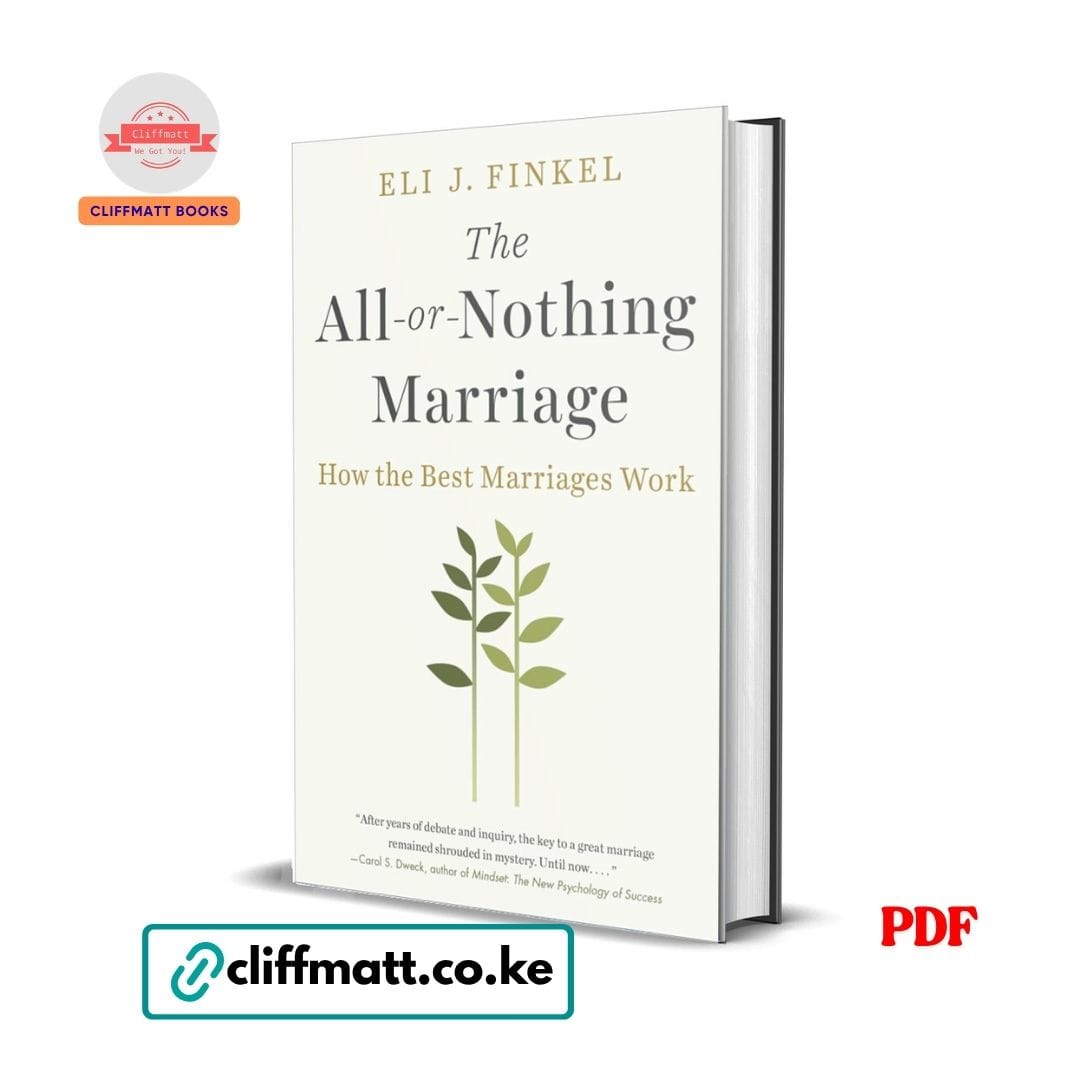
What Is The All-or-Nothing Marriage About?
The best marriages today are better than the best marriages of earlier eras. Indeed, they are the best marriages the world has ever known.
This is Eli Finkel’s central, counterintuitive, thoroughly documented claim — and it is both the most encouraging and the most demanding thing a researcher has ever said about contemporary marriage. Encouraging because the potential for a genuinely extraordinary marriage has never been higher. Demanding because the reason the average marriage is simultaneously getting worse while the best marriages are getting better is that the specific expectations modern spouses bring to marriage have never been higher — and meeting those expectations requires a specific, deliberate, evidence-based investment of time, energy, and intentionality that most couples are not currently making.
The All-or-Nothing Marriage reverse engineers fulfilling marriages — from the “traditional” to the utterly nontraditional — and shows how any marriage can be better. Finkel combines the specific findings of over a hundred scientific papers with the specific accessibility of a guide written for every married person who wants to understand what the science actually says — not what popular culture assumes, not what conventional wisdom asserts, but what twenty-five years of rigorous relationship research has actually found — about what makes the specific best marriages work.
This is a book for the newlywed to the empty nester, for those thinking about getting married or remarried, and for anyone looking for illuminating advice that will make a real difference to getting the most out of marriage today.
The Historical Framework — How Marriage Has Changed
The most intellectually distinctive contribution of The All-or-Nothing Marriage is its sweeping historical account of how the purpose and structure of marriage has evolved across four centuries — and why understanding that history is the specific prerequisite for understanding what today’s marriages need to thrive.
Era One: The Pragmatic Marriage (1620–1850)
The primary function of marriage from 1620 to 1850 was food, shelter, and protection from violence. Marriage in this era was an economic institution — a practical arrangement for the survival and management of a household. The specific expectations spouses brought to marriage were modest and practical: physical safety, economic cooperation, and the specific division of labour that made household survival possible. Love was a pleasant addition, not a requirement. Emotional intimacy was not the point. Personal fulfilment was not the standard by which a marriage was judged.
Importantly: almost every marriage met its era’s standard. When the bar is survival and economic cooperation, most partnerships clear it.
Era Two: The Companionate Marriage (1850–1965)
From 1850 to 1965, the purpose revolved around love and companionship. Industrialisation changed everything. As paid employment outside the home became available, as economic survival became less dependent on the specific family unit, as urbanisation created new communities of choice, the specific emotional dimensions of marriage — love, companionship, friendship, and the specific belonging that a genuinely intimate partnership produces — moved to the centre of what spouses expected from each other.
This is the era of the breadwinner-homemaker model: the specific division of labour that freed the marriage from being primarily an economic arrangement while creating new constraints — women’s economic dependence, rigid gender roles, and the specific isolation of the nuclear family from the broader community networks that had previously cushioned the specific demands marriage placed on individual spouses.
Era Three: The Self-Expressive Marriage (1965–Present)
Today, a new kind of marriage has emerged, one oriented toward self-discovery, self-esteem, and personal growth. 21st century spouses seek partners who bring out their best, most authentic selves. This is the marriage that Finkel calls the All-or-Nothing Marriage — and the name captures both its extraordinary potential and its extraordinary fragility.
The specific demands of the self-expressive marriage are the demands of Maslow’s highest tier: self-actualisation. Spouses expect their marriage to be not merely a safe place and a loving place but the specific relationship that enables each partner to become more fully who they most deeply are — the specific relationship that supports individual growth, validates individual identity, and provides the specific psychological environment in which genuine personal flourishing is possible.
The beauty of this model is that the potential psychological benefits increase as you climb the hierarchy of needs. The specific marriages that meet the self-expressive standard are the best marriages in human history: deeply fulfilling, deeply intimate, and genuinely enabling of personal growth in ways that no previous era’s marriages achieved. But the marriages that fail to meet this standard — while meeting the previous era’s standards of economic cooperation and basic love — feel inadequate even when they are in many respects fine. This is the All-or-Nothing dynamic: the summit is higher, the fall is steeper, and the investment required to reach the summit is greater than most couples currently recognise.
What Does The All-or-Nothing Marriage Cover? (Structure and Key Arguments)
Part One — Marriage Today: Temperamental but Thrilling
The opening diagnostic: the specific state of contemporary marriage — simultaneously the most polarised, the most demanding, and the most potentially rewarding institution in modern social life. Finkel establishes the specific paradox that defines his inquiry: the best marriages are getting better while the average marriage is declining, and the same force — the rising expectations of the self-expressive era — is responsible for both.
Part Two — Historical Perspective
The three-era historical arc documented above. This section is the specific intellectual foundation that makes everything else in the book coherent. Without understanding how marriage’s purpose has changed — from survival to love to self-expression — the specific demands that contemporary marriages place on spouses appear to be the result of individual selfishness or cultural decline. Finkel shows that they are the result of a specific historical evolution that has produced something genuinely unprecedented and genuinely extraordinary when it works.
Part Three — The All-or-Nothing Marriage
Personal Fulfilment and Marital Commitment — The Détente:
The specific tension at the heart of the modern marriage: the particular conflict between the self-expressive individual’s genuine need for personal fulfilment and the specific relational commitment that genuine marriage requires. How the specific couples who navigate this tension most successfully understand it not as a zero-sum competition between self and spouse but as the specific mutual project of enabling each partner’s growth through the specific security and the specific encouragement that genuine commitment provides.
Marriage at the Summit — The Maslow Application:
The specific application of Maslow’s hierarchy of needs to marriage: the particular insight that as the specific lower-tier needs (safety, belonging, esteem) are increasingly met by the specific combination of economic development, welfare institutions, and expanded social networks outside the marriage, the specific higher-tier needs (self-actualisation, authenticity, personal growth) move to the centre of what spouses expect from each other. The specific implication: the specific potential of modern marriage is extraordinary, but the specific investment required to realise that potential is greater than most couples understand.
For Richer or Poorer — The Inequality Dimension:
One of the most socially important insights in the book: the specific way that the specific demands of the self-expressive marriage are unevenly distributed across economic lines. The specific couples with the most time, the most financial security, and the most psychological resources are the specific couples best equipped to meet the specific demanding standards of the self-expressive marriage. The specific couples with the least time and the least financial security — navigating the specific daily stresses of economic precarity — find the specific psychological investment that self-expressive marriage requires most difficult to sustain. This dimension gives The All-or-Nothing Marriage its specific social conscience.
Part Four — Toward Stronger Marriages
For Better or Worse — Responsiveness:
The specific most important daily practice in any marriage: the particular responsiveness that makes a spouse feel genuinely known, genuinely valued, and genuinely cared for. The specific communication behaviours, the specific attention practices, and the specific emotional availability that responsiveness requires — and the specific evidence that responsiveness is the single most consistent predictor of marital satisfaction across every demographic and every cultural context that relationship research has examined.
Lovehacking — Science-Based Shortcuts:
Finkel introduces a set of must-try “lovehacks.” These are the specific, evidence-based, time-efficient interventions that the specific research has identified as producing disproportionate improvements in marital satisfaction with relatively modest investment. The specific lovehacks include the reappraisal exercise — a seven-minute writing exercise, three times per year, that research has shown to halt the natural decline in marital satisfaction that the specific stresses of modern life produce — and other specific, practically executable interventions that make a measurable difference to marital quality without requiring extensive time or therapy. For every Kenyan married couple who wants to make their marriage meaningfully better but whose specific daily demands leave limited time for extended relationship work, this chapter is the most immediately actionable in the book.
Going All In — Investment:
The specific case for deliberate investment in the marriage: the particular evidence that the specific couples who allocate deliberate time, deliberate energy, and deliberate attention to the specific quality of their relationship — not merely to the specific logistics of their shared life — consistently report higher marital satisfaction than the specific couples who allow the specific busyness of work, parenting, and daily obligation to crowd out the specific relational investment that the marriage most needs. The specific practices: date nights with the specific rule of discussing something beyond logistics, annual retreats, and the specific daily small acts of affection and appreciation that the research consistently identifies as the highest-return marital investments available.
Recalibrating — When Expectations Need Adjustment:
The specific honest chapter: the particular guidance for couples whose specific circumstances — financial stress, health challenges, young children, demanding careers — genuinely limit the specific investment that the self-expressive marriage standard requires. Finkel’s specific practical alternative for these couples is not to abandon the marriage but to temporarily recalibrate the specific expectations placed on it, to lean more heavily on the specific friendships and community relationships that can meet some of the needs that the marriage cannot currently fully address, and to return to the specific higher-investment marital engagement when circumstances allow. This chapter is the specific most practically relevant for the specific Kenyan couple navigating the specific economic and social pressures of contemporary Kenyan life.
The Marital Buffet — Multiple Pathways:
The specific closing framework: the evidence-based recognition that no single marital structure is optimal for every couple, and that the specific best marriage for any specific couple is the specific structure that genuinely serves both partners’ specific highest needs given their specific circumstances, values, and aspirations.
Who Is Eli J. Finkel?
Eli J. Finkel is an award-winning researcher of social relationships and a professor of psychology at Northwestern University. As the director of Northwestern’s Relationships and Motivation Lab, he has published over a hundred scientific papers. The Economist has called him “one of the leading lights in the realm of relationship psychology.” BlinkistEli J. Finkel
The All-or-Nothing Marriage is his first book for a general readership — and the specific distillation of a career’s worth of research into the most readable, most historically grounded, and most practically applicable account of what modern marriage is, why it works when it works, and what any specific couple can do to make their specific marriage better.
Frequently Asked Questions (FAQ)
What does “All-or-Nothing Marriage” mean?
The term describes the specific paradox of contemporary marriage: because modern spouses expect their marriage to meet their highest psychological needs — self-actualisation, personal growth, authentic self-expression — the marriages that succeed are the most fulfilling in human history, while those that fail to meet this standard feel inadequate even when they function well by earlier standards. The potential is higher than ever; so is the cost of falling short.
What are the three eras of marriage history according to Finkel?
Finkel identifies three eras: the Pragmatic Marriage (1620–1850), focused on economic survival and protection; the Companionate Marriage (1850–1965), focused on love and companionship; and the Self-Expressive Marriage (1965–present), focused on personal growth, authentic self-expression, and mutual self-actualisation.
What are “lovehacks” in The All-or-Nothing Marriage?
Lovehacks are specific, science-based, time-efficient interventions that research has shown to meaningfully improve marital satisfaction without requiring extensive time investment. The most widely cited example is a seven-minute writing exercise, done three times per year, that has been shown in controlled studies to halt the natural decline in marital satisfaction over time.
Is this book only for couples in difficulty?
No. The All-or-Nothing Marriage is for every married couple — from newlyweds building a foundation to long-married couples wanting to reinvigorate their relationship. The historical framework and the science-based practical advice are relevant at every stage of marriage.
How does this book complement Attached by Amir Levine?
Attached explains the psychological wiring — the attachment styles — that each person brings into a relationship. The All-or-Nothing Marriage explains what the marriage itself needs to thrive given the specific historical moment it exists in. Together they provide both the individual psychological understanding and the relational structure understanding that a genuinely flourishing marriage requires.
Why Kenyan Married Couples Are Buying This Book
Women’s attitudes toward love and marriage have shifted considerably. Wives are no longer willing to sacrifice their own dreams and personal development for the sake of a relationship and marriage. This shift is as evident in Nairobi as anywhere — and it represents the specific Kenyan marriage entering exactly the self-expressive era that Finkel documents. The specific Kenyan professional couple, the specific dual-income Kenyan household, and the specific Kenyan married person who wants their marriage to be not merely stable but genuinely fulfilling are all navigating the specific terrain that The All-or-Nothing Marriage maps with the most scientific rigour and the most practical guidance available from any single book on contemporary marriage.
At Ksh 100, the most scientifically grounded and most historically comprehensive account of how the best marriages work — available to every Kenyan couple who wants theirs to be one of them.
Who This Book Is For:
- Kenyan married couples who want the most thoroughly researched and most practically equipped guide to building the specific genuinely fulfilling marriage that the science says is possible
- Kenyan newlyweds who want to build their marriage on the specific evidence-based foundation that the research most consistently identifies with long-term marital satisfaction
- Kenyan professional and dual-career couples who want the specific framework for understanding what their marriage needs in the specific demanding context of two careers, children, and limited time
- Kenyan counsellors, pastors, and marriage preparation facilitators who want the most scientifically grounded resource available for the specific couples they guide
- Every reader of Attached (Levine & Heller), Men Are from Mars, Women Are from Venus (Gray), Love & Respect (Eggerichs), His Needs Her Needs (Harley), and God Is My CEO (Julian) who wants the most scientifically rigorous and most historically grounded account of what makes the best marriages work to complete their relationships library
📖 Author: Eli J. Finkel
🏢 Publisher: Dutton / Penguin Random House
📄 Format: PDF eBook (instant download via WhatsApp or email)
💰 Price: Ksh 100 only
🚀 Delivery: Instant after M-Pesa payment confirmation
👉 Order now on cliffmatt.co.ke — Pay via M-Pesa, receive your PDF instantly.




Reviews
There are no reviews yet.