


Description
Why do some ideas, products, messages, and behaviours suddenly explode into cultural phenomena while others — equally good, equally well-funded, equally well-intentioned — never go anywhere? Why did crime in New York City drop suddenly and dramatically in the 1990s? Why did Hush Puppies shoes become a fashion trend again after years of near-extinction? Why do some books, some songs, some social movements reach a critical mass and then spread unstoppably while others plateau and die?
The answer, Malcolm Gladwell argues, is the tipping point — the specific moment when an idea, trend, or social behaviour crosses a threshold, tips, and spreads like an epidemic. Understanding what causes that moment — the specific people, the specific context, and the specific quality of the message — is the most practically useful insight available to anyone trying to make an idea spread.
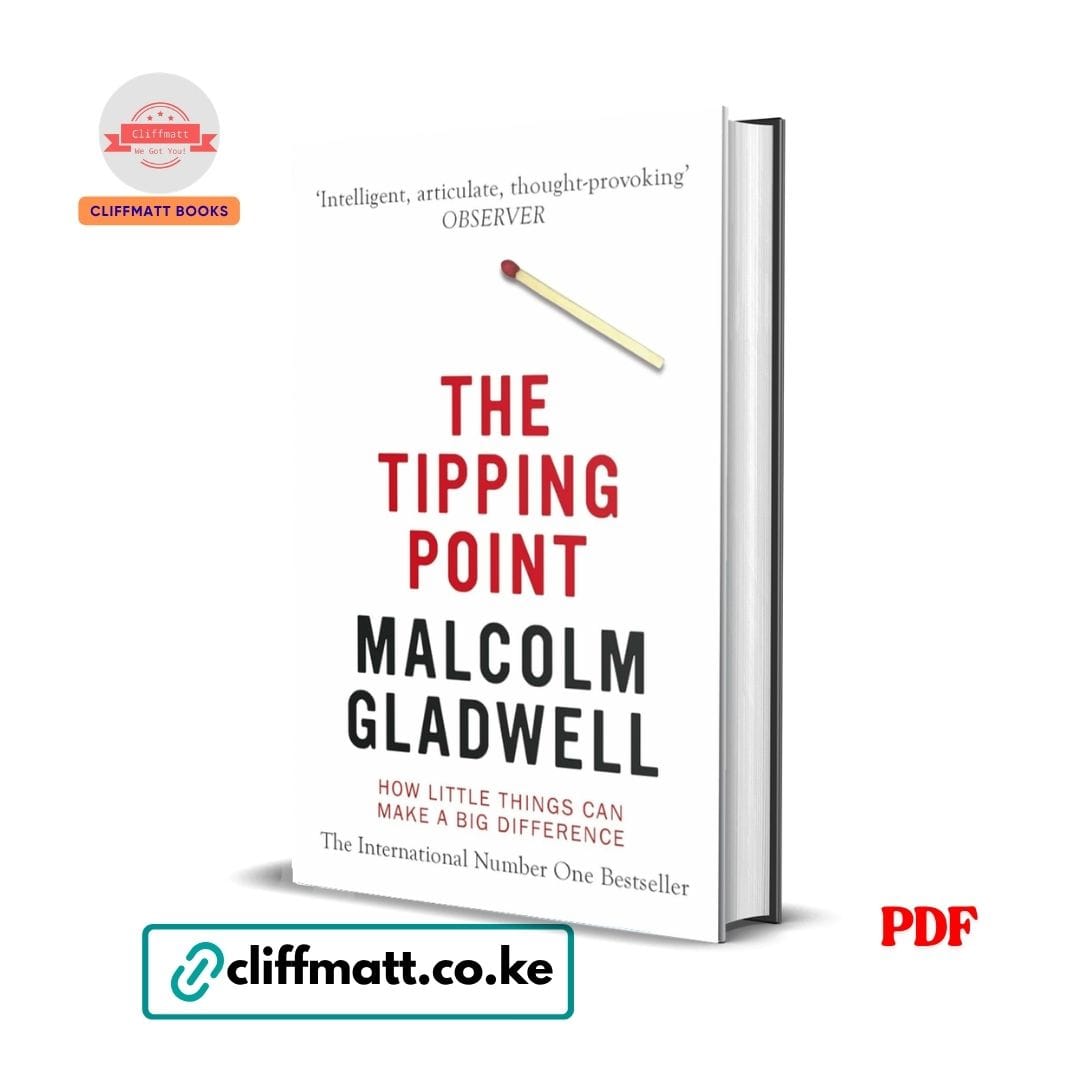
The Tipping Point is Malcolm Gladwell’s first and most influential book — the International Number One Bestseller that introduced millions of readers to a new way of thinking about social change, viral spread, and the specific conditions that make little things produce big differences. “Intelligent, articulate, thought-provoking.” — Observer. Available now on Cliffmatt Books for only Ksh 100.
What This Book Teaches:
The Three Rules of Epidemics:
- Why Gladwell uses the epidemic as his central metaphor — the specific ways that social changes, idea spreads, and behaviour shifts follow the same patterns as biological epidemics; the specific threshold moment when exponential growth replaces linear growth
- The three agents of change that determine whether an idea tips or plateaus — the Law of the Few, the Stickiness Factor, and the Power of Context; the specific mechanisms that explain why the same idea can spread explosively in one set of conditions and die in another
The Law of the Few — People Who Make Ideas Spread:
- Why the spread of ideas depends on a very small number of exceptional people — not the masses but the specific individuals whose particular social gifts allow them to connect, persuade, and activate everyone else
- Connectors — people who know an extraordinary number of people across many different social worlds; the specific social architecture that makes them the bridges through which ideas move from one community to another; why knowing a connector is worth knowing a hundred ordinary people
- Mavens — people who accumulate information and expertise, and who feel a specific social obligation to share it; the specific quality of passionate, knowledgeable enthusiasm that makes the maven’s recommendation more trusted and more acted upon than any advertisement
- Salesmen — people with the specific gift of infectious enthusiasm and the specific communication skills to persuade people who are already sceptical; the specific micro-communication qualities (tone, body language, rhythm) that make some people’s advocacy irresistibly compelling
- For Kenyan marketers and entrepreneurs: identifying the Connectors, Mavens, and Salesmen in your specific Kenyan market — the WhatsApp group administrators, the community opinion leaders, the enthusiastic early adopters — and understanding why reaching them is worth reaching a thousand ordinary customers
The Stickiness Factor — What Makes an Idea Stay:
- Why some messages are remembered and acted upon while others — equally important, equally well-distributed — are forgotten immediately; the specific quality of “stickiness” that makes the difference
- The specific, often counterintuitive changes to how a message is packaged, structured, and presented that dramatically increase its stickiness — the lessons from Sesame Street and Blue’s Clues that explain why small changes in format can produce dramatic changes in whether a message lands
- Why the obvious solution is almost never the right one — the specific examples from advertising and media where the intuitively appealing approach produced poor results and the seemingly counterintuitive approach produced dramatically better ones
- For Kenyan content creators and marketers: the specific stickiness principles applied to WhatsApp marketing, social media content, and the specific challenge of making a message memorable in Kenya’s high-volume, high-noise information environment
The Power of Context — Environment Shapes Behaviour:
- Why the specific environment in which an idea or behaviour occurs matters as much as the idea itself; the specific ways that context determines whether people tip toward adoption or away from it
- The Broken Windows theory — the specific evidence that fixing small environmental problems (broken windows, graffiti, fare evasion) produces large-scale behavioural changes; why the environment sends messages that people respond to without consciously processing
- The Magic Number 150 — Gladwell’s chapter on why human communities function most effectively when they stay below approximately 150 members; the specific cognitive limitation that makes larger groups less cohesive, less innovative, and less capable of the specific social trust that drives viral spread
- The fundamental attribution error — the specific human tendency to overestimate the role of individual character and underestimate the role of context in determining behaviour; why context change is more reliable than character change as a tool for social transformation
- For Kenyan social entrepreneurs and change-makers: the specific context interventions that are most likely to produce behaviour change at scale in Kenyan communities; why changing the environment is often more effective and more sustainable than changing the message
The Tipping Point in Practice:
- The Baltimore syphilis epidemic — how Gladwell uses a real public health crisis to demonstrate all three rules simultaneously; the specific people, the specific stickiness, and the specific context that caused a contained outbreak to become an epidemic
- Paul Revere’s midnight ride — why Revere’s warning spread and produced action while William Dawes’s identical warning did not; the specific social network analysis that explains the difference
- The suicide epidemic in Micronesia — how a single highly publicised suicide became the sticky message that tipped a generation of young men toward imitation; the specific lesson about the power of context and the danger of the wrong kind of stickiness
- For Kenyan readers: applying the tipping point framework to Kenya’s specific social challenges — health behaviour change, financial inclusion, education access, and the specific conditions under which positive social changes can tip
Why The Tipping Point Is Essential for Kenyan Readers:
Kenya is a country where social change happens faster than almost anywhere else on earth — where mobile money tipped from fringe product to universal infrastructure in less than a decade, where political movements emerge and spread with extraordinary speed, and where community-level behaviour change has been the mechanism for some of the continent’s most remarkable public health and development achievements. Understanding the mechanics of how things tip — the specific people, the specific stickiness, the specific context — is not just intellectually interesting but practically powerful for every Kenyan who wants to make something spread.
Who This Book Is For:
- Every Kenyan entrepreneur, marketer, and content creator who wants to understand why some ideas spread and others do not — and how to design their own ideas for maximum spread
- Public health and development professionals who want the most accessible, most practically useful framework for thinking about behaviour change at scale
- Social entrepreneurs and community leaders who want to understand the specific levers that produce social change
- Anyone who has ever wondered why one WhatsApp message goes viral while an identical one disappears; why one product becomes a movement while a better one stays niche
- Readers of Freakonomics (Levitt & Dubner), The Innovator’s Dilemma (Christensen), Traffic Secrets (Brunson), and How to Be a People Magnet (Lowndes) who want the foundational framework for understanding how ideas and behaviours spread through social systems
📖 Author: Malcolm Gladwell
📄 Format: PDF eBook (instant download via WhatsApp or email)
💰 Price: Ksh 100 only
🚀 Delivery: Instant after M-Pesa payment confirmation
👉 Order now on cliffmatt.co.ke — Pay via M-Pesa, receive your PDF instantly.











Reviews
There are no reviews yet.