


Description
One hundred thousand years ago, at least six human species inhabited the earth. Today there is just one.
Us.
How did Homo sapiens — a medium-sized African ape with no claws, no fangs, no particular physical strength, and no obvious evolutionary advantages over the dozen or so large animal species that could kill it — come to utterly dominate every ecosystem on earth, drive most other large animals to extinction, build cities and civilisations, develop writing and mathematics, construct weapons of mass destruction, and now stand on the verge of redesigning not just the world but the biological blueprint that created it?
Yuval Noah Harari — Professor of History at the Hebrew University of Jerusalem — spent his career asking that question. The answer he found is not the answer that conventional history offers. It is not about the specific tools, the specific weapons, or the specific organisational systems that distinguished early Homo sapiens from the other human species it encountered, competed with, and ultimately replaced. It is about something much stranger and much more interesting: the specific capacity for fiction.
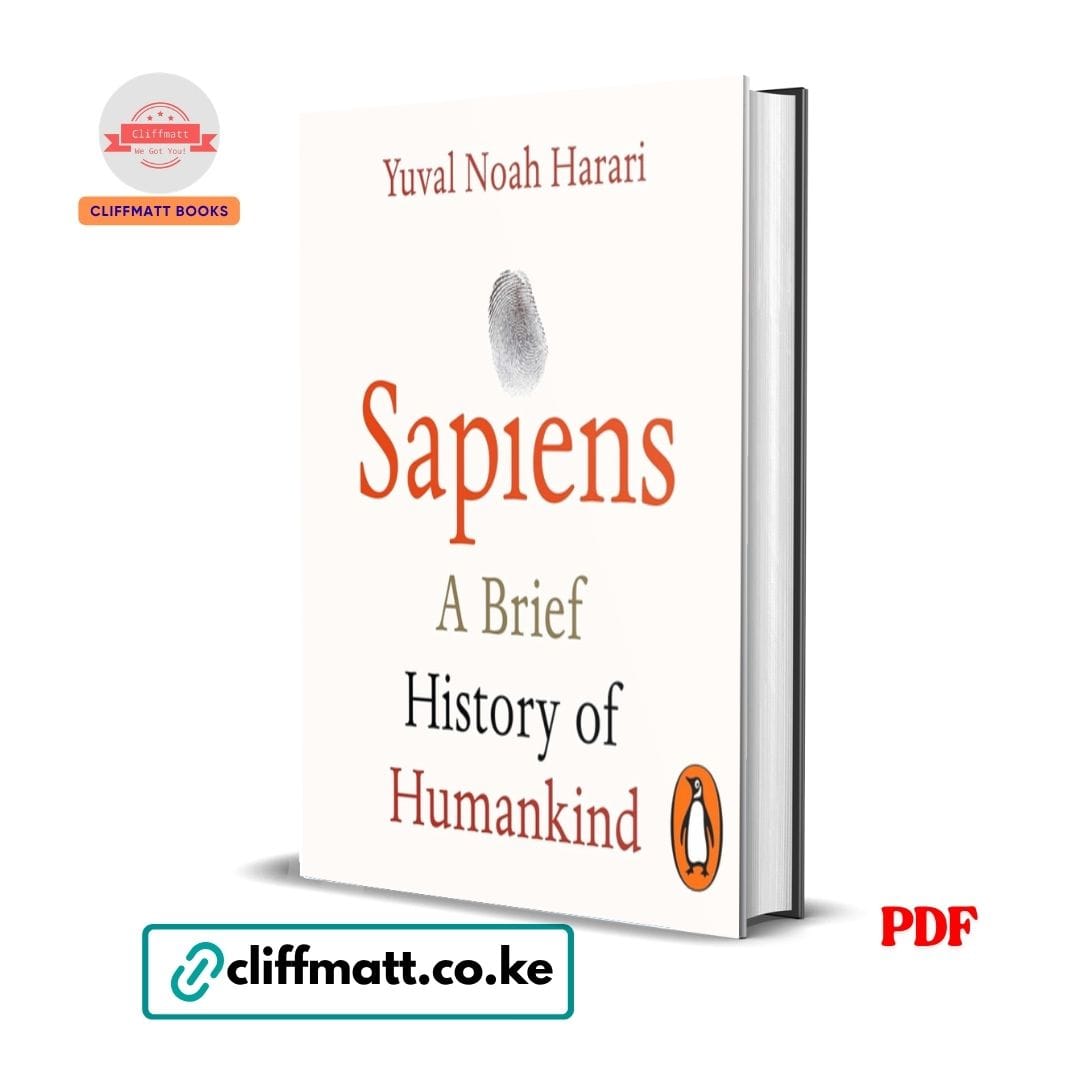
Sapiens: A Brief History of Humankind — published by Penguin, over 20 million copies sold, recommended by Barack Obama, Bill Gates, and Mark Zuckerberg — is the most ambitious, the most intellectually original, and the most genuinely perspective-shifting account of the full arc of human history available to any reader at any level of prior historical knowledge. It is the book that makes you see not just where humanity has come from but what humanity actually is — and what the specific answer to that question most specifically implies about the specific world you are living in right now.
At Ksh 100, the most important history book of the 21st century is available to every Kenyan.
What This Book Covers:
The Cognitive Revolution — The First Leap:
- The specific sapiens advantage — the particular capacity that distinguishes Homo sapiens from every other animal species and every other human species that has ever existed: the specific ability to create and believe in things that exist only in the imagination; the particular “shared fictions” (Harari’s term for the specific collectively believed stories — about gods, about nations, about money, about human rights, and about the specific other realities that exist only because enough people agree they do) that allowed Homo sapiens to cooperate in groups of thousands and eventually millions, while every other animal species is limited to the specific cooperation that the specific direct personal relationship makes possible
- The specific Cognitive Revolution — the particular genetic mutation or developmental shift approximately 70,000 years ago that produced the specific new kind of thinking, the specific new kind of language, and the specific new capacity for collective imagination that allowed Homo sapiens to begin accumulating the specific shared cultural knowledge and the specific shared social structures that no genetic evolution could have produced on the specific timeline that the specific human achievements most specifically required
- The specific other human species — the particular account of the specific Homo neanderthalensis, the specific Homo erectus, the specific Homo floresiensis, and the specific other human species that coexisted with Homo sapiens before their specific extinction; the particular controversy about whether the specific sapiens expansion was accompanied by the specific interbreeding with or the specific violent elimination of the specific other human species; what the specific genetic evidence most recently reveals about the specific relationship between the specific sapiens that left Africa 70,000 years ago and the specific human species they encountered in Eurasia
- The specific first colonisation — how the specific cognitive revolution enabled the specific most dramatic and the specific most ecologically consequential human expansion in the specific history of life on earth: the specific colonisation of Australia approximately 45,000 years ago, the specific Americas approximately 16,000 years ago, and the specific Pacific Islands in the specific last few thousand years; the specific extinction wave of the specific large megafauna that accompanied the specific arrival of the specific sapiens colonists in each of these specific previously human-free ecosystems; the specific environmental consequences that the specific first human footprint most specifically left
The Agricultural Revolution — The Second Leap:
- The specific “history’s biggest fraud” argument — Harari’s most provocative and most intellectually stimulating claim: that the specific Agricultural Revolution, conventionally understood as the specific greatest leap forward in the specific history of human progress, was from the specific perspective of the specific average individual human being a catastrophe rather than an advancement; the specific evidence that the specific average farmer of 10,000 BCE worked harder, ate less varied food, suffered more disease, and died younger than the specific average hunter-gatherer of the same period
- The specific wheat paradox — Harari’s particular argument that the specific story of the specific Agricultural Revolution is not the story of the specific Homo sapiens who domesticated the specific wheat but the story of the specific wheat that domesticated the specific Homo sapiens; the particular evolutionary perspective in which the specific ability to recruit the specific most numerous, the specific most geographically widespread, and the specific most reproductively successful large primate on earth to clear land, plant seeds, and defend fields from competitors looks more like the specific wheat’s evolutionary triumph than the specific sapiens‘ technological achievement
- The specific hierarchy creation — how the specific Agricultural Revolution produced the specific surplus that made the specific permanent settlements possible, the specific surplus that made the specific specialisation possible, the specific surplus that made the specific taxation possible, and the specific surplus that made the specific most profound and the specific most durable human inequality possible; the particular account of how the specific agricultural civilisations consistently produced the specific small elite of the specific king, the specific priest, and the specific warrior whose specific ability to control the specific storage and the specific distribution of the specific agricultural surplus gave them the specific power over the specific majority that the specific specific history of every specific agricultural civilisation most specifically documents
- The specific imagined order — how the specific large-scale human cooperation that the specific agricultural surplus made necessary required the specific collective belief in the specific shared stories (the specific divine right of kings, the specific natural hierarchy of the specific caste system, the specific specific legal framework of the specific specific civilisation) that Harari calls the “imagined order” — the specific collective fiction that the specific most powerful institutions of every specific human civilisation have always most essentially been
The Unification of Humankind — Money, Empires, and Religion:
Money — The Most Successful Fiction:
- The specific money story — Harari’s account of the specific most successful shared fiction in the specific history of Homo sapiens: the specific money system; the particular argument that the specific value of any specific unit of currency is entirely a function of the specific collective trust in the specific shared story that gives it its value; why the specific paper note in your pocket is not intrinsically valuable but is the specific most universally trusted fictional object ever created — accepted as payment by billions of specific people who have never met each other and who share no other common beliefs
- The specific credit and future trust — how the specific introduction of credit (the specific promise of the specific future payment) revolutionised human economic activity by allowing the specific investment in the specific specific projects whose specific returns would only arrive in the specific future; the specific connection between the specific ability to borrow against the specific future and the specific specific economic dynamism that the specific specific modern economy most essentially requires
Empires — The Most Successful Political Fiction:
- The specific imperial project — the particular account of how the specific empires (the specific Persian, the specific Roman, the specific Mongol, the specific British, and the specific others) produced the specific most dramatic political unification of the specific human species across the specific largest territories; the specific ambivalence of Harari’s assessment — acknowledging both the specific violence and the specific exploitation of the specific imperial project and the specific genuine cultural transmission, the specific genuine legal order, and the specific genuine economic integration that the specific most successful empires also consistently produced
- The specific colonial Africa — the specific most immediately Kenyan-relevant section of the imperial chapter; how the specific European empires reorganised the specific African continent’s specific political structures, the specific African continent’s specific economic systems, and the specific African continent’s specific cultural self-understanding in the specific ways that the specific post-independence African history most directly inherits; the specific connection to How Europe Underdeveloped Africa (Rodney) and The State of Africa (Meredith) as the specific most detailed accounts of the specific specific story that Harari surveys at the specific most global level
Religion — The Most Powerful Shared Fiction:
- The specific religion analysis — the particular section that the specific Kenyan Christian reader will find the specific most stimulating and the specific most potentially uncomfortable; Harari’s consistent treatment of the specific religious systems (including Christianity, Islam, Buddhism, and the specific others) as the specific most powerful versions of the specific “shared fiction” — the specific collectively believed stories that allow the specific large-scale human cooperation that the specific biological evolution could not have produced on the specific relevant timeline
- The specific important clarification — Harari’s framework does not evaluate whether the specific religious claims are true or false; it analyses how the specific belief in them functions sociologically and historically to produce the specific large-scale human cooperation that the specific civilisational achievements most essentially require; the specific reader who understands this distinction will find Harari’s religious analysis intellectually stimulating without experiencing it as a personal assault on their specific faith; the specific reader who is specifically sensitive to secular treatments of religious belief may find this section challenging
- The specific “universal order” concept — how Harari identifies the specific capacity to create and believe in the specific “universal orders” (the specific systems of belief and law and value that apply to all human beings rather than merely to the specific in-group) as the specific most important human innovation available; the specific argument that the specific most important human achievements (the specific universal human rights, the specific international law, the specific global financial system) are all specific instantiations of this specific capacity
The Scientific Revolution — The Third Leap:
- The specific ignorance as engine — Harari’s particular account of the specific most distinctive feature of the specific Scientific Revolution: not the specific new knowledge it produced but the specific new relationship with ignorance that it established; the particular argument that the specific pre-scientific cultures consistently assumed that the specific most important truths were already known (in the specific sacred texts, in the specific traditions, in the specific wisdom of the specific ancestors) while the specific Scientific Revolution was uniquely characterised by the specific institutionalised admission of ignorance and the specific systematic pursuit of the specific new knowledge that the specific admission most powerfully motivates
- The specific science and empire partnership — Harari’s most uncomfortable historical argument: that the specific Scientific Revolution and the specific European imperial expansion were not separate and coincidental phenomena but were the specific specific mutually reinforcing partners of the specific European global dominance; that the specific specific European curiosity about the specific specific unknown world was simultaneously the specific intellectual foundation of the specific scientific enterprise and the specific ideological foundation of the specific imperial project; why the specific specific European scientists consistently accompanied the specific specific European conquerors and the specific specific European conquerors consistently funded the specific specific European scientists
- The specific Industrial Revolution and its consequences — how the specific scientific understanding of energy conversion (the specific steam engine, the specific internal combustion engine, the specific electrical generator) produced the specific most dramatic transformation of the specific specific human relationship with the specific specific physical environment in the specific specific history of the specific species; the specific specific environmental consequences (the specific species extinction rate, the specific atmospheric carbon concentration, and the specific specific temperature trajectory) that the specific specific industrial era has produced
The Future of Sapiens — Where We Are Going:
- The specific happiness question — Harari’s particularly honest and particularly uncomfortable engagement with the specific question that the specific conventional history of human progress most consistently avoids: whether the specific Homo sapiens of the specific specific present is significantly happier than the specific Homo sapiens of the specific specific past; the specific evidence that the specific relationship between the specific material standard of living and the specific subjective experience of happiness is significantly weaker than the specific conventional narrative of human progress most specifically assumes
- The specific upcoming revolutions — the particular account of the specific three specific revolutions that Harari identifies as the specific most likely transformers of the specific human future: the specific biotechnology revolution (the specific redesign of the specific biological blueprint of the specific living organism), the specific cyborg revolution (the specific merging of the specific biological organism with the specific technological system), and the specific artificial intelligence revolution (the specific creation of the specific non-organic intelligence that may eventually exceed the specific cognitive capacity of the specific biological brain that created it)
- The specific “what do we want to become?” question — Harari’s particular most urgent and most personally challenging closing argument: that the specific Homo sapiens is on the verge of acquiring the specific capacity to redesign itself, to redesign other species, and to create the specific entirely new kinds of minds that the specific biological evolution never produced; that the specific most important question facing the specific specific humanity of the specific specific current moment is not “what can we do?” (the specific answer is rapidly becoming “almost anything”) but “what do we want to become?”; and that the specific specific humanity of the specific specific current moment is pursuing the specific specific power to answer the specific second question while almost entirely neglecting the specific specific moral, the specific specific philosophical, and the specific specific spiritual preparation that the specific specific power of the specific specific answer most specifically requires
The African and Kenyan Dimension:
- The specific African origin — the particular significance of the specific African continent in the specific Harari narrative: Africa is where the specific Homo sapiens species first appeared, where the specific Cognitive Revolution most likely occurred, and from which the specific most consequential human migration in the specific history of the species originated; the specific pride and the specific particular significance of the specific African reader encountering the specific full account of the specific human story that begins in Africa
- The specific colonial chapter in global context — how Harari’s global perspective contextualises the specific African colonial experience within the specific broader pattern of the specific European imperial expansion; the specific comparison with the specific other conquered peoples and the specific specific insight that the specific global perspective produces about the specific specific Kenyan colonial and post-colonial experience
- The specific African future in Harari’s framework — the particular implications of the specific biotechnology, the specific artificial intelligence, and the specific climate change trajectories that Harari identifies for the specific African continent and the specific specific Kenyan future; why the specific questions Harari raises about the specific human future are the specific questions that the specific specific Kenyan reader — inheriting a continent with the specific specific youngest population, the specific specific fastest growing economy, and the specific specific most consequential environmental geography — most specifically needs to be asking
Why Kenyan Readers Are Buying This Book:
Sapiens has been read by over 20 million people across every culture, every religion, and every level of prior historical knowledge. It has been recommended by three of the most influential people on earth — Barack Obama, Bill Gates, and Mark Zuckerberg. It has been assigned in university courses across every academic discipline and in every continent. And it has consistently produced the specific single most widely reported reading experience available from any non-fiction book published in the last decade: the specific genuine sense that the specific world looks different — larger, stranger, more contingent, and more interesting — after reading it than it did before.
For the specific Kenyan reader — who inherits both the specific specific pride of the specific human story’s African origin and the specific specific complexity of the specific colonial and post-colonial African experience — Sapiens offers the specific most comprehensive and the specific most intellectually honest single-volume account of how the specific world in which Kenya operates came to be the way it is.
At Ksh 100, the most important and most widely recommended history book of the 21st century is available to every Kenyan.
Who This Book Is For:
- Every Kenyan who has ever asked where humanity came from, how the world got to be the way it is, and where it is most likely going — and who wants the most ambitious and the most intellectually honest single-volume answer available
- Kenyan university students in history, anthropology, sociology, economics, political science, and every other social science and humanities discipline who want the most comprehensive and most conceptually original synthesis of the relevant scholarship available in a single, highly readable volume
- Kenyan professionals, entrepreneurs, and leaders who want the specific broadest and the specific most historically grounded intellectual context for understanding the specific world in which they are operating and the specific decisions they are making
- Kenyan readers who have been moved by The State of Africa (Meredith), How Europe Underdeveloped Africa (Rodney), Decolonising the Mind (Ngũgĩ), and Meditations (Marcus Aurelius) and who want the most comprehensive single-volume account of the full arc of human history that gives each of those specific books its specific deepest context
- Every serious Kenyan reader who wants the most discussed, most recommended, and most intellectually transformative non-fiction book of the 21st century at the most affordable price available in the Kenyan market
📖 Author: Yuval Noah Harari
🏢 Publisher: Penguin
📄 Format: PDF eBook (instant download via WhatsApp or email)
💰 Price: Ksh 100 only
🚀 Delivery: Instant after M-Pesa payment confirmation
👉 Order now on cliffmatt.co.ke — Pay via M-Pesa, receive your PDF instantly.














Reviews
There are no reviews yet.